Department of Endocrinology, Shandong Provincial Hospital, Cheeloo College of Medicine, Shandong University, Jinan, China.
Shandong Clinical Medical Center of Endocrinology and Metabolism, Jinan, China.
Front Endocrinol (Lausanne). 2021 Dec 7;12:760981. doi: 10.3389/fendo.2021.760981. eCollection 2021.
Nonalcoholic fatty liver disease (NAFLD) is becoming a global public health challenge. A convenient NAFLD indicator will greatly facilitate risk appraisal and prevention. As a readily available and inexpensive hematological index in routine clinical examinations, red blood cells (RBCs) are gaining increasing attention in many diseases, such as metabolic syndrome, but their association with NAFLD is unknown.
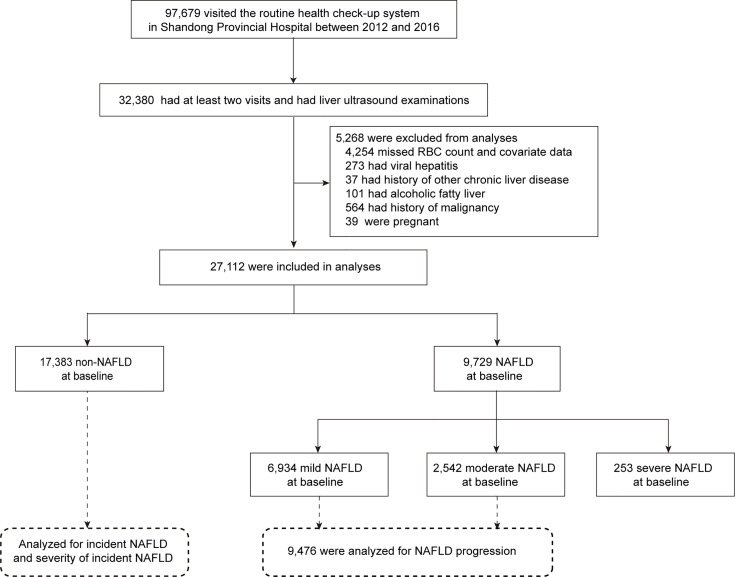
This health management cohort study included 27,112 subjects (17,383 non-NAFLD and 9,729 NAFLD) with up to 5 years of follow-up (median 2.8 years). NAFLD was diagnosed by ultrasonography. NAFLD severity was categorized as mild, moderate, or severe. The generalized estimation equation (GEE), an extension of generalized linear models that allows for analysis of repeated measurements, was used to analyze the association between RBC count and NAFLD.
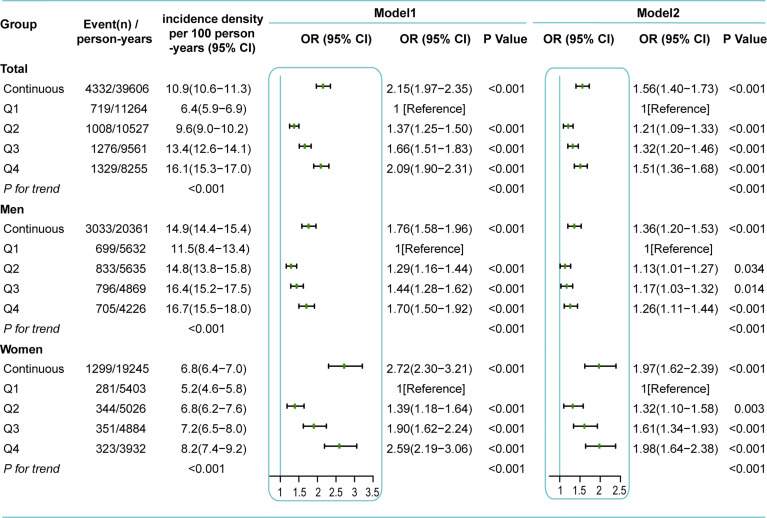
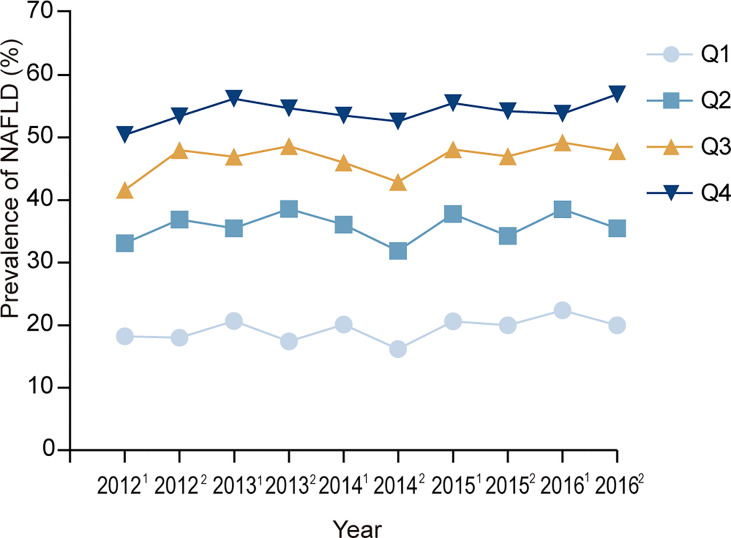
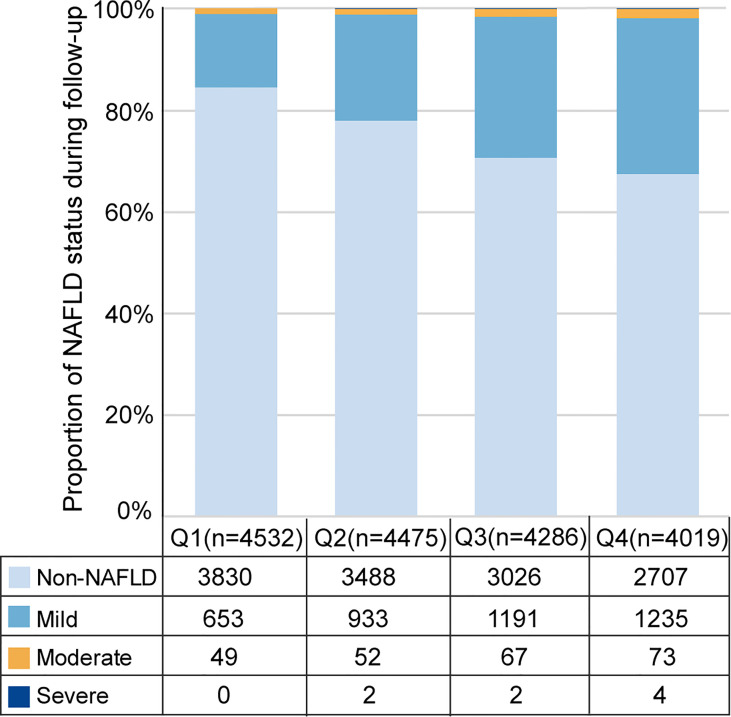
Overall, 4,332 of 17,383 (24.9%) subjects without NAFLD at baseline developed NAFLD. Incident NAFLD risk was positively associated with RBC count. After adjustment for hemoglobin and other confounders, the risk of incident NAFLD was 21%, 32%, and 51% higher in the second, third, and fourth RBC count quartiles, respectively, than in the lowest quartile. In 1,798 of 9,476 (19.0%) subjects with NAFLD at baseline, the severity of NAFLD increased. NAFLD progression risk increased progressively as RBC count increased (P for trend < 0.001). Every one-unit (10 cells/L) increase in RBC count was associated with a 53% [OR 1.53 (95% CI 1.32-1.77)] increased risk for NAFLD progression.
Elevated RBC count was independently associated with a high risk of NAFLD incidence and progression. This finding revealed a convenient NAFLD risk indicator.
非酒精性脂肪性肝病(NAFLD)正在成为全球公共健康挑战。一个方便的 NAFLD 指标将极大地方便风险评估和预防。红细胞(RBC)作为常规临床检查中一种现成且廉价的血液学指标,在许多疾病中,如代谢综合征中,越来越受到关注,但它们与 NAFLD 的关系尚不清楚。
这项健康管理队列研究纳入了 27112 名受试者(17383 名非 NAFLD 和 9729 名 NAFLD),随访时间长达 5 年(中位数 2.8 年)。NAFLD 通过超声诊断。将 NAFLD 严重程度分为轻度、中度和重度。广义估计方程(GEE)是广义线性模型的扩展,允许对重复测量进行分析,用于分析 RBC 计数与 NAFLD 之间的关联。
在基线时没有 NAFLD 的 17383 名受试者中,共有 4332 名(24.9%)发展为 NAFLD。新发 NAFLD 风险与 RBC 计数呈正相关。在校正血红蛋白和其他混杂因素后,RBC 计数处于第二、第三和第四 quartile 的新发 NAFLD 风险分别比最低 quartile 高 21%、32%和 51%。在基线时有 NAFLD 的 9476 名受试者中,有 1798 名(19.0%)NAFLD 严重程度增加。随着 RBC 计数的增加,NAFLD 进展风险逐渐增加(趋势 P<0.001)。RBC 计数每增加一个单位(10 个细胞/L),NAFLD 进展的风险增加 53%[比值比 1.53(95%置信区间 1.32-1.77)]。
升高的 RBC 计数与 NAFLD 发病和进展的高风险独立相关。这一发现揭示了一个方便的 NAFLD 风险指标。