Silliman Katherine, Zhao Honggang, Justice Megan, Thongda Wilawan, Bowen Bryant, Peatman Eric
School of Fisheries, Aquaculture, and Aquatic Sciences Auburn University Auburn Alabama USA.
Department of Natural Resources Cornell University Ithaca New York USA.
Evol Appl. 2021 Nov 9;14(12):2815-2830. doi: 10.1111/eva.13314. eCollection 2021 Dec.
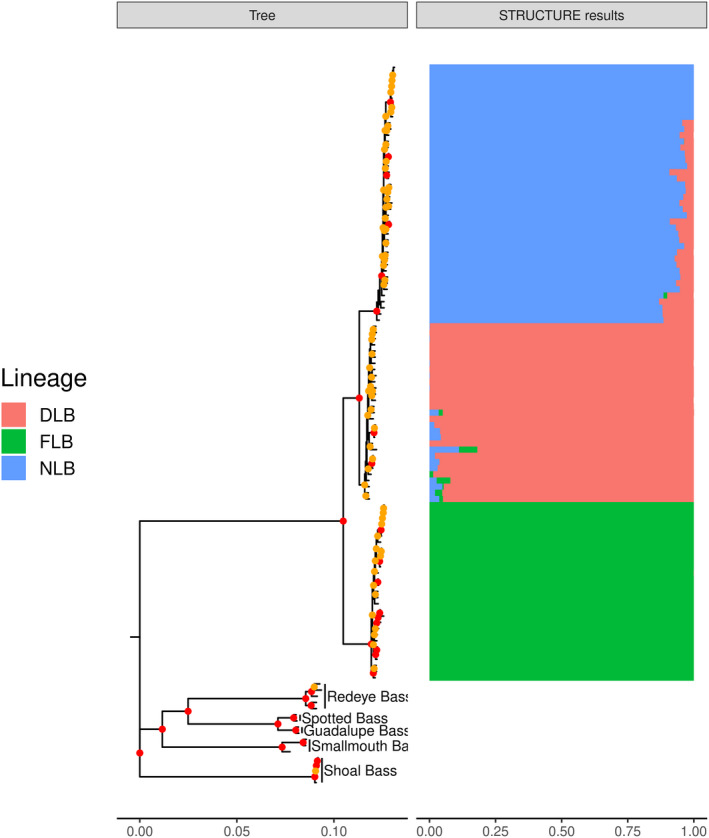
Hybrid zones between diverged lineages offer a unique opportunity to study evolutionary processes related to speciation. Natural and anthropogenic hybridization in the black basses ( spp.) is well documented, including an extensive intergrade zone between the widespread northern Largemouth Bass (. ) and the Florida Bass (. ). Phenotypic surveys have identified an estuarine population of Largemouth Bass (. ) in the Mobile-Tensaw Delta, with larger relative weight and smaller adult size compared to inland populations, suggesting a potential third lineage of largemouth bass. To determine the evolutionary relationships among these Mobile Delta bass populations, . and . , putative pure and intergrade populations of all three groups were sampled across the eastern United States. Phylogenetic analyses of 8582 nuclear SNPs derived from genotype-by-sequencing and the ND2 mitochondrial gene determined that Delta bass populations stem from a recently diverged lineage of Largemouth Bass. Using a novel quantitative pipeline, a panel of 73 diagnostic SNPs was developed for the three lineages, evaluated for accuracy, and then used to screen 881 samples from 52 sites for genetic integrity and hybridization on the Agena MassARRAY platform. These results strongly support a redrawing of native ranges for both the intergrade zone and . , which has significant implications for current fisheries management. Furthermore, Delta bass ancestry was shown to contribute significantly to the previously described intergrade zone between northern Largemouth Bass and Florida Bass, suggesting a more complex pattern of secondary contact and introgression among these diverged lineages.
分化谱系之间的杂交带为研究与物种形成相关的进化过程提供了独特的机会。黑鲈属(spp.)中的自然杂交和人为杂交已有充分记录,包括分布广泛的北方大口黑鲈(. )和佛罗里达黑鲈(. )之间广阔的过渡带。表型调查在莫比尔 - 滕索三角洲发现了一个大口黑鲈(. )的河口种群,与内陆种群相比,其相对体重更大,成年个体尺寸更小,这表明大口黑鲈可能存在第三个谱系。为了确定这些莫比尔三角洲鲈鱼种群、. 和. 之间的进化关系,在美国东部对所有三个群体的假定纯种和过渡种群进行了采样。对通过测序分型获得的8582个核单核苷酸多态性(SNP)以及线粒体基因ND2进行系统发育分析,确定三角洲鲈鱼种群源自最近分化的大口黑鲈谱系。使用一种新颖的定量方法,为这三个谱系开发了一组73个诊断性SNP,评估其准确性,然后在Agena MassARRAY平台上用于筛选来自52个地点的881个样本的遗传完整性和杂交情况。这些结果有力地支持了对过渡带和. 的原生范围进行重新划定,这对当前的渔业管理具有重大意义。此外,研究表明三角洲鲈鱼的血统对先前描述的北方大口黑鲈和佛罗里达黑鲈之间的过渡带贡献显著,这表明这些分化谱系之间的二次接触和基因渗入模式更为复杂。