
患者对骨科创伤手术人群中阿片类药物使用的理解:一项调查研究。
Patient understanding regarding opioid use in an orthopaedic trauma surgery population: a survey study.
机构信息
Department of Orthopaedic Surgery, Johns Hopkins Hospital, Baltimore, MD, USA.
Department of Surgery, Johns Hopkins Hospital, Baltimore, MD, USA.
出版信息
J Orthop Surg Res. 2021 Dec 24;16(1):736. doi: 10.1186/s13018-021-02881-w.
BACKGROUND
Prior studies have assessed provider knowledge and factors associated with opioid misuse; similar studies evaluating patient knowledge are lacking. The purpose of this study was to assess the degree of understanding regarding opioid use in orthopaedic trauma patients. We also sought to determine the demographic factors and clinical and personal experiences associated with level of understanding.
METHODS
One hundred and sixty-six adult orthopaedic trauma surgery patients across two clinical sites of an academic institution participated in an internet-based survey (2352 invited, 7.1% response rate). Demographic, clinical, and personal experience variables, as well as perceptions surrounding opioid use were collected. Relationships between patient characteristics and opioid perceptions were identified using univariate and multivariable logistic regressions. Alpha = 0.05.
RESULTS
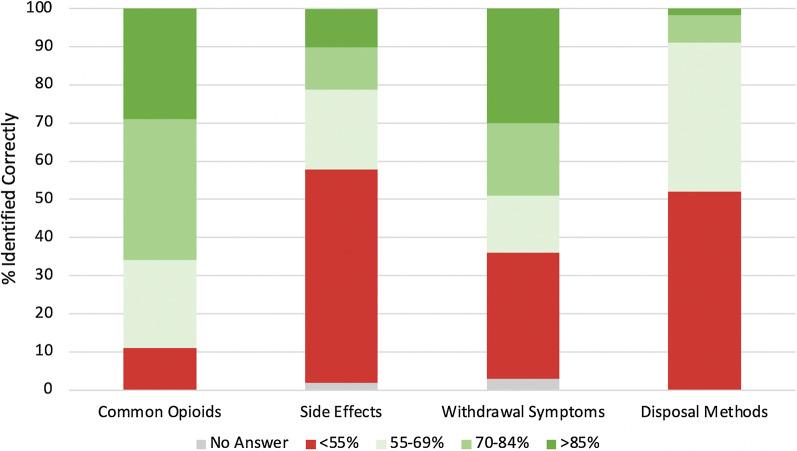
Excellent recognition (> 85% correct) of common opioids, side effects, withdrawal symptoms, and disposal methods was demonstrated by 29%, 10%, 30%, and 2.4% of patients; poor recognition (< 55%) by 11%, 56%, 33%, and 52% of patients, respectively. Compared with white patients, non-white patients had 7.8 times greater odds (95% confidence interval [CI] 1.9-31) of perceiving addiction discrepancy (p = 0.004). Employed patients with higher education levels were less likely to have excellent understanding of side effects (adjusted odds ratio [aOR] 0.06, 95% CI 0.006-0.56; p = 0.01) and to understand that dependence can occur within 2 weeks (aOR 0.28, 95% CI 0.09-0.86; p = 0.03) than unemployed patients. Patients in the second least disadvantaged ADI quartile were more knowledgeable about side effects (aOR 8.8, 95% CI 1.7-46) and withdrawal symptoms (aOR 2.7, 95% CI 1.0-7.2; p = 0.046) than those in the least disadvantaged quartile. Patients who knew someone who was dependent or overdosed on opioids were less likely to perceive addiction discrepancy (aOR 0.24, 95% CI 0.07-0.76; p = 0.02) as well as more likely to have excellent knowledge of withdrawal symptoms (aOR 2.6, 95% CI 1.1-6.5, p = 0.03) and to understand that dependence can develop within 2 weeks (aOR 3.8, 95% CI 1.5-9.8, p = 0.005).
CONCLUSIONS
Level of understanding regarding opioid use is low among orthopaedic trauma surgery patients. Clinical and personal experiences with opioids, in addition to demographics, should be emphasized in the clinical history.
背景
先前的研究评估了提供者对阿片类药物滥用的认识和相关因素;缺乏类似的评估患者认知的研究。本研究旨在评估骨科创伤患者对阿片类药物使用的理解程度。我们还试图确定与理解程度相关的人口统计学因素、临床和个人经验。
方法
在一家学术机构的两个临床地点,166 名成年骨科创伤外科患者参与了一项基于互联网的调查(邀请了 2352 人,应答率为 7.1%)。收集了人口统计学、临床和个人经验变量,以及对阿片类药物使用的看法。使用单变量和多变量逻辑回归确定患者特征与阿片类药物认知之间的关系。α=0.05。
结果
29%、10%、30%和 2.4%的患者对常见阿片类药物、副作用、戒断症状和处置方法有很好的认识(>85%正确);11%、56%、33%和 52%的患者对其有较差的认识(<55%正确)。与白人患者相比,非白人患者对成瘾差异的认知差异的可能性高 7.8 倍(95%置信区间 [CI] 1.9-31)(p=0.004)。受教育程度较高的在职患者不太可能对副作用有很好的理解(调整后的优势比[aOR] 0.06,95%CI 0.006-0.56;p=0.01),也不太可能理解依赖可能在 2 周内发生(aOR 0.28,95%CI 0.09-0.86;p=0.03),而失业患者则不太可能理解。在第二最不受劣势影响的 ADI 四分位数中,患者对副作用(aOR 8.8,95%CI 1.7-46)和戒断症状(aOR 2.7,95%CI 1.0-7.2;p=0.046)的认识要好于最不受劣势影响的四分位数。了解有人依赖或阿片类药物过量的患者不太可能对成瘾差异有认知(aOR 0.24,95%CI 0.07-0.76;p=0.02),并且更有可能对戒断症状有很好的了解(aOR 2.6,95%CI 1.1-6.5,p=0.03),并且了解依赖可能在 2 周内发生(aOR 3.8,95%CI 1.5-9.8,p=0.005)。
结论
骨科创伤外科患者对阿片类药物使用的理解程度较低。在临床病史中,除了人口统计学因素外,还应强调与阿片类药物相关的临床和个人经验。
 Zotero 插件