Department of Breast Cancer and Reconstructive Surgery, Maria Sklodowska-Curie National Research Institute of Oncology, Roentgen 5 Str., 02-781, Warsaw, Poland.
Pathology Department, Maria Sklodowska-Curie National Research Institute of Oncology, Warsaw, Poland.
Breast Cancer Res. 2021 Dec 24;23(1):118. doi: 10.1186/s13058-021-01494-9.
The first aim of the study was to compare the scores and types of stromal immune cells in 30 patients with primary DCIS and in the same patients after invasive breast recurrence in order to assess possible differences in both during tumor progression. The second aim was to evaluate possible differences in stromal cells of 30 patients with primary DCIS before progression and in the control group of 11 DCIS patients without recurrence during long-term follow-up.
Evaluation of tumor-infiltrating lymphocytes (TILs) and immunohistochemical stains for immune cell markers CD4, CD8, CD20, CD138, FOXP3, CD163 and TGF beta was performed on the stroma of primary DCIS before progression, invasive breast cancer of the same patients after progression and DCIS without progression.
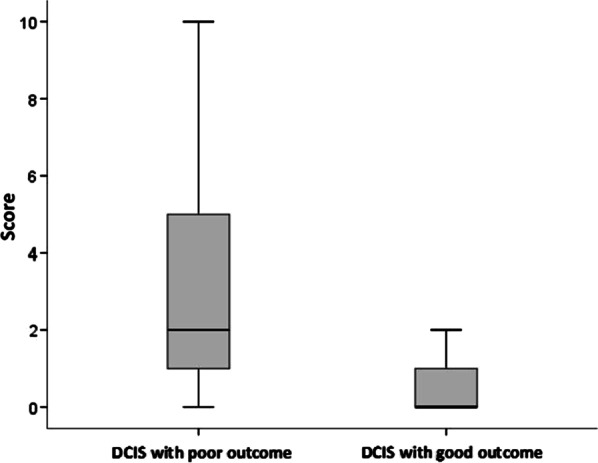
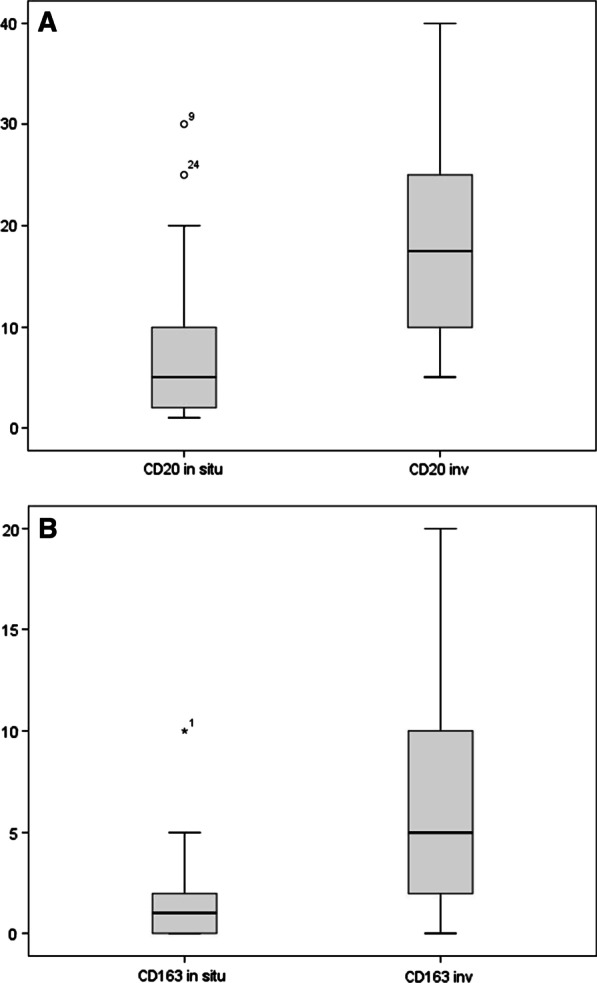
The comparison of stromal cells in 30 patients with initial DCIS and its invasive recurrence revealed an increased level of CD20 + immune cells (median score 5% vs. 17%, respectively, p < 0.001) and CD163 + cells (median score 1% vs. 5%, respectively, p < 0.001) in invasive breast cancer. The comparison of stromal cells in 30 patients with initial DCIS before recurrence and the control group of 11 patients with DCIS without recurrence showed statistically significant difference for CD138 + cells, which were more prevalent in patients with worse prognosis (median score 0 vs. 2%, respectively, p < 0.001). No similar relationship was found for the other tested cells as well as for TGF-beta.
CD138 + immune cells that were more prevalent in patients with a worse prognosis should be explored in further studies to confirm or exclude their role as a potential biological marker of DCIS invasive recurrence.
本研究的首要目的是比较 30 例原发性乳腺导管原位癌(DCIS)患者和同一患者浸润性乳腺癌复发后的肿瘤基质中免疫细胞的评分和类型,以评估肿瘤进展过程中两者的可能差异。次要目的是评估 30 例原发性 DCIS 患者在进展前和 11 例无复发的长期随访 DCIS 患者对照组的基质中间质细胞的可能差异。
对原发性 DCIS 进展前、同一患者浸润性乳腺癌复发后的肿瘤基质中浸润性淋巴细胞(TIL)以及免疫细胞标志物 CD4、CD8、CD20、CD138、FOXP3、CD163 和 TGFβ的免疫组化染色进行评估。
对 30 例原发性 DCIS 患者及其浸润性复发患者的基质细胞进行比较,发现浸润性乳腺癌中 CD20+免疫细胞(中位数评分 5%比 17%,p<0.001)和 CD163+细胞(中位数评分 1%比 5%,p<0.001)水平升高。对 30 例原发性 DCIS 患者进展前和 11 例无复发 DCIS 患者的对照组基质细胞进行比较,发现 CD138+细胞的中位数评分在预后较差的患者中更高(0 比 2%,p<0.001),存在统计学差异。其他测试细胞以及 TGF-β无类似关系。
在预后较差的患者中更为常见的 CD138+免疫细胞应在进一步研究中进行探索,以确认或排除其作为 DCIS 浸润性复发潜在生物学标志物的作用。