Department of Veterinary Science, Faculty of Agriculture, University of Miyazaki, Miyazaki, Japan.
Center for Animal Disease Control, University of Miyazaki, Miyazaki, Japan.
Vet Med Sci. 2022 Mar;8(2):877-885. doi: 10.1002/vms3.696. Epub 2021 Dec 24.
Miyazaki Prefecture is one of the hotspots of severe fever with thrombocytopenia syndrome (SFTS) cases and related deaths in Japan since 2013 and other pathogens of tick-borne diseases (TBDs). Japanese spotted fever and scrub typhus are also endemic in this region.
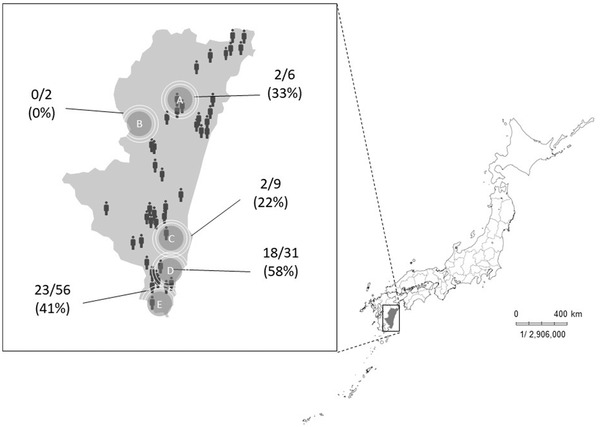
A total of 105 wild boars, hunted in 2009, were serologically examined as sentinels for TBDs to indirectly demonstrate the potential hazard of ticks transmitting pathogens to humans in the studied area.
The collected blood and spleens of the wild boars underwent serological and molecular tests for SFTSV, Rickettsia japonica (Rj) [antibody to spotted fever group rickettsiae (SFGR) were tested by using species-common antigen], and Orientia tsutsugamushi (Ot).
Seroprevalences of SFTSV, SFGR, and Ot were 41.9%, 29.5%, and 33.3%, respectively. SFTS viral RNA was identified in 7.6% of the sera, whereas DNA of Rj or Ot was not detected in any sample. In total, 43.8% of the boars possessed an infection history with SFTSV (viral gene and/or antibody). Of these, 23.8% had multiple-infection history with SFGR and/or Ot.
The high prevalence of SFTSV in wild boars might reflect the high risk of exposure to the virus in the studied areas. In addition, SFTSV infection was significantly correlated with Ot infection, and so were SFGR infection and Ot infection, indicating that these pathogens have common factors for infection or transmission. These data caution of the higher risk of SFTSV infection in areas with reported cases of other TBDs.
自 2013 年以来,宫崎县一直是日本严重发热伴血小板减少综合征(SFTS)病例和相关死亡以及其他蜱传疾病(TBD)热点地区之一。日本斑疹热和丛林斑疹伤寒也在该地区流行。
2009 年,作为 TBD 的监测哨,共检测了 105 头野猪的血清学,以间接证明该研究区域蜱传播病原体给人类的潜在危险。
采集野猪的血液和脾脏,进行 SFTSV、日本立克次体(Rj)[用种间共同抗原检测斑点热群立克次体(SFGR)抗体]和恙虫东方体(Ot)的血清学和分子学检测。
SFTSV、SFGR 和 Ot 的血清阳性率分别为 41.9%、29.5%和 33.3%。在 7.6%的血清中检测到 SFTS 病毒 RNA,而在任何样本中均未检测到 Rj 或 Ot 的 DNA。总的来说,43.8%的野猪具有 SFTSV 的感染史(病毒基因和/或抗体)。其中,23.8%的野猪同时感染了 SFGR 和/或 Ot。
野猪中 SFTSV 的高流行率可能反映了研究区域接触病毒的高风险。此外,SFTSV 感染与 Ot 感染显著相关,SFGR 感染与 Ot 感染也显著相关,表明这些病原体具有共同的感染或传播因素。这些数据表明,在有其他 TBD 报告病例的地区,SFTSV 感染的风险更高。