College of Medicine and Medical Research Institute, Chungbuk National University, Cheongju, Republic of Korea.
Research Institute of Life Science, Gyeongsang National University, Jinju, Republic of Korea.
Exp Mol Med. 2021 May;53(5):713-722. doi: 10.1038/s12276-021-00610-1. Epub 2021 May 6.
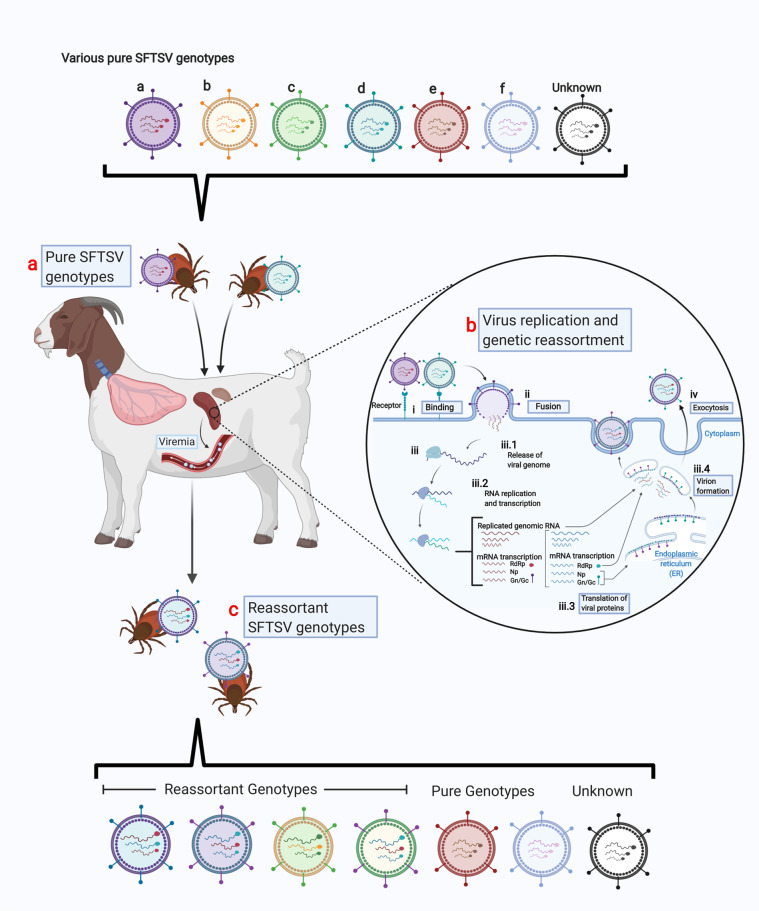
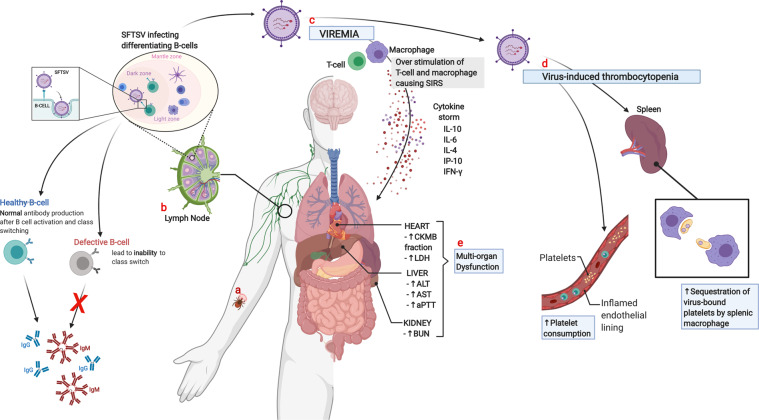
An emerging infectious disease first identified in central China in 2009, severe fever with thrombocytopenia syndrome (SFTS) was found to be caused by a novel phlebovirus. Since SFTSV was first identified, epidemics have occurred in several East Asian countries. With the escalating incidence of SFTS and the rapid, worldwide spread of SFTSV vector, it is clear this virus has pandemic potential and presents an impending global public health threat. In this review, we concisely summarize the latest findings regarding SFTSV, including vector and virus transmission, genotype diversity and epidemiology, probable pathogenic mechanism, and clinical presentation of human SFTS. Ticks most likely transmit SFTSV to animals including humans; however, human-to-human transmission has been reported. The majority of arbovirus transmission cycle includes vertebrate hosts, and potential reservoirs include a variety of both domestic and wild animals. Reports of the seroprevalence of SFTSV in both wild and domestic animals raises the probability that domestic animals act as amplifying hosts for the virus. Major clinical manifestation of human SFTS infection is high fever, thrombocytopenia, leukocytopenia, gastrointestinal symptoms, and a high case-fatality rate. Several animal models were developed to further understand the pathogenesis of the virus and aid in the discovery of therapeutics and preventive measures.
一种新发传染病于 2009 年在中国中部首次被发现,严重发热伴血小板减少综合征(SFTS)被认为是由一种新型布尼亚病毒引起的。自 SFTSV 首次被发现以来,该病毒已在几个东亚国家引发了流行。随着 SFTS 的发病率不断上升,以及 SFTSV 载体在全球范围内的快速传播,很明显,这种病毒具有大流行的潜力,对全球公共卫生构成迫在眉睫的威胁。在这篇综述中,我们简要总结了 SFTSV 的最新发现,包括病毒的传播媒介和传播途径、基因型多样性和流行病学、可能的发病机制以及人类 SFTS 的临床表现。蜱虫很可能将 SFTSV 传播给包括人类在内的动物;然而,已经有报告称存在人与人之间的传播。大多数虫媒病毒的传播周期包括脊椎动物宿主,而潜在的宿主包括各种家养和野生动物。SFTSV 在野生动物和家养动物中的血清流行率报告增加了动物可能作为病毒的扩增宿主的可能性。人类 SFTS 感染的主要临床表现为高热、血小板减少、白细胞减少、胃肠道症状和高病死率。已经开发了几种动物模型来进一步了解病毒的发病机制,并有助于发现治疗方法和预防措施。