Heart Rhythm Science Center, Minneapolis Heart Institute Foundation, Minneapolis, Minnesota, USA.
J Cardiovasc Electrophysiol. 2022 Feb;33(2):154-159. doi: 10.1111/jce.15343. Epub 2022 Jan 7.
Cardiac perforation during leadless pacemaker implantation is more likely to require intervention than perforation by a transvenous lead. This study reports the consequences of Micra pacemaker perforations and related device and operator use problems based on information the manufacturer has submitted to the Food and Drug Administration (FDA).
FDA's Manufacturer and User Facility Device Experience (MAUDE) database was searched for Micra perforations. Data extracted included deaths, major adverse clinical events (MACEs), and device and/or operator use problems.
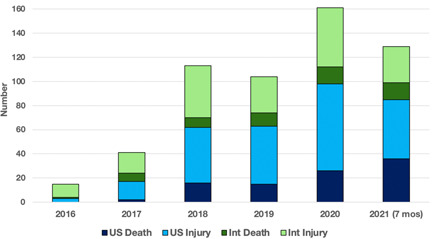
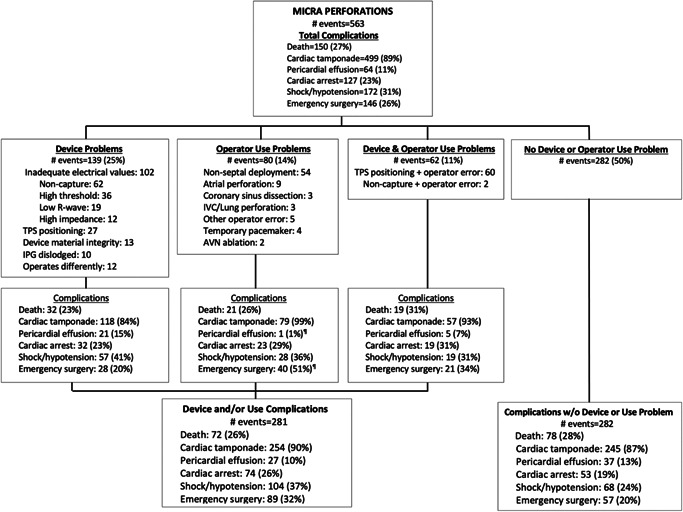
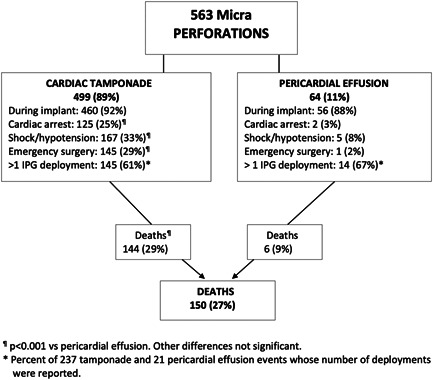
Between 2016 and July 2021, 563 perforations were reported within 30 days of implant and resulted in 150 deaths (27%), 499 cardiac tamponades (89%), 64 pericardial effusions (11%), and 146 patients (26%) required emergency surgery. Half of perforations were associated with 139 (25%) device problems, 78 (14%) operator use problems, and 62 (11%) combined device and operator use problems. Inadequate electrical measurements or difficult positioning were the most frequent device problems (n = 129); non-septal implants and perforation of other structures were the most frequent operator use problems (n = 69); a combined operator use and device problem resulted in 62 delivery system perforations. No device or operator use problem was identified for 282 perforations (50%), but they were associated with 78 deaths, 245 tamponades, and 57 emergency surgeries.
The Micra perforations reported in MAUDE are often associated with death and major complications requiring emergency intervention. Device and use problems account for at least half of perforations. Studies are needed to identify who is at risk for a perforation and how MACE can be avoided or mitigated.
与经静脉导联穿孔相比,无导线起搏器植入过程中的心脏穿孔更有可能需要介入治疗。本研究报告了基于制造商向食品和药物管理局(FDA)提交的信息,无导线起搏器穿孔及相关设备和操作人员使用问题的后果。
在 FDA 的制造商和用户设施设备体验(MAUDE)数据库中搜索 Micra 穿孔的信息。提取的数据包括死亡、主要不良临床事件(MACE)以及设备和/或操作人员使用问题。
2016 年至 2021 年 7 月,植入后 30 天内报告了 563 例穿孔,导致 150 例死亡(27%)、499 例心脏压塞(89%)、64 例心包积液(11%)和 146 例患者(26%)需要紧急手术。一半的穿孔与 139 例(25%)设备问题、78 例(14%)操作人员使用问题和 62 例(11%)设备和操作人员使用问题相关。电测量不足或定位困难是最常见的设备问题(n=129);非间隔植入和其他结构穿孔是最常见的操作人员使用问题(n=69);操作人员使用和设备问题联合导致 62 例输送系统穿孔。282 例穿孔(50%)未发现设备或操作人员使用问题,但与 78 例死亡、245 例心脏压塞和 57 例紧急手术相关。
MAUDE 报告的 Micra 穿孔常与死亡和需要紧急干预的重大并发症相关。设备和使用问题至少占穿孔的一半。需要研究确定哪些人有穿孔风险,以及如何避免或减轻 MACE。