Lhomme Sébastien, Abravanel Florence, Cintas Pascal, Izopet Jacques
Infinity, Université Toulouse, CNRS, INSERM, UPS, 31300 Toulouse, France.
Laboratoire de Virologie, Hôpital Purpan, CHU Toulouse, 31300 Toulouse, France.
Pathogens. 2021 Dec 3;10(12):1582. doi: 10.3390/pathogens10121582.
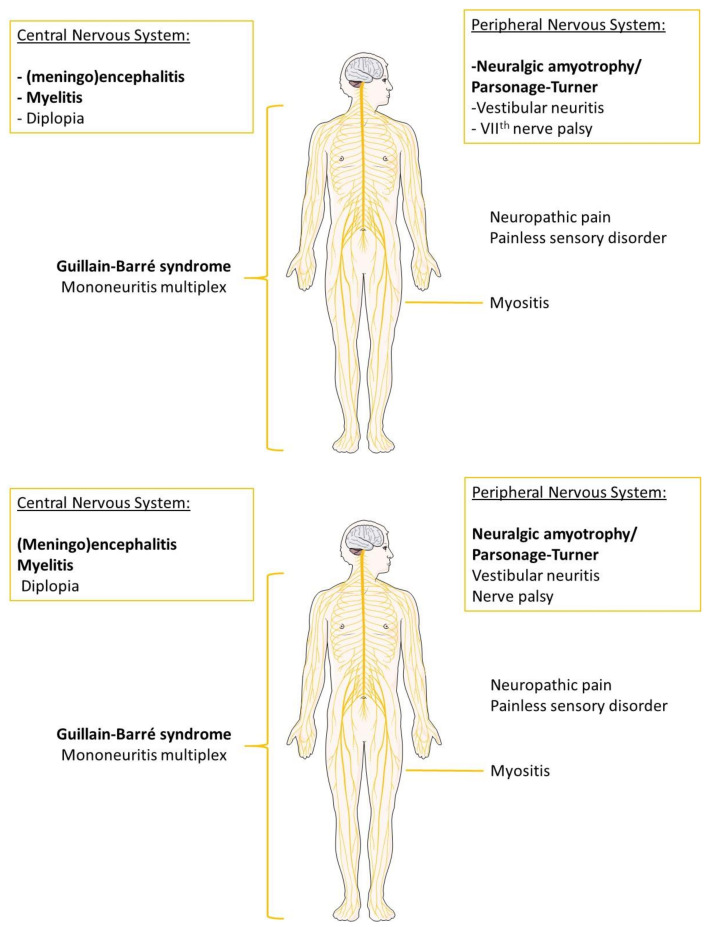
Hepatitis E virus (HEV) is the first cause of viral hepatitis in the world. While the water-borne HEV genotypes 1 and 2 are found in developing countries, HEV genotypes 3 and 4 are endemic in developed countries due to the existence of animal reservoirs, especially swine. An HEV infection produces many extra-hepatic manifestations in addition to liver symptoms, especially neurological disorders. The most common are neuralgic amyotrophy or Parsonage-Turner syndrome, Guillain-Barré syndrome, myelitis, and encephalitis. The pathophysiology of the neurological injuries due to HEV remains uncertain. The immune response to the virus probably plays a role, but direct virus neurotropism could also contribute to the pathophysiology. This review describes the main neurological manifestations and their possible pathogenic mechanisms.
戊型肝炎病毒(HEV)是全球病毒性肝炎的首要病因。虽然在发展中国家发现了经水传播的HEV 1型和2型,但由于存在动物宿主,尤其是猪,HEV 3型和4型在发达国家呈地方性流行。HEV感染除了引起肝脏症状外,还会产生许多肝外表现,尤其是神经紊乱。最常见的是神经痛性肌萎缩或帕森热-特纳综合征、吉兰-巴雷综合征、脊髓炎和脑炎。HEV所致神经损伤的病理生理学仍不明确。对该病毒的免疫反应可能起一定作用,但病毒的直接嗜神经性也可能参与病理生理过程。本综述描述了主要的神经表现及其可能的致病机制。