Chávez-Larrea María A, Cholota-Iza Cristina, Medina-Naranjo Viviana, Yugcha-Díaz Michelle, Ron-Román Jorge, Martin-Solano Sarah, Gómez-Mendoza Gelacio, Saegerman Claude, Reyna-Bello Armando
Research Unit of Epidemiology and Risk Analysis Applied to Veterinary Sciences (UREAR-ULiège), Fundamental and Applied Research for Animal and Health (FARAH) Center, Department of Infections and Parasitic Diseases, Faculty of Veterinary Medicine, University of Liège, 4000 Liège, Belgium.
Grupo de Investigación en Sanidad Animal y Humana (GISAH), Carrera de Ingeniería en Biotecnología, Departamento de Ciencias de la Vida y la Agricultura, Universidad de las Fuerzas Armadas-ESPE, Sangolquí P.O. Box 171-5-231, Ecuador.
Pathogens. 2021 Dec 8;10(12):1593. doi: 10.3390/pathogens10121593.
Babesia species are intraerythrocytic protozoa, distributed in tropical and subtropical areas of the world, causing anemic diseases in many animals, including cattle. This disease, called babesisosis, is transmitted from one animal to another through ticks (Tick Borne-Disease or TBD). On the other hand, Ecuador has a tropical climate that allows the development of the vector , and therefore favors the transmission of spp. in cattle.
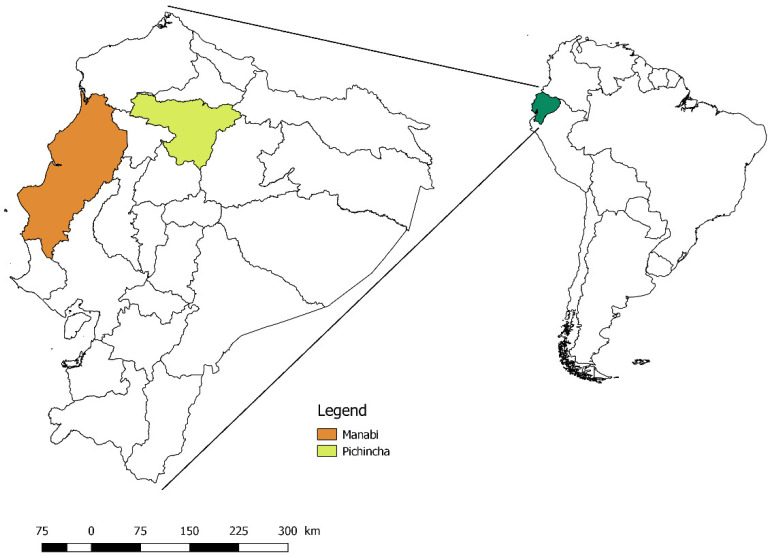
We determined the presence of spp. by PCR using 18s ribosomal gene as target (18s PCR) in 20 farms in the area of El Carmen (zone below 300 m above sea level) and 1 farm in Quito (2469 m.a.s.l.). In addition, we analyzed parameters such as age, sex, and packed cell volume (PCV) as explanatory variable associated with the disease.
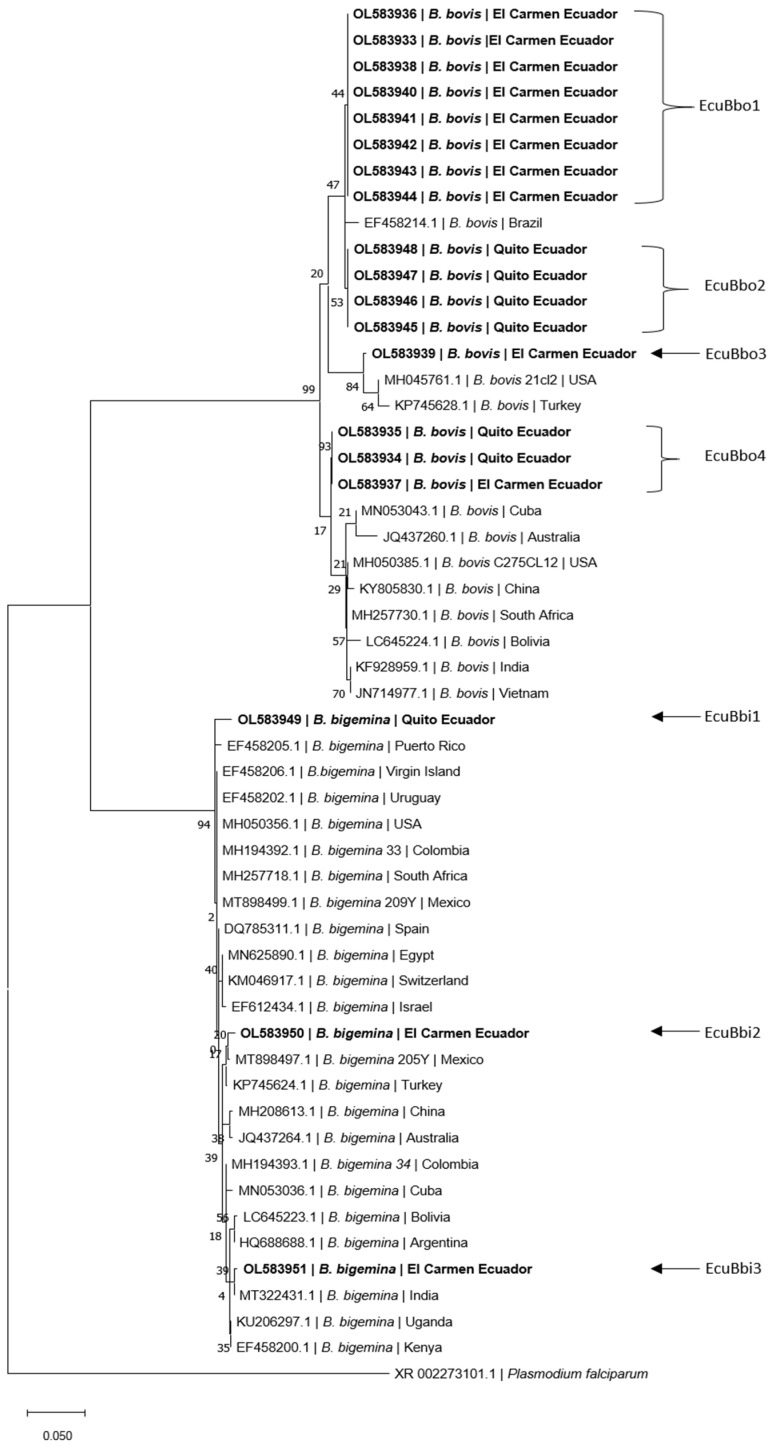
The 18s PCR test showed that 18.94% (14.77% and 4.17% ) and 20.28% (14.69% and 5.59% ) of the cattle were positive for spp in farms sampled in El Carmen and in Quito, respectively. Age influenced the presence of animals positive for spp., but sex and PCV did not. The phylogenetic analysis of sequences showed 4 isolates of and 3 isolates of in the 2 study zones, with similarities between 99.73 and 100% with other sequences. One isolate was similar in the zone of El Carmen and Quito.
This work is the first molecular characterization of and in Ecuador, and it is also the first evidence of spp. in cattle in the area of Quito at an altitude of 2469 m.a.s.l., being the highest altitude reported for animals with babesiosis and for the tick . Climatic factors as well as mobility of tick-carrying animals without any control allow the presence of Babesiosis outbreaks in new geographical areas.
巴贝斯虫属是红细胞内的原生动物,分布于世界热带和亚热带地区,可导致包括牛在内的许多动物患贫血病。这种疾病称为巴贝斯虫病,通过蜱虫(蜱传疾病或TBD)在动物之间传播。另一方面,厄瓜多尔属热带气候,有利于病媒的滋生,因此有利于巴贝斯虫属在牛群中的传播。
我们使用18s核糖体基因作为靶标通过PCR(18s PCR)在埃尔卡门地区(海拔300米以下区域)的20个农场和基多的1个农场(海拔2469米)检测巴贝斯虫属的存在情况。此外,我们分析了年龄、性别和红细胞压积(PCV)等参数,作为与该疾病相关的解释变量。
18s PCR检测显示,在埃尔卡门和基多采样的农场中,分别有18.94%(14.77% 和4.17% )以及20.28%(14.69% 和5.59% )的牛巴贝斯虫属检测呈阳性。年龄影响巴贝斯虫属检测呈阳性的动物的存在情况,但性别和红细胞压积则无影响。序列的系统发育分析显示,在两个研究区域有4株 分离株和3株 分离株,与其他序列的相似性在99.73%至100%之间。在埃尔卡门和基多地区有1株 分离株相似。
这项工作是厄瓜多尔对 和 的首次分子特征描述,也是基多地区海拔2469米处牛群中巴贝斯虫属的首个证据,这是报告的患巴贝斯虫病动物和蜱虫的最高海拔。气候因素以及携带蜱虫的动物不受控制的移动使得巴贝斯虫病在新的地理区域爆发。