Gonzaga Zennia Jean C, Chen Shuxiong, Lehoux Mélanie, Segura Mariela, Rehm Bernd H A
Centre for Cell Factories and Biopolymers (CCFB), Griffith Institute for Drug Discovery, Griffith University, Don Young Road, Natha, QLD 4111, Australia.
Research Group on Infectious Diseases in Production Animals and Swine and Poultry Infectious Diseases Research Centre, Faculty of Veterinary Medicine, Université de Montréal, 3200 Rue Sicotte, CP5000, St-Hyacinthe, QC J2S 7C6, Canada.
Vaccines (Basel). 2021 Nov 24;9(12):1386. doi: 10.3390/vaccines9121386.
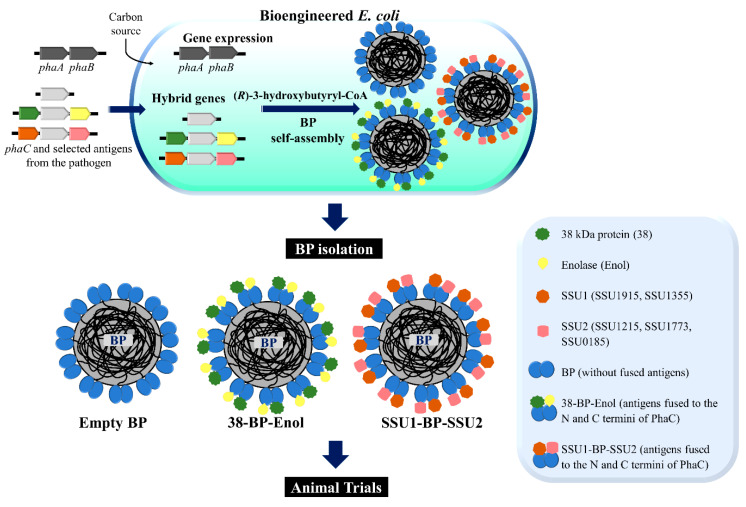
is a zoonotic pathogen affecting pigs and humans. This bacterium causes severe economic losses in the swine industry and poses a serious threat to public health and food safety. There is no effective commercial vaccine available for pigs or humans. In this study, we applied the biopolymer particle (BP) vaccine technology to incorporate seven conserved antigens (38 kDa protein (38), enolase (Enol), SSU1915, SSU1355, SSU0185, SSU1215, and SSU1773 (SSU1 and SSU2)). Two combinations of these antigens (38 and Enol; all SSU antigens designated as SSU1 and SSU2) were engineered to mediate production of BPs coated with either antigens 38 and Enol or SSU1 and SSU2 inside recombinant . The isolated and purified empty BPs, 38-BP-Enol and SSU1-BP-SSU2, showed size ranges of 312-428 nm and 292-344 nm with and without the QuilA adjuvant, respectively, and all showed a negative surface charge. Further characterization of purified BPs confirmed the presence of the expected antigen-comprising fusion proteins as assessed by tryptic peptide fingerprinting analysis using quadrupole time-of-flight mass spectrometry and immunoblotting. Vaccination with 38-BP-Enol and SSU1-BP-SSU2 formulated with and without QuilA adjuvant induced significant antigen-specific humoral immune responses in mice. Antigen-coated BPs induced significant and specific Ig (IgM + IgG) and IgG immune responses (1.0 × 10-1.0 × 10) when compared with mice vaccinated with empty BPs. Functionality of the immune response was confirmed in challenge experiments using an acute murine infection model, which showed 100% survival of the 38-BP-Enol and SSU1-BP-SSU2 vaccinated mice compared to 70% survival when vaccinated with empty BPs. Overall, our data suggest that antigen-coated BPs could be developed into particulate vaccines that induce protective immunity against infections.
是一种影响猪和人类的人畜共患病原体。这种细菌在养猪业中造成严重的经济损失,并对公众健康和食品安全构成严重威胁。目前尚无针对猪或人类的有效商业疫苗。在本研究中,我们应用生物聚合物颗粒(BP)疫苗技术,纳入七种保守抗原(38 kDa蛋白(38)、烯醇酶(Enol)、SSU1915、SSU1355、SSU0185、SSU1215和SSU1773(SSU1和SSU2))。将这些抗原的两种组合(38和Enol;所有SSU抗原指定为SSU1和SSU2)进行工程改造,以介导在重组体内产生包被有抗原38和Enol或SSU1和SSU2的BP。分离并纯化的空BP、38-BP-Enol和SSU1-BP-SSU2,在有无QuilA佐剂的情况下,大小范围分别为312 - 428 nm和292 - 344 nm,且均显示负表面电荷。通过使用四极杆飞行时间质谱和免疫印迹的胰蛋白酶肽指纹图谱分析评估,对纯化BP的进一步表征证实了预期的含抗原融合蛋白的存在。用含和不含QuilA佐剂配制的38-BP-Enol和SSU1-BP-SSU2对小鼠进行疫苗接种,诱导了显著的抗原特异性体液免疫反应。与接种空BP的小鼠相比,抗原包被的BP诱导了显著且特异性的Ig(IgM + IgG)和IgG免疫反应(1.0×10 - 1.0×10)。在使用急性小鼠感染模型的攻毒实验中证实了免疫反应的功能性,结果显示接种38-BP-Enol和SSU1-BP-SSU2的小鼠存活率为100%,而接种空BP的小鼠存活率为70%。总体而言,我们的数据表明,抗原包被的BP可开发成诱导针对感染的保护性免疫的颗粒疫苗。