Weng Yingjie, Lu Di, Bollyky Jenna, Jain Vivek, Desai Manisha, Lindan Christina, Boothroyd Derek, Judson Timothy, Doernberg Sarah B, Holubar Marisa, Sample Hannah, Huang Beatrice, Maldonado Yvonne, Rutherford George W, Grumbach Kevin
Quantitative Sciences Unit, Department of Medicine, Stanford University, Palo Alto, CA 94304, USA.
Division of Primary Care & Population Health, School of Medicine, Stanford University, Stanford, CA 94305, USA.
Vaccines (Basel). 2021 Nov 29;9(12):1406. doi: 10.3390/vaccines9121406.
The study was designed to compare intentions to receive COVID-19 vaccination by race-ethnicity, to identify beliefs that may mediate the association between race-ethnicity and intention to receive the vaccine and to identify the demographic factors and beliefs most strongly predictive of intention to receive a vaccine.
Cross-sectional survey conducted from November 2020 to January 2021, nested within a longitudinal cohort study of the prevalence and incidence of SARS-CoV-2 among a general population-based sample of adults in six San Francisco Bay Area counties (called TrackCOVID). Study Cohort: In total, 3161 participants among the 3935 in the TrackCOVID parent cohort responded.
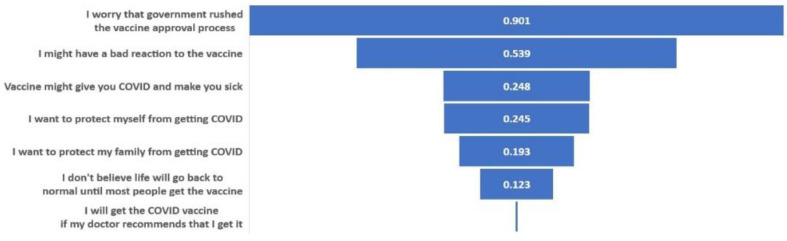
Rates of high vaccine willingness were significantly lower among Black (41%), Latinx (55%), Asian (58%), Multi-racial (59%), and Other race (58%) respondents than among White respondents (72%). Black, Latinx, and Asian respondents were significantly more likely than White respondents to endorse lack of trust of government and health agencies as a reason not to get vaccinated. Participants' motivations and concerns about COVID-19 vaccination only partially explained racial-ethnic differences in vaccination willingness. Concerns about a rushed government vaccine approval process and potential bad reactions to the vaccine were the two most important factors predicting vaccination intention.
Vaccine outreach campaigns must ensure that the disproportionate toll of COVID-19 on historically marginalized racial-ethnic communities is not compounded by inequities in vaccination. Efforts must emphasize messages that speak to the motivations and concerns of groups suffering most from health inequities to earn their trust to support informed decision making.
本研究旨在比较不同种族/族裔群体接种新冠疫苗的意愿,确定可能介导种族/族裔与接种意愿之间关联的信念,并找出最能预测接种意愿的人口统计学因素和信念。
2020年11月至2021年1月进行的横断面调查,嵌套于一项关于旧金山湾区六个县成年人群体中新冠病毒流行率和发病率的纵向队列研究(称为TrackCOVID)。研究队列:TrackCOVID母队列中的3935名参与者中,共有3161人做出回应。
黑人(41%)、拉丁裔(55%)、亚裔(58%)、多族裔(59%)和其他种族(58%)受访者的高疫苗接种意愿率显著低于白人受访者(72%)。与白人受访者相比,黑人、拉丁裔和亚裔受访者更有可能认可对政府和卫生机构缺乏信任是不接种疫苗的一个原因。参与者对新冠疫苗接种的动机和担忧只能部分解释接种意愿的种族/族裔差异。对政府疫苗审批过程仓促以及疫苗可能产生的不良反应的担忧是预测接种意愿的两个最重要因素。
疫苗推广活动必须确保新冠疫情对历史上处于边缘地位的种族/族裔社区造成的不成比例的影响,不会因接种疫苗的不平等而加剧。必须强调能够回应那些受健康不平等影响最大群体的动机和担忧的信息,以赢得他们的信任,支持他们做出明智的决策。