Bari Md Sazzadul, Hossain Md Jamal, Ahmmed Foyez, Sarker Md Moklesur Rahman, Khandokar Labony, Chaithy Aperajita Paul, Aziz Farina, Mitra Saikat, Emran Talha Bin, Islam Md Saiful, Islam Md Rabiul, Mohamed Isa Naina
Department of Pharmacy, State University of Bangladesh, 77 Satmasjid Road, Dhanmondi, Dhaka 1205, Bangladesh.
Department of Statistics, Comilla University, Kotbari, Cumilla 3506, Bangladesh.
Vaccines (Basel). 2021 Dec 7;9(12):1449. doi: 10.3390/vaccines9121449.
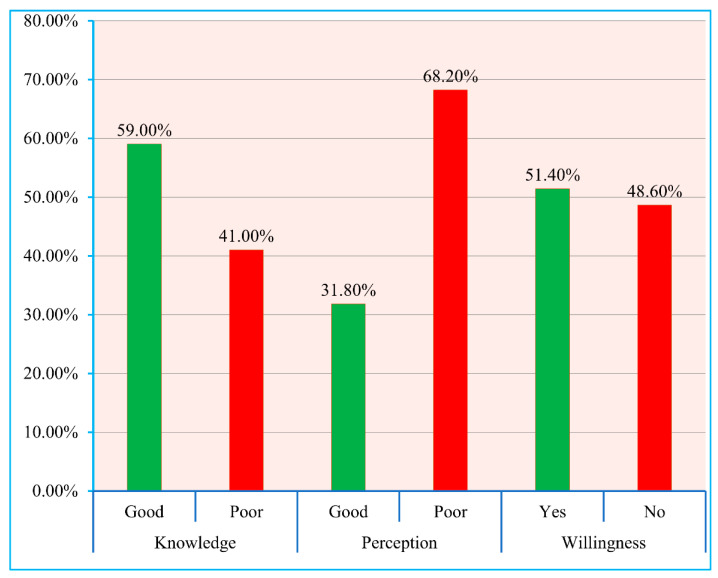
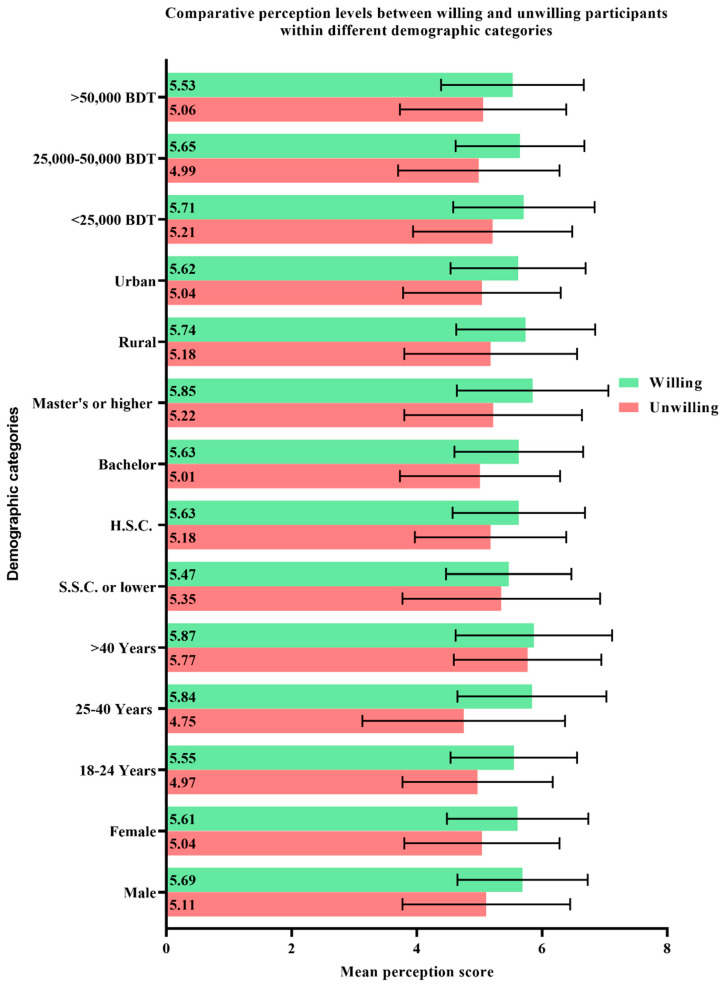
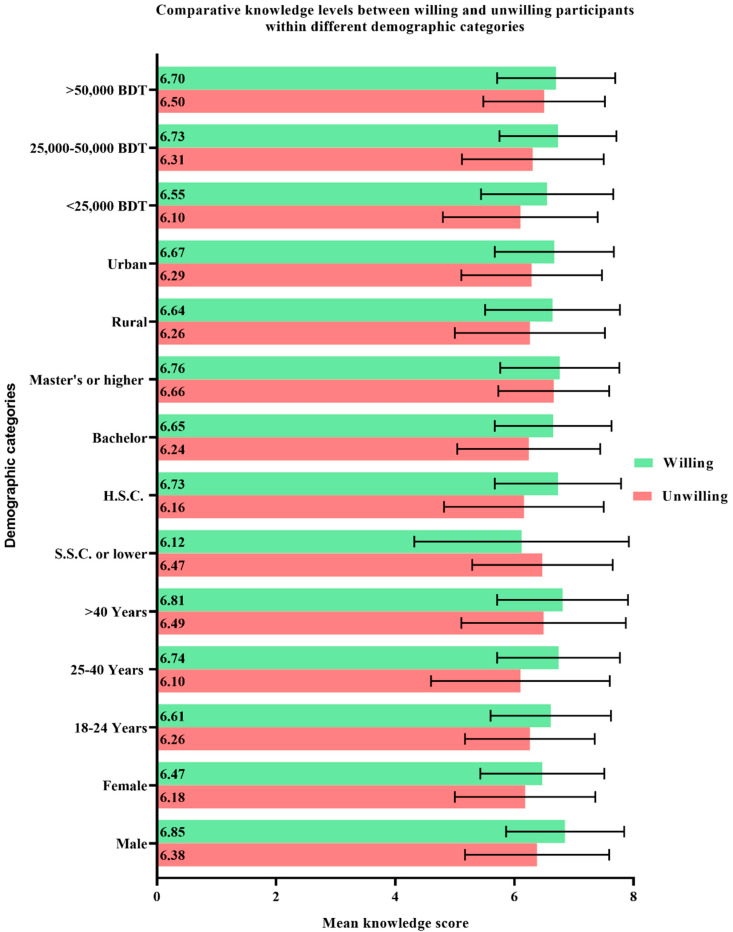
Vaccine willingness among the mass populace, as well as their proper knowledge and perception regarding vaccines and the vaccination process, may contribute extensively towards attaining their anticipated vaccination rates. The current study endeavored to ascertain the Bangladeshi population's knowledge, perception, and willingness towards COVID-19 vaccination. Relevant information was collected from 1201 adults aged 18 years or older by employing an online-based survey from 1 to 30 July 2021. Descriptive statistics, the chi-square (χ) test, and a binary logistic regression analysis were applied in order to compare the extent of knowledge and perception prevalent among different demographic groups and correlate such prevalence with respective vaccine willingness. The participants expressed mean (± standard deviation) knowledge and perception scores of 6.48 ± 1.13 out of 8 and 5.37 ± 1.22 out of 7, respectively. A multivariate analysis confirmed the significant association ( < 0.05) of gender, age, and family income with the knowledge score, whereas age and knowledge level significantly influenced perception. Current living area, family income, and age were considerable contributors to COVID-19 vaccine willingness. Overall vaccine willingness was found to be significantly curtailed by inadequate knowledge (AOR 0.514, CI 95% 0.401-0.658, < 0.001) and perception (AOR 0.710, CI 95% 0.548-0.920, = 0.010) among the participants. All of the concerned authorities' efforts are warranted in order to improve public understanding, perception, and inclination towards vaccination.
普通民众的疫苗接种意愿,以及他们对疫苗和接种过程的正确知识与认知,可能对实现预期的接种率有很大贡献。当前的研究致力于确定孟加拉国人口对新冠疫苗接种的知识、认知和意愿。2021年7月1日至30日,通过在线调查从1201名18岁及以上的成年人中收集了相关信息。应用描述性统计、卡方(χ)检验和二元逻辑回归分析,以比较不同人口群体中普遍存在的知识和认知程度,并将这种普遍性与各自的疫苗接种意愿相关联。参与者的知识和认知得分的平均值(±标准差)分别为8分中的6.48±1.13分和7分中的5.37±1.22分。多变量分析证实,性别、年龄和家庭收入与知识得分存在显著关联(<0.05),而年龄和知识水平对认知有显著影响。当前居住地区、家庭收入和年龄是新冠疫苗接种意愿的重要影响因素。总体而言,发现参与者知识不足(调整后比值比0.514,95%置信区间0.401 - 0.658,<0.001)和认知不足(调整后比值比0.710,95%置信区间0.548 - 0.920,=0.010)会显著降低疫苗接种意愿。所有相关当局都有必要做出努力,以提高公众对疫苗接种的理解、认知和倾向。