Rzymski Piotr, Zeyland Joanna, Poniedziałek Barbara, Małecka Ilona, Wysocki Jacek
Department of Environmental Medicine, Poznań University of Medical Sciences, 60-806 Poznań, Poland.
Integrated Science Association (ISA), Universal Scientific Education and Research Network (USERN), 60-806 Poznań, Poland.
Vaccines (Basel). 2021 Apr 14;9(4):382. doi: 10.3390/vaccines9040382.
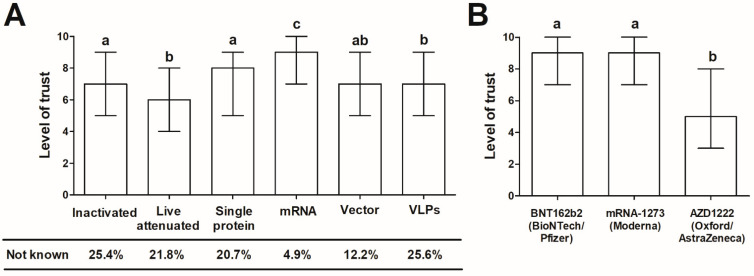
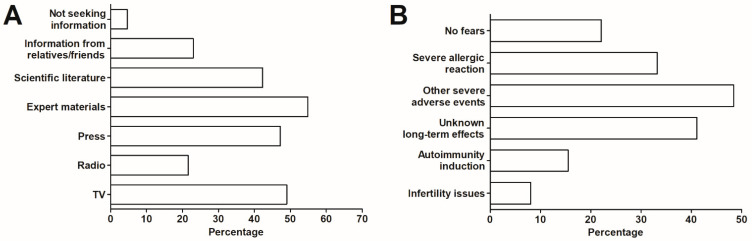
Vaccine hesitancy is a major threat to the success of COVID-19 vaccination programs. The present cross-sectional online survey of adult Poles ( = 1020) expressing a willingness to receive the COVID-19 vaccine was conducted between February and March 2021 and aimed to assess (i) the general trust in different types of vaccines, (ii) the level of acceptance of the COVID-19 vaccines already in use in Poland (BNT162b2 by BioNTech/Pfizer, mRNA-1273 by Moderna and AZD1222 by Oxford/AstraZeneca) as well as eight vaccines approved outside European Union (EU) or in advanced stages of clinical trials, (iii) level of fear of vaccination against COVID-19, and (iv) main sources of information on COVID-19 vaccination. Among all major vaccine technology, the highest level of trust was observed for the mRNA platform, with a considerable number of surveyed (>20%) not aware of the existence of vaccines produced using the traditional approach (inactivated and live attenuated vaccines). The age of participants was the main factor differentiating the level of trust in a particular vaccine type. Both BNT162b and mRNA-1273 received a high level of acceptance, contrary to AZD1222. From eight vaccines unauthorized in the EU at the moment of study, the CVnCoV (mRNA; CureVac) was met with the highest level of trust, followed by Ad26.COV2.S (vector; Janssen/Johnson&Johnson) and NVX-CoV2373 (protein; Novavax). Sputnik V (vector; Gamaleya Research Institute) was decidedly the least trusted vaccine. The median level of fear (measured by the 10-point Likert-type scale) in the studied group was 4.0, mostly related to the risk of serious allergic reactions, other severe adverse events and unknown long-term effects of vaccination. Female, individuals with a lower level of education and those not seeking any information on the COVID-19 vaccines revealed a higher fear of vaccination. Experts' materials were the major source of information on COVID-19 vaccines in the studied group. The study shows the level of trust in COVID-19 vaccines can vary much across the producers while the mRNA vaccines are received with a high level of acceptance. It also emphasizes the need for effective and continuous science communication when fighting the pandemic as it may be an ideal time to increase the general awareness of vaccines.
疫苗犹豫是新冠疫苗接种计划成功实施的重大威胁。本次针对1020名表示愿意接种新冠疫苗的成年波兰人的横断面在线调查于2021年2月至3月进行,旨在评估:(i)对不同类型疫苗的总体信任度;(ii)波兰已使用的新冠疫苗(BioNTech/辉瑞的BNT162b2、莫德纳的mRNA-1273和牛津/阿斯利康的AZD1222)以及欧盟以外已获批或处于临床试验后期的八种疫苗的接受程度;(iii)对新冠疫苗接种的恐惧程度;(iv)新冠疫苗接种信息的主要来源。在所有主要疫苗技术中,对mRNA平台的信任度最高,相当一部分受访者(>20%)不知道使用传统方法(灭活疫苗和减毒活疫苗)生产的疫苗的存在。参与者的年龄是区分对特定疫苗类型信任程度的主要因素。与AZD1222不同,BNT162b和mRNA-1273都获得了较高的接受度。在研究时欧盟尚未批准的八种疫苗中,CVnCoV(mRNA;CureVac)获得的信任度最高,其次是Ad26.COV2.S(载体;杨森/强生)和NVX-CoV2373(蛋白质;诺瓦瓦克斯)。卫星V(载体;加马列亚研究所)无疑是最不受信任的疫苗。研究组的恐惧中位数水平(用10分制李克特量表衡量)为4.0,主要与严重过敏反应、其他严重不良事件以及疫苗未知的长期影响风险有关。女性、受教育程度较低的个体以及那些不寻求任何新冠疫苗信息的人对疫苗接种的恐惧更高。专家资料是研究组中新冠疫苗信息的主要来源。该研究表明,不同生产商生产的新冠疫苗的信任度可能有很大差异,而mRNA疫苗获得了较高的接受度。它还强调,在抗击疫情时需要进行有效且持续的科学传播,因为这可能是提高公众对疫苗总体认识的理想时机。