Im Jong Hee, Son Seungmin, Ko Jae-Heung, Kim Kyung-Hwan, An Chung Sun, Han Kyung-Hwan
School of Biological Sciences, College of Natural Sciences, Seoul National University, Seoul 151-747, Korea.
Department of Horticulture, Michigan State University, East Lansing, MI 48824, USA.
Plants (Basel). 2021 Nov 28;10(12):2611. doi: 10.3390/plants10122611.
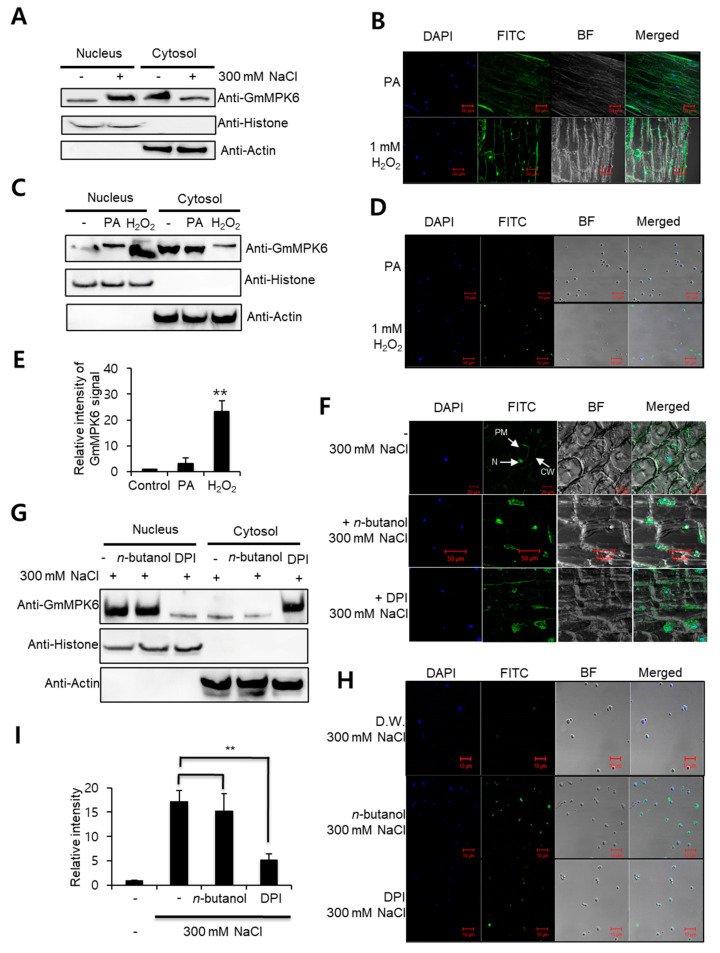
The plant mitogen-activated protein kinase (MPK) cascade, a highly conserved signal transduction system in eukaryotes, plays a crucial role in the plant's response to environmental stimuli and phytohormones. It is well-known that nuclear translocation of MPKs is necessary for their activities in mammalian cells. However, the mechanism underlying nuclear translocation of plant MPKs is not well elucidated. In the previous study, it has been shown that soybean MPK6 (GmMPK6) is activated by phosphatidic acid (PA) and hydrogen peroxide (HO), which are two signaling molecules generated during salt stress. Using the two signaling molecules, we investigated how salt stress triggers its translocation to the nucleus. Our results show that the translocation of GmMPK6 to the nucleus is mediated by HO, but not by PA. Furthermore, the translocation was interrupted by diphenylene iodonium (DPI) (an inhibitor of RBOH), confirming that HO is the signaling molecule for the nuclear translocation of GmMPK6 during salt stress.
植物促分裂原活化蛋白激酶(MPK)级联反应是真核生物中高度保守的信号转导系统,在植物对环境刺激和植物激素的响应中起着关键作用。众所周知,MPK的核转位对于其在哺乳动物细胞中的活性是必要的。然而,植物MPK核转位的潜在机制尚未得到充分阐明。在先前的研究中,已表明大豆MPK6(GmMPK6)被磷脂酸(PA)和过氧化氢(HO)激活,这两种信号分子是在盐胁迫期间产生的。利用这两种信号分子,我们研究了盐胁迫如何触发其向细胞核的转位。我们的结果表明,GmMPK6向细胞核的转位是由HO介导的,而不是由PA介导的。此外,转位被二亚苯基碘鎓(DPI)(一种RBOH抑制剂)阻断,证实HO是盐胁迫期间GmMPK6核转位的信号分子。