Liu Jixiang, Chang Yajun, Sun Linhe, Du Fengfeng, Cui Jian, Liu Xiaojing, Li Naiwei, Wang Wei, Li Jinfeng, Yao Dongrui
Jiangsu Key Laboratory for the Research and Utilization of Plant Resources, Institute of Botany, Jiangsu Province and Chinese Academy of Sciences (Nanjing Botanical Garden Mem. Sun Yat-Sen), Nanjing 210014, China.
Jiangsu Engineering Research Center of Aquatic Plant Resources and Water Environment Remediation, Nanjing 210014, China.
Plants (Basel). 2021 Dec 2;10(12):2653. doi: 10.3390/plants10122653.
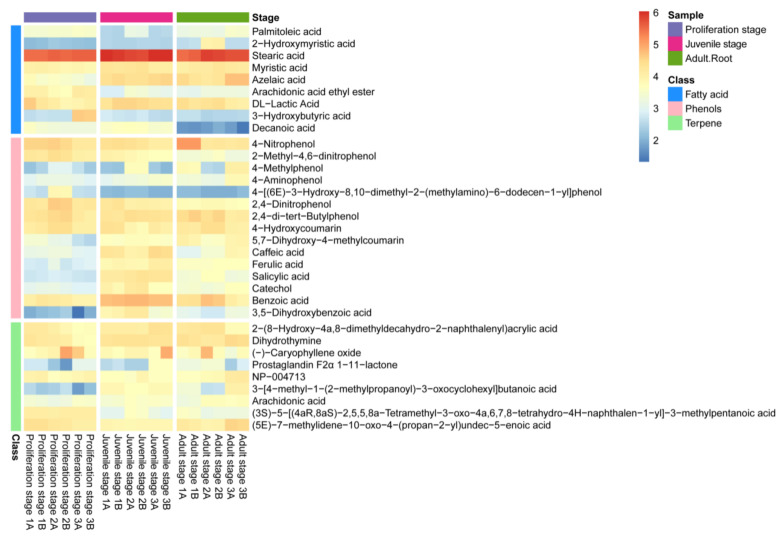
In recent years, with the frequent global occurrence of harmful algal blooms, the use of plant allelopathy to control algal blooms has attracted special and wide attention. This study validates the possibility of turning water dropwort into a biological resource to inhibit the growth of harmful blooms via allelopathy. The results revealed that there were 33 types of allelopathic compounds in the water dropwort culture water, of which 15 were phenolic acids. Regarding water dropwort itself, 18 phenolic acids were discovered in all the organs of water dropwort via a targeted metabolomics analysis; they were found to be mainly synthesized in the leaves and then transported to the roots and then ultimately released into culture water where they inhibited growth. Next, three types of phenolic acids synthesized in water dropwort, i.e., benzoic, salicylic, and ferulic acids, were selected to clarify their inhibitory effects on the growth of and their mechanism(s) of action. It was found that the inhibitory effect of phenolic acids on the growth of increased with the increase of the exposure concentration, although the algae cells were more sensitive to benzoic acid than to salicylic and ferulic acids. Further study indicated that the inhibitory effects of the three phenolic acids on the growth of were largely due to the simultaneous action of reducing the number of cells, damaging the integrity of the cell membrane, inhibiting chlorophyll a (Chl-a) synthesis, decreasing the values of and , and increasing the activity of the antioxidant enzymes (SOD, POD, and CAT) of . Thus, the results of this study indicate that both culture water including the rich allelochemicals in water dropwort and biological algae inhibitors made from water dropwort could be used to control the growth of noxious algae in the future.
近年来,随着全球有害藻华事件的频繁发生,利用植物化感作用控制藻华受到了广泛的特别关注。本研究验证了通过化感作用将水芹转化为抑制有害藻华生长的生物资源的可能性。结果表明,水芹培养水中存在33种化感化合物,其中15种为酚酸。对于水芹本身,通过靶向代谢组学分析在水芹的所有器官中发现了18种酚酸;发现它们主要在叶片中合成,然后运输到根部,最终释放到培养水中,在那里抑制藻华生长。接下来,选择了水芹中合成的三种酚酸,即苯甲酸、水杨酸和阿魏酸,以阐明它们对藻华生长的抑制作用及其作用机制。结果发现,酚酸对藻华生长的抑制作用随着暴露浓度的增加而增强,尽管藻类细胞对苯甲酸比对水杨酸和阿魏酸更敏感。进一步研究表明,这三种酚酸对藻华生长的抑制作用主要是由于同时减少细胞数量、破坏细胞膜完整性、抑制叶绿素a(Chl-a)合成、降低光合效率和增加藻华抗氧化酶(SOD、POD和CAT)活性的综合作用。因此,本研究结果表明,含有水芹丰富化感物质的培养水和由水芹制成的生物抑藻剂在未来都可用于控制有害藻类的生长。