Greene Sharon K, Levin-Rector Alison, McGibbon Emily, Baumgartner Jennifer, Devinney Katelynn, Ternier Alexandra, Sell Jessica, Kahn Rebecca, Kishore Nishant
Bureau of Communicable Disease, New York City Department of Health and Mental Hygiene, Long Island City, NY, USA.
Bureau of Immunization, New York City Department of Health and Mental Hygiene, Long Island City, NY, USA.
Vaccine X. 2022 Apr;10:100134. doi: 10.1016/j.jvacx.2021.100134. Epub 2021 Dec 22.
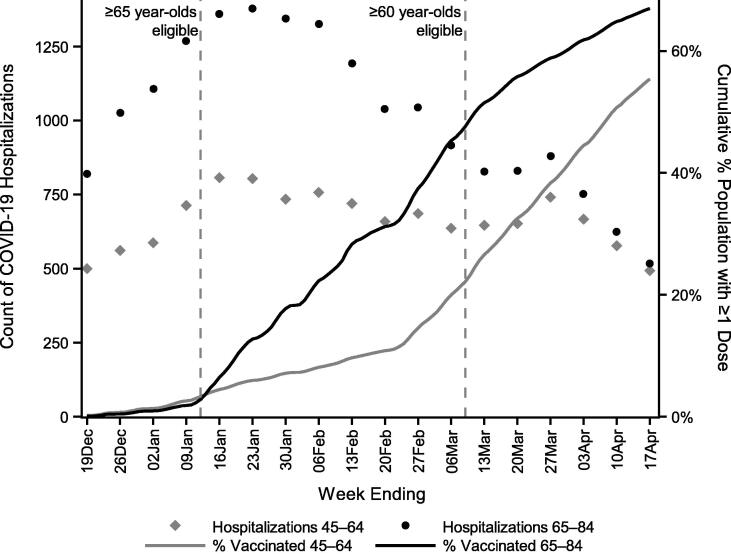
In clinical trials, several SARS-CoV-2 vaccines were shown to reduce risk of severe COVID-19 illness. Local, population-level, real-world evidence of vaccine effectiveness is accumulating. We assessed vaccine effectiveness for community-dwelling New York City (NYC) residents using a quasi-experimental, regression discontinuity design, leveraging a period (January 12-March 9, 2021) when ≥ 65-year-olds were vaccine-eligible but younger persons, excluding essential workers, were not.
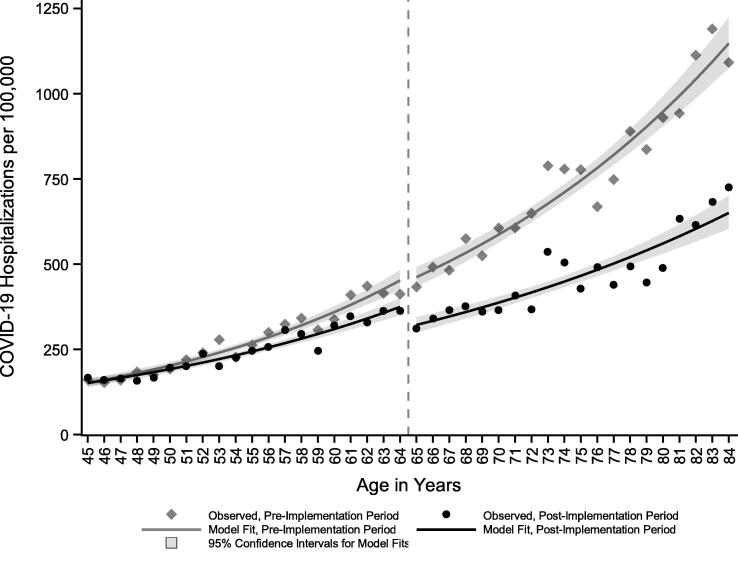
We constructed segmented, negative binomial regression models of age-specific COVID-19 hospitalization rates among 45-84-year-old NYC residents during a post-vaccination program implementation period (February 21-April 17, 2021), with a discontinuity at age 65 years. The relationship between age and hospitalization rates in an unvaccinated population was incorporated using a pre-implementation period (December 20, 2020-February 13, 2021). We calculated the rate ratio (RR) and 95% confidence interval (CI) for the interaction between implementation period (pre or post) and age-based eligibility (45-64 or 65-84 years). Analyses were stratified by race/ethnicity and borough of residence. Similar analyses were conducted for COVID-19 deaths.
Hospitalization rates among 65-84-year-olds decreased from pre- to post-implementation periods (RR 0.85, 95% CI: 0.74-0.97), controlling for trends among 45-64-year-olds. Accordingly, an estimated 721 (95% CI: 126-1,241) hospitalizations were averted. Residents just above the eligibility threshold (65-66-year-olds) had lower hospitalization rates than those below (63-64-year-olds). Racial/ethnic groups and boroughs with higher vaccine coverage generally experienced greater reductions in RR point estimates. Uncertainty was greater for the decrease in COVID-19 death rates (RR 0.85, 95% CI: 0.66-1.10).
The vaccination program in NYC reduced COVID-19 hospitalizations among the initially age-eligible ≥ 65-year-old population by approximately 15% in the first eight weeks. The real-world evidence of vaccine effectiveness makes it more imperative to improve vaccine access and uptake to reduce inequities in COVID-19 outcomes.
在临床试验中,几种新冠病毒疫苗已显示出可降低重症新冠疾病的风险。关于疫苗有效性的本地、人群层面的真实世界证据正在不断积累。我们采用准实验性回归断点设计,利用2021年1月12日至3月9日这一时期,评估了纽约市(NYC)社区居民的疫苗有效性,在此期间,65岁及以上人群有资格接种疫苗,而不包括必要工作人员在内的较年轻人群则没有资格。
我们构建了分段负二项回归模型,用于分析2021年2月21日至4月17日疫苗接种项目实施后期间45至84岁纽约市居民按年龄划分的新冠住院率,断点为65岁。使用2020年12月20日至2021年2月13日的实施前期纳入未接种疫苗人群中年龄与住院率之间的关系。我们计算了实施期(前期或后期)与基于年龄的资格(45至64岁或65至84岁)之间相互作用的率比(RR)和95%置信区间(CI)。分析按种族/族裔和居住行政区进行分层。对新冠死亡情况进行了类似分析。
65至84岁人群的住院率在实施前后有所下降(RR 0.85,95% CI:0.74至0.97),同时控制了45至64岁人群的趋势。据此,估计避免了721例(95% CI:126至1241)住院情况。刚好高于资格阈值(65至66岁)的居民住院率低于低于该阈值(63至64岁)的居民。疫苗接种覆盖率较高的种族/族裔群体和行政区,RR点估计值的下降幅度通常更大。新冠死亡率下降的不确定性更大(RR 0.85,95% CI:0.66至1.10)。
纽约市的疫苗接种项目在最初符合年龄资格的65岁及以上人群中,在最初八周内将新冠住院率降低了约15%。疫苗有效性的真实世界证据使得改善疫苗可及性和接种率以减少新冠疾病结果方面的不平等变得更加紧迫。