Department of Infectious Diseases, Fifth Medical Center of Chinese PLA General Hospital, National Clinical Research Center for Infectious Diseases, No.100 Western 4th Ring Road, Beijing 100039, China; Wuhan Huoshenshan Hospital, Wuhan, China.
Department of Hematology, Union Hospital, Tongji Medical College, Huazhong University of Science and Technology, Wuhan, China; National Industrial Base for Stem Cell Engineering Products, Tianjin, China.
EBioMedicine. 2022 Jan;75:103789. doi: 10.1016/j.ebiom.2021.103789. Epub 2021 Dec 25.
The long-term consequences of human umbilical cord-derived mesenchymal stem cell (UC-MSC) treatment for COVID-19 patients are yet to be reported. This study assessed the 1-year outcomes in patients with severe COVID-19, who were recruited in our previous UC-MSC clinical trial.
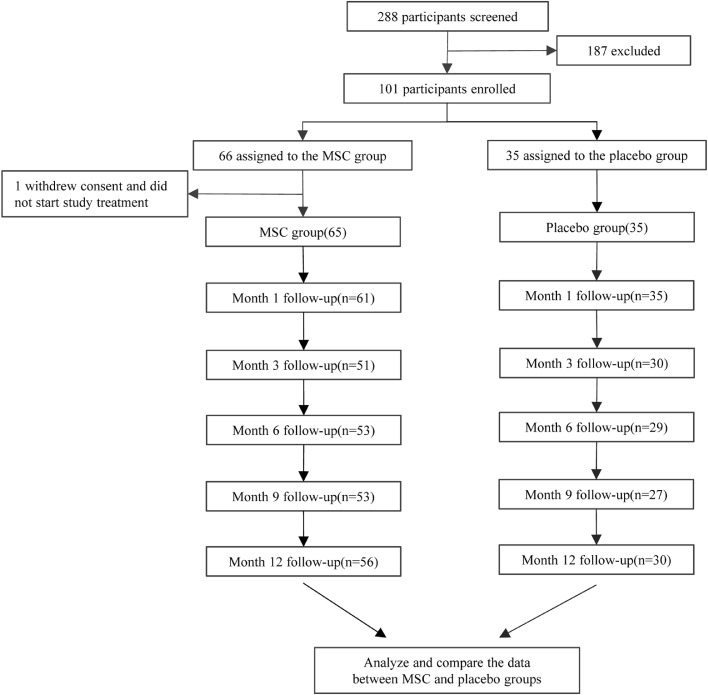
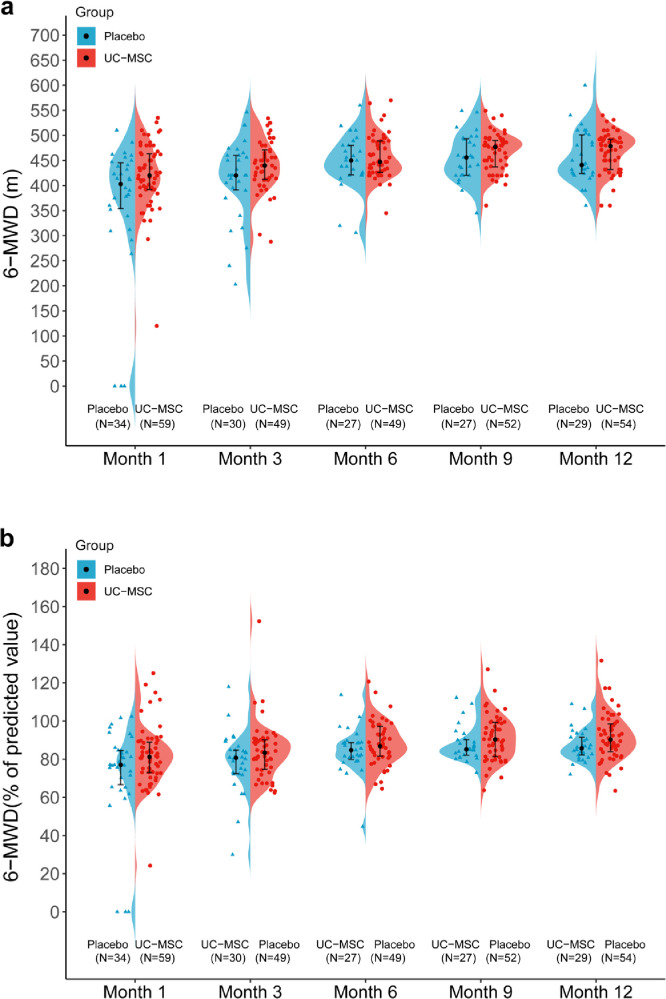
In this prospective, longitudinal, cohort study, 100 patients enrolled in our phase 2 trial were prospectively followed up at 3-month intervals for 1 year to evaluate the long-term safety and effectiveness of UC-MSC treatment. The primary endpoint was an altered proportion of whole-lung lesion volumes measured by high-resolution CT. Other imaging outcomes, 6 min walking distance (6-MWD), lung function, plasma biomarkers, and adverse events were also recorded and analyzed. This trial was registered with ClinicalTrials.gov (NCT04288102).
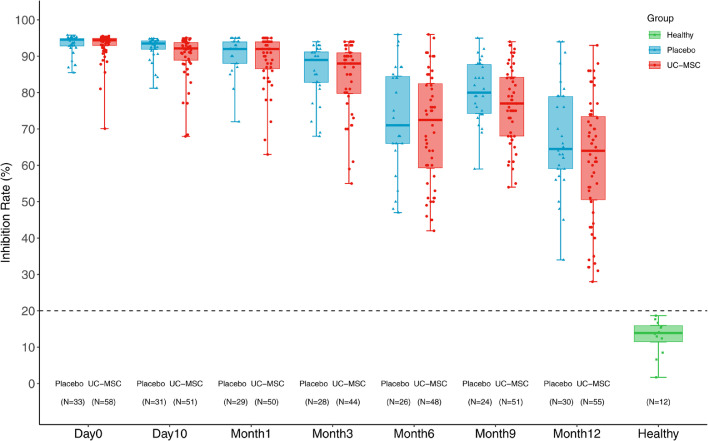
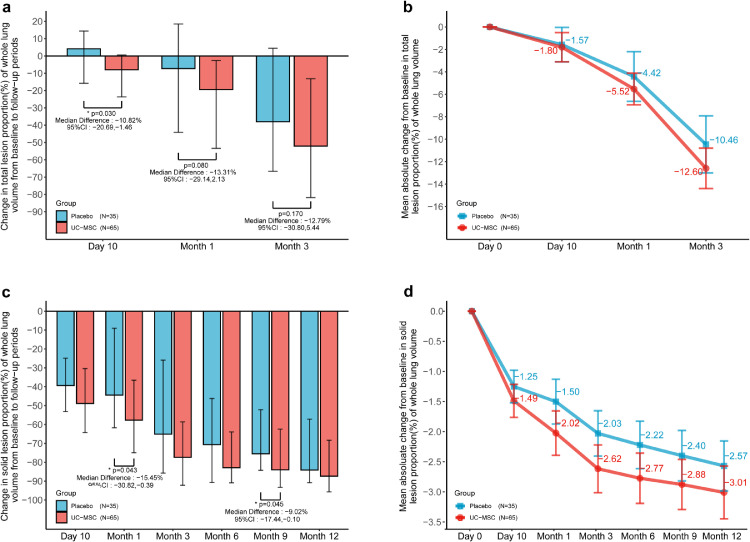
MSC administration improved in whole-lung lesion volume compared with the placebo with a difference of -10.8% (95% CI: -20.7%, -1.5%, p = 0.030) on day 10. MSC also reduced the proportion of solid component lesion volume compared with the placebo at each follow-up point. More interestingly, 17.9% (10/56) of patients in the MSC group had normal CT images at month 12, but none in the placebo group (p = 0.013). The incidence of symptoms was lower in the MSC group than in the placebo group at each follow-up time. Neutralizing antibodies were all positive, with a similar median inhibition rate (61.6% vs. 67.6%) in both groups at month 12. No difference in adverse events at the 1-year follow-up and tumor markers at month 12 were observed between the two groups.
UC-MSC administration achieves a long-term benefit in the recovery of lung lesions and symptoms in COVID-19 patients.
The National Key R&D Program of China, the Innovation Groups of the National Natural Science Foundation of China, and the National Science and Technology Major Project.
人脐带间充质干细胞(UC-MSC)治疗 COVID-19 患者的长期后果尚未报道。本研究评估了我们之前的 UC-MSC 临床研究中招募的重症 COVID-19 患者的 1 年结局。
在这项前瞻性、纵向、队列研究中,100 名参加我们 2 期试验的患者以 3 个月为间隔进行前瞻性随访 1 年,以评估 UC-MSC 治疗的长期安全性和有效性。主要终点是通过高分辨率 CT 测量的全肺病变体积的比例变化。还记录和分析了其他成像结局、6 分钟步行距离(6-MWD)、肺功能、血浆生物标志物和不良事件。这项试验在 ClinicalTrials.gov 上注册(NCT04288102)。
与安慰剂组相比,MSC 给药后全肺病变体积改善,差异为-10.8%(95%CI:-20.7%,-1.5%,p=0.030)在第 10 天。MSC 还降低了与安慰剂相比,在每个随访点的实性成分病变体积的比例。更有趣的是,在 MSC 组中,有 17.9%(10/56)的患者在 12 个月时有正常的 CT 图像,但安慰剂组中没有(p=0.013)。在每个随访时间点,MSC 组的症状发生率均低于安慰剂组。中和抗体均为阳性,两组在第 12 个月的抑制率中位数相似(61.6%比 67.6%)。在 1 年随访时,两组之间在不良事件和肿瘤标志物方面没有差异。
UC-MSC 给药可使 COVID-19 患者的肺部病变和症状长期恢复获益。
中国国家重点研发计划、中国国家自然科学基金创新群体和国家科技重大专项。