Yuan Meng-Qi, Song Le, Wang Ze-Rui, Zhang Zi-Ying, Shi Ming, He Junli, Mo Qiong, Zheng Ning, Yao Wei-Qi, Zhang Yu, Dong Tengyun, Li Yuanyuan, Zhang Chao, Song Jinwen, Huang Lei, Xu Zhe, Yuan Xin, Fu Jun-Liang, Zhen Cheng, Cai Jianming, Dong Jinghui, Zhang Jianzeng, Xie Wei-Fen, Li Yonggang, Zhang Bo, Shi Lei, Wang Fu-Sheng
Senior Department of Infectious Diseases, The Fifth Medical Center of Chinese PLA General Hospital, National Clinical Research Center for Infectious Diseases, No. 100 Western 4Th Ring Road, Beijing, 100039, China.
Medical School of Chinese PLA, Beijing, 100853, China.
Stem Cell Res Ther. 2025 Feb 25;16(1):94. doi: 10.1186/s13287-025-04148-1.
The long-term effects and outcomes of human mesenchymal stem cell (MSC) therapy in patients with severe coronavirus disease 2019 (COVID-19) remain poorly understood. This study aimed to evaluate the extended safety and efficacy of MSC treatment in severe patients with COVID-19 who participated in our earlier randomized, double-blind, placebo-controlled clinical trial, with follow-up conducted over 3 years.
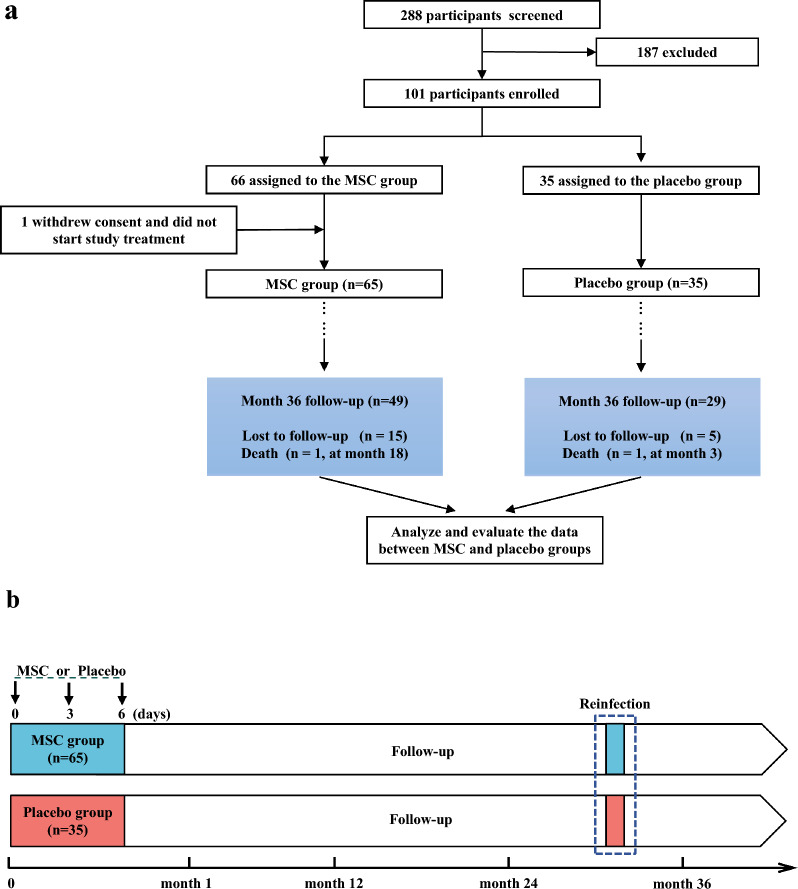
One hundred patients with severe COVID-19 were randomized to receive either an MSC infusion (n = 65, 4 × 10 cells/dose, on days 0, 3, and 6) or a placebo, with both groups receiving the standard of care. At 36 months post-MSC therapy, patients were followed up to long-term safety and efficacy, particularly the effects of MSC therapy on persistent COVID-19 symptoms. Evaluated outcomes included lung imaging results, 6-min walking distance (6-MWD), pulmonary function test results, quality of life scores based on the Short Form-36 (SF-36) health survey, Long COVID symptoms, new-onset comorbidities, tumor marker levels, and rates of COVID-19 reinfection.
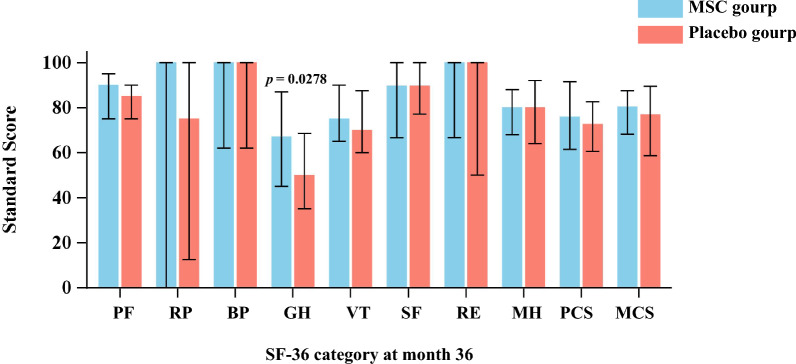
Three years post-treatment, 46.94% (23/49) of patients in the MSC group and 34.48% (10/29) in the placebo group showed normal findings on computed tomography (CT) images (odds ratio [OR] = 1.68, 95% confidence interval [CI]: 0.65-4.34). The general health (GH) score from the SF-36 was higher in the MSC group (67.0) compared to the placebo group (50.0), with a difference of 12.86 (95% CI: 1.44-24.28). Both groups showed similar results for total lung severity scores (TSS), 6-MWD, pulmonary function tests, and Long COVID symptoms. No significant differences between groups were observed in new-onset complications (including tumorigenesis) or tumor marker levels. After adjusting for China's dynamic zero-COVID-19 strategy, severe acute respiratory syndrome coronavirus 2 (SARS-CoV-2) reinfection rates were 53.06% (26/49) in the MSC group and 67.86% (19/28) in the placebo group (OR = 0.54, 95% CI: 0.20-1.41).
These findings support the long-term safety of MSC therapy in patients with severe COVID-19 over 3 years. MSC treatment may offer potential benefits for lung recovery and improved quality of life in patients experiencing Long COVID symptoms.
ClinicalTrials.gov, NCT04288102. Registered 28 February 2020, https://clinicaltrials.gov/study/NCT04288102 .
人间充质干细胞(MSC)疗法对2019年冠状病毒病(COVID-19)重症患者的长期影响和结果仍知之甚少。本研究旨在评估MSC治疗对参与我们早期随机、双盲、安慰剂对照临床试验的COVID-19重症患者的长期安全性和疗效,并进行了3年的随访。
100例COVID-19重症患者被随机分为接受MSC输注组(n = 65,4×10⁶细胞/剂量,在第0、3和6天)或安慰剂组,两组均接受标准治疗。在MSC治疗后36个月,对患者进行长期安全性和疗效随访,特别是MSC疗法对持续性COVID-19症状的影响。评估的结果包括肺部影像学结果、6分钟步行距离(6-MWD)、肺功能测试结果、基于简明健康调查问卷(SF-36)的生活质量评分、长期COVID症状、新发合并症、肿瘤标志物水平以及COVID-19再感染率。
治疗三年后,MSC组46.94%(23/49)的患者和安慰剂组34.48%(10/29)的患者在计算机断层扫描(CT)图像上显示正常结果(优势比[OR]=1.68,95%置信区间[CI]:0.65 - 4.34)。与安慰剂组(50.0)相比,MSC组SF-36的总体健康(GH)评分更高(67.0),差值为12.86(95%CI:1.44 - 24.28)。两组在全肺严重程度评分(TSS)、6-MWD、肺功能测试和长期COVID症状方面结果相似。在新发并发症(包括肿瘤发生)或肿瘤标志物水平方面,两组之间未观察到显著差异。在调整中国的COVID-19动态清零策略后,MSC组严重急性呼吸综合征冠状病毒2(SARS-CoV-2)再感染率为53.06%(26/49),安慰剂组为67.86%(19/28)(OR = 0.54,95%CI:0.20 - 1.41)。
这些发现支持了MSC疗法对COVID-19重症患者3年以上的长期安全性。MSC治疗可能对经历长期COVID症状的患者的肺部恢复和生活质量改善具有潜在益处。
ClinicalTrials.gov,NCT04288102。2020年2月28日注册,https://clinicaltrials.gov/study/NCT04288102 。