
大剂量静脉注射在COVID-19危重症患者中的早期经验
Early Experience of High-dose Intravenous in Critically Ill Patients of COVID-19.
作者信息
Patel Parth Sudhendu, Patel Sudhendu, Shah Vidhi, Aswani Varsha, Narwaria Mahendra
机构信息
Department of Critical Care, Bombay Hospital, Institute of Medical Sciences, Ahmedabad, Gujarat, India.
Department of Medicine, Sterling Hospital, Ahmedabad, Gujarat, India.
出版信息
Indian J Crit Care Med. 2021 Sep;25(9):1066-1068. doi: 10.5005/jp-journals-10071-23963.
BACKGROUND
Immune dysregulation is one of the main reasons for mortality and morbidity in coronavirus disease 2019 (COVID-19). Mycobacterium w (Mw) is recently approved for gram-negative sepsis. Moreover, it is also found effective in COVID-19 patients in previous studies. The traditional route of administration for Mw is intradermal, which has a limitation of administering 0.1 mL per injection and local injection site reaction. Intravenous (IV) administration of Mw has not been explored in COVID-19. We report the retrospective analysis of six critically ill COVID-19 patients who received Mw (IV).
PATIENTS AND METHODS
At baseline, all patients in this case series required O supplementation, and their inflammatory biomarkers were elevated. All patients received 0.6 mL Mw (high-dose) in normal saline along with the standard-of-care treatment.
RESULTS
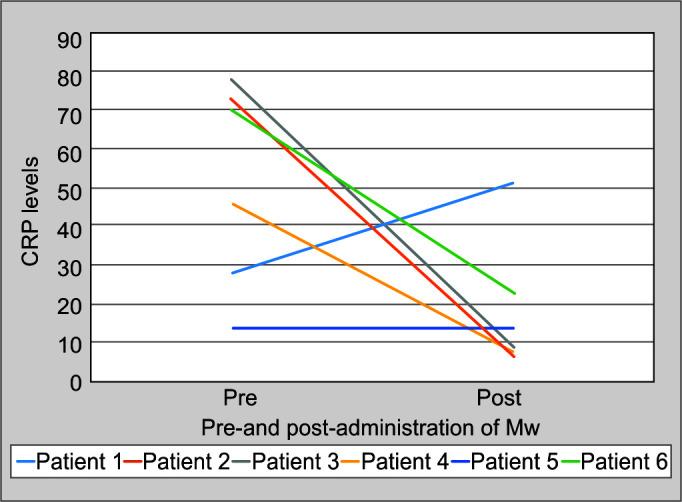
After Mw administration, gradual improvement in O requirement was observed and patients were discharged from the hospital with no mortality. A reduction in mean C-reactive protein (CRP) (51.48-18.52 mg/dL), interleukin-6 (IL-6) (260.22-14.47 pg/mL), and FiO (81.67-43.33) was also observed. No side effects were observed with the use of Mw by IV route.
CONCLUSION
Use of 0.6 mL Mw by IV route in this case series was associated with decreased O supplementation without any side effects in critically ill patients of COVID-19.
HOW TO CITE THIS ARTICLE
Patel PS, Patel S, Shah V, Aswani V, Narwaria M. Early Experience of High-dose Intravenous in Critically Ill Patients of COVID-19. Indian J Crit Care Med 2021;25(9):1066-1068.
背景
免疫失调是2019冠状病毒病(COVID-19)死亡和发病的主要原因之一。W型分枝杆菌(Mw)最近被批准用于革兰氏阴性菌败血症。此外,在先前的研究中还发现它对COVID-19患者有效。Mw的传统给药途径是皮内注射,每次注射限制为0.1 mL,且存在局部注射部位反应。在COVID-19中尚未探索Mw的静脉注射给药方式。我们报告了对6例接受Mw静脉注射的重症COVID-19患者的回顾性分析。
患者与方法
在基线时,该病例系列中的所有患者均需要吸氧,且其炎症生物标志物升高。所有患者在接受标准治疗的同时,静脉输注了0.6 mL溶于生理盐水(高剂量)的Mw。
结果
给予Mw后,观察到患者对氧气的需求逐渐改善,且患者均康复出院,无死亡病例出现。同时还观察到平均C反应蛋白(CRP)(从51.48 mg/dL降至18.52 mg/dL)和白细胞介素-6(IL-6)(从260.22 pg/mL降至14.47 pg/mL)水平降低,以及吸氧分数(FiO)(从8l.67降至43.33)下降情况。静脉使用Mw未观察到任何副作用。
结论
在该病例系列中,对重症COVID-19患者静脉使用0.6 mL Mw可减少氧气补充需求,且无任何副作用。
如何引用本文
帕特尔PS,帕特尔S,沙阿V,阿斯瓦尼V,纳瓦里亚M。高剂量静脉注射Mw治疗重症COVID-19患者的早期经验。《印度重症监护医学杂志》2021;25(9):1066 - 1068。

 Zotero 插件