Laboratory of Phytomedicines, Pharmacology and Biotechnology (PhytoPharmaTec), Department of Biophysics and Pharmacology, São Paulo State University (Unesp), Institute of Biosciences, Botucatu 18618-689, São Paulo, Brazil.
Department of Pathology, Botucatu Medical School, Sao Paulo State University (Unesp), Botucatu 18618-687, São Paulo, Brazil.
World J Gastroenterol. 2021 Dec 7;27(45):7801-7812. doi: 10.3748/wjg.v27.i45.7801.
Inflammatory bowel disease (IBD) comprises two distinct diseases, Crohn's disease (CD) and ulcerative colitis (UC), both of which are chronic, relapsing inflammatory disorders of the gastrointestinal tract with a mostly unknown etiology. The incidence and prevalence of IBD are continually increasing, indicating the need for further studies to investigate the genetic determinants of these diseases. Since microRNAs (miRNAs) regulate protein translation complementary binding to mRNA, discovering differentially expressed miRNAs (DE) in UC or CD patients could be important for diagnostic biomarker identification, assisting in the appropriate disease differentiation progressing the understanding of IBD pathogenesis.
To determine the miRNA expression profile in UC and CD patients and the potential pathophysiological contributions of differentially expressed miRNA.
A total of 20 formalin-fixed paraffin-embedded colonic samples were collected from the Pathology Department of Botucatu Medical School at São Paulo State University (Unesp). The diagnosis of UC or CD was based on clinical, endoscopic, radiologic, and histological criteria and confirmed by histopathological analysis at the time of selection. The TaqMan™ Array Human MicroRNA A+B Cards Set v3.0 (Applied Biosystems™) platform was used to analyze 754 miRNAs. Targets of DE-miRNAs were predicted using miRNA Data Integration Portal (mirDIP) and the miRNA Target Interaction database (MiRTarBase). All statistical analyses were conducted using GraphPad Prism software. Parametric and nonparametric data were analyzed using -tests and Mann-Whitney tests, respectively.
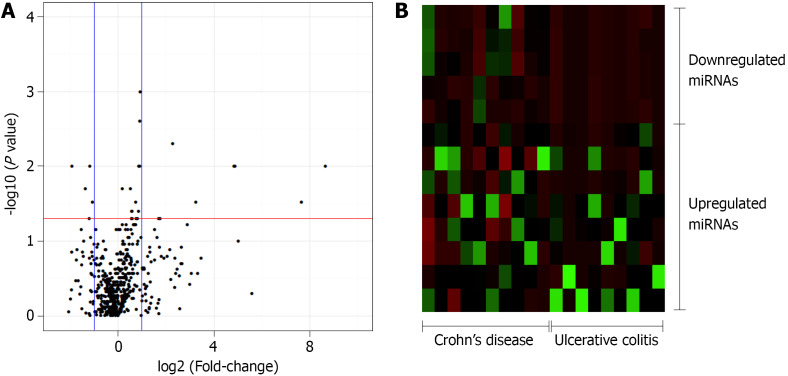
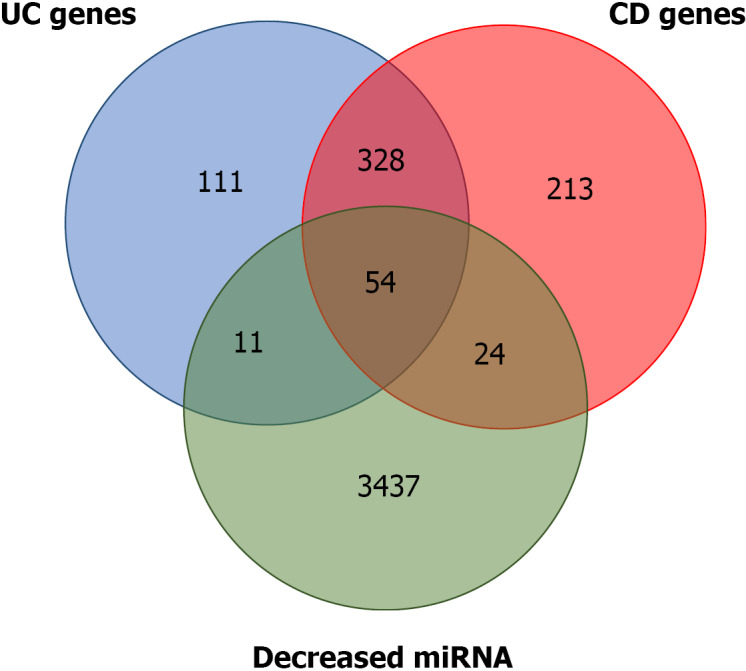
The results showed that of the 754 miRNAs that were initially evaluated, 643 miRNAs were found to be expressed in at least five of the patients who were diagnosed with either CD or UC; the remaining 111 miRNAs were not considered to be expressed in these patients. The expression levels of 28 miRNAs were significantly different between the CD and UC patients ( ≤ 0.05); 13 miRNAs demonstrated a fold-change in expression level greater than 1. Five miRNAs with a downregulated expression were selected for enrichment analysis. The miRNAs whose expression levels were significantly lower in UC patients than in CD patients were enriched in certain signaling pathways that were mostly correlated with cancer-related processes and respective biomarkers.
MiRNAs could be used to differentiate UC from CD, and differently expressed miRNAs could help explain the distinct pathophysiology of each disease.
炎症性肠病(IBD)包括两种不同的疾病,克罗恩病(CD)和溃疡性结肠炎(UC),这两种疾病都是胃肠道的慢性、复发性炎症性疾病,其病因大多未知。IBD 的发病率和患病率持续上升,表明需要进一步研究以调查这些疾病的遗传决定因素。由于 microRNAs(miRNAs)通过与 mRNA 的互补结合来调节蛋白质翻译,因此在 UC 或 CD 患者中发现差异表达的 miRNAs(DE)对于鉴定诊断生物标志物可能很重要,有助于进行适当的疾病分化,深入了解 IBD 的发病机制。
确定 UC 和 CD 患者的 miRNA 表达谱以及差异表达 miRNA 的潜在病理生理贡献。
从圣保罗州立大学博图卡图医学院病理科收集了总共 20 例福尔马林固定石蜡包埋的结肠样本。UC 或 CD 的诊断基于临床、内镜、放射学和组织学标准,并在选择时通过组织病理学分析确认。使用 TaqMan™Array Human MicroRNA A+B Cards Set v3.0(Applied Biosystems™)平台分析了 754 个 miRNAs。使用 miRNA Data Integration Portal(mirDIP)和 miRNA Target Interaction database(MiRTarBase)预测差异表达 miRNA 的靶标。所有统计分析均使用 GraphPad Prism 软件进行。参数和非参数数据分别使用 t 检验和 Mann-Whitney 检验进行分析。
结果表明,在最初评估的 754 个 miRNAs 中,有 643 个 miRNAs 在被诊断为 CD 或 UC 的患者中至少有 5 个表达;其余 111 个 miRNAs 未被认为在这些患者中表达。28 个 miRNA 的表达水平在 CD 和 UC 患者之间存在显著差异(≤0.05);13 个 miRNA 的表达水平变化倍数大于 1。选择了 5 个表达下调的 miRNA 进行富集分析。在 UC 患者中表达水平明显低于 CD 患者的 miRNA 富集在与癌症相关的过程和各自的生物标志物密切相关的某些信号通路中。
miRNAs 可用于区分 UC 和 CD,差异表达的 miRNAs 可能有助于解释每种疾病的不同病理生理学。