State Key Laboratory for Managing Biotic and Chemical Threats to the Quality and Safety of Agro-products, Institute of Agro-product Safety and Nutrition, Zhejiang Academy of Agricultural Sciences, Hangzhou, China.
Greentown Agricultural Testing Technology Co., Ltd, Hangzhou, China.
Ann Med. 2023;55(2):2261477. doi: 10.1080/07853890.2023.2261477. Epub 2023 Sep 29.
Inflammatory bowel disease (IBD) is a chronic inflammation of the gastrointestinal tract that co-occurs with gut microbiota dysbiosis; however, its etiology remains unclear. MicroRNA (miRNA)-microbiome interactions play an essential role in host health and disease.
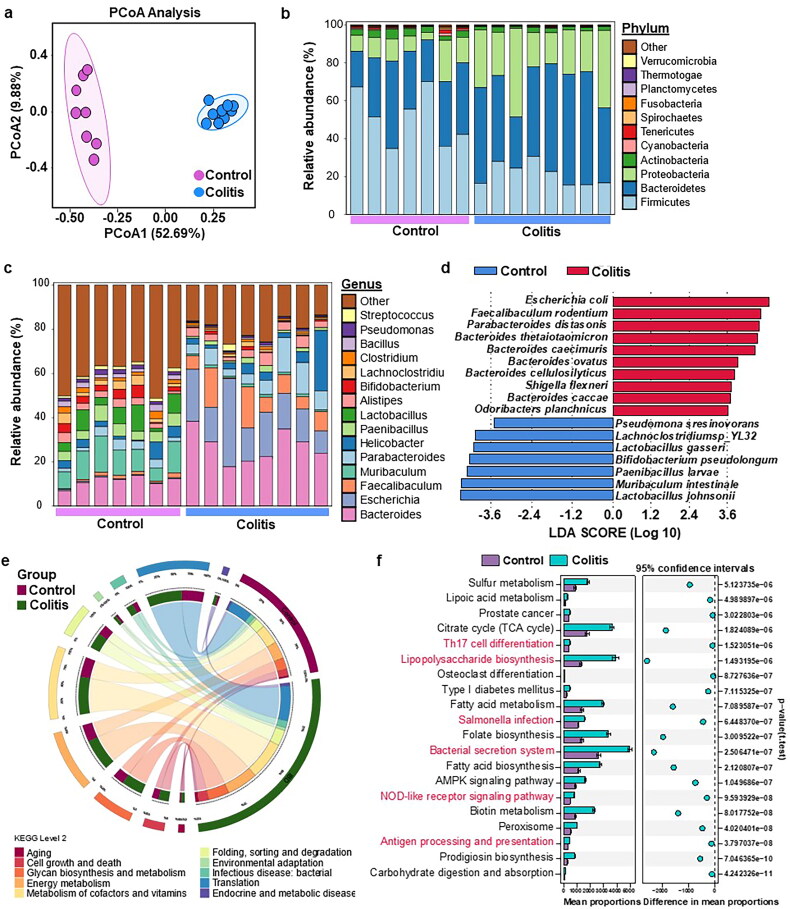
To investigate the gut microbiome and host miRNA profiles in colitis, we used a Dextran Sulfate Sodium (DSS)-induced ulcerative colitis (UC) model. Metagenomic sequencing and metabolome profiling were performed to explore typical microbiota and metabolite signatures in colitis, whereas mRNA and miRNA sequencing were used to determine differentially expressed miRNAs and their target genes in the inflamed colon.
A total of 986 miRNAs were identified between the two groups, with 41 upregulated and 21 downregulated miRNAs in colitis mice compared to the control group. Notably, the target genes of these significantly altered miRNAs were primarily enriched in the immune and inflammation-related pathways. Second, LEfSe analysis revealed bacterial biomarkers distinguishing the two groups, with significantly higher levels of commonly encountered pathogens such as and in the UC group, whereas beneficial species such as were more abundant in the control group. Microbiota metabolites histamine, N-acetylhistamine, and glycocholic acid were found to be downregulated in colitis mice. Spearman correlation further revealed the potential crosstalk between the microbiota profile and colonic miRNA, revealing the possibility of microbiome-miRNA interactions involved in IBD development.
Our data reveal the relationships between multi-omic features during UC and suggest that targeting specific miRNAs may provide new avenues for the development of effective miRNA-based therapeutics.
炎症性肠病(IBD)是一种胃肠道的慢性炎症,与肠道微生物失调共同发生;然而,其病因仍不清楚。MicroRNA(miRNA)-微生物组相互作用在宿主健康和疾病中起着至关重要的作用。
为了研究结肠炎中的肠道微生物组和宿主 miRNA 谱,我们使用了葡聚糖硫酸钠(DSS)诱导的溃疡性结肠炎(UC)模型。进行宏基因组测序和代谢组谱分析,以探索结肠炎中的典型微生物群和代谢物特征,而 mRNA 和 miRNA 测序用于确定在炎症结肠中差异表达的 miRNA 及其靶基因。
共鉴定出两组之间的 986 个 miRNA,与对照组相比,结肠炎小鼠中有 41 个上调和 21 个下调的 miRNA。值得注意的是,这些明显改变的 miRNA 的靶基因主要富集在免疫和炎症相关途径中。其次,LEfSe 分析显示区分两组的细菌生物标志物,UC 组中常见病原体如 和 的水平显著升高,而有益物种如 在对照组中更为丰富。在结肠炎小鼠中发现微生物群代谢物组氨酸、N-乙酰组氨酸和甘胆酸下调。Spearman 相关性进一步揭示了微生物组谱和结肠 miRNA 之间的潜在串扰,表明 miRNA 可能参与 IBD 发展的微生物组-miRNA 相互作用的可能性。
我们的数据揭示了 UC 期间多组学特征之间的关系,并表明靶向特定的 miRNA 可能为开发有效的基于 miRNA 的治疗方法提供新的途径。