School of Health Sciences, University of Dundee, Dundee, Scotland, UK.
Department of Nursing and Midwifery, University of Huddersfield, Huddersfield, UK.
Matern Child Nutr. 2022 Apr;18(2):e13296. doi: 10.1111/mcn.13296. Epub 2021 Dec 29.
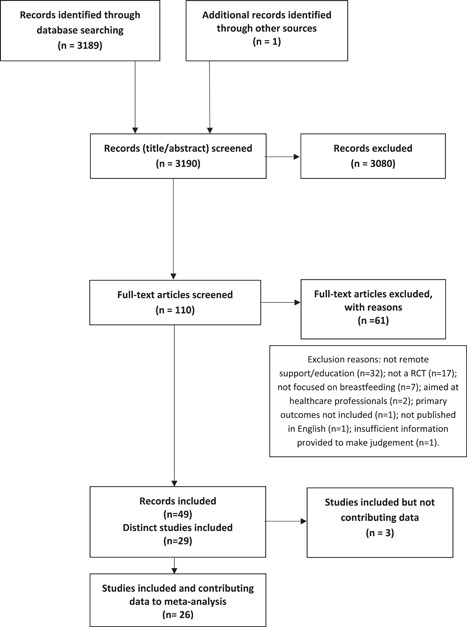
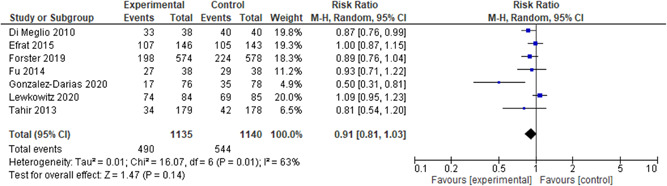
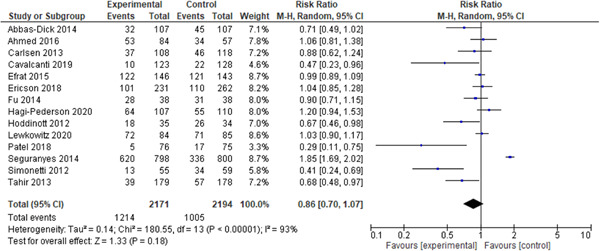
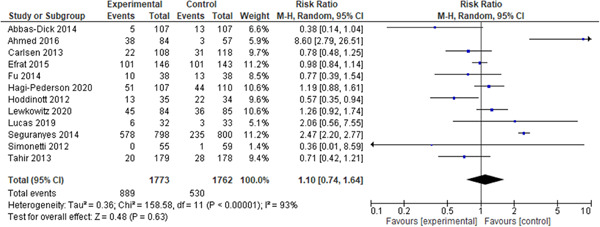
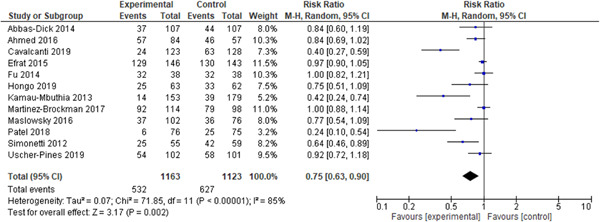
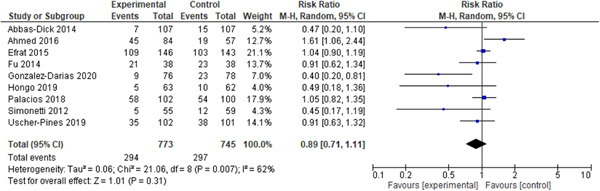
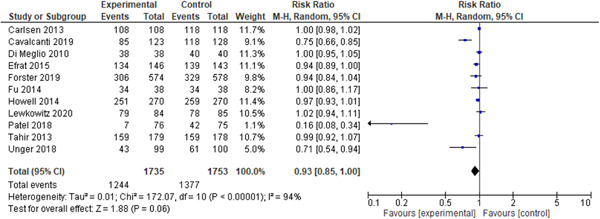
The Covid-19 pandemic has led to a substantial increase in remotely provided maternity care services, including breastfeeding support. It is, therefore, important to understand whether breastfeeding support provided remotely is an effective method of support. To determine if breastfeeding support provided remotely is an effective method of support. A systematic review and meta-analysis were conducted. Twenty-nine studies were included in the review and 26 contributed data to the meta-analysis. Remotely provided breastfeeding support significantly reduced the risk of women stopping exclusive breastfeeding at 3 months by 25% (risk ratio [RR]: 0.75, 95% confidence interval [CI]: 0.63, 0.90). There was no significant difference in the number of women stopping any breastfeeding at 4-8 weeks (RR: 1.10, 95% CI: 0.74, 1.64), 3 months (RR: 0.89, 95% CI: 0.71, 1.11), or 6 months (RR: 0.91, 95% CI: 0.81, 1.03) or the number of women stopping exclusive breastfeeding at 4-8 weeks (RR: 0.86, 95% CI: 0.70, 1.07) or 6 months (RR: 0.93, 95% CI: 0.85, 1.0). There was substantial heterogeneity of interventions in terms of mode of delivery, intensity, and providers. This demonstrates that remote interventions can be effective for improving exclusive breastfeeding at 3 months but the certainty of the evidence is low. Improvements in exclusive breastfeeding at 4-8 weeks and 6 months were only found when studies at high risk of bias were excluded. They are also less likely to be effective for improving any breastfeeding. Remote provision of breastfeeding support and education could be provided when it is not possible to provide face-to-face care.
新冠疫情大流行导致远程提供的产妇护理服务大幅增加,包括母乳喂养支持。因此,了解远程提供的母乳喂养支持是否是一种有效的支持方法非常重要。为了确定远程提供的母乳喂养支持是否是一种有效的支持方法,我们进行了系统评价和荟萃分析。该综述共纳入了 29 项研究,其中 26 项研究的数据纳入了荟萃分析。远程提供的母乳喂养支持可显著降低 3 个月时女性停止纯母乳喂养的风险,降幅为 25%(风险比 [RR]:0.75,95%置信区间 [CI]:0.63,0.90)。在 4-8 周(RR:1.10,95%CI:0.74,1.64)、3 个月(RR:0.89,95%CI:0.71,1.11)或 6 个月(RR:0.91,95%CI:0.81,1.03)时,停止任何母乳喂养的女性数量,以及在 4-8 周(RR:0.86,95%CI:0.70,1.07)或 6 个月(RR:0.93,95%CI:0.85,1.03)时停止纯母乳喂养的女性数量方面,两组间无显著差异。这些干预措施在分娩方式、强度和提供者方面存在很大的异质性。这表明远程干预措施可以有效提高 3 个月时的纯母乳喂养率,但证据的确定性较低。只有当排除高偏倚风险的研究时,才会发现 4-8 周和 6 个月时的纯母乳喂养率有所提高。而且,对于提高任何母乳喂养率,这种方法可能效果不大。在无法提供面对面护理时,可以远程提供母乳喂养支持和教育。