Lee Yoonsub, Lee Dajung, Kim Sungtae, Ku Young, Rhyu In-Chul
Department of Periodontology, Dental Research Institute, Seoul National University School of Dentistry, Seoul, Korea.
J Periodontal Implant Sci. 2021 Dec;51(6):398-408. doi: 10.5051/jpis.2101400070.
In this study, we aimed to evaluate the clinical validity of the modified tunneling technique using minimal soft tissue harvesting and volume-stable collagen matrix in the anterior mandible.
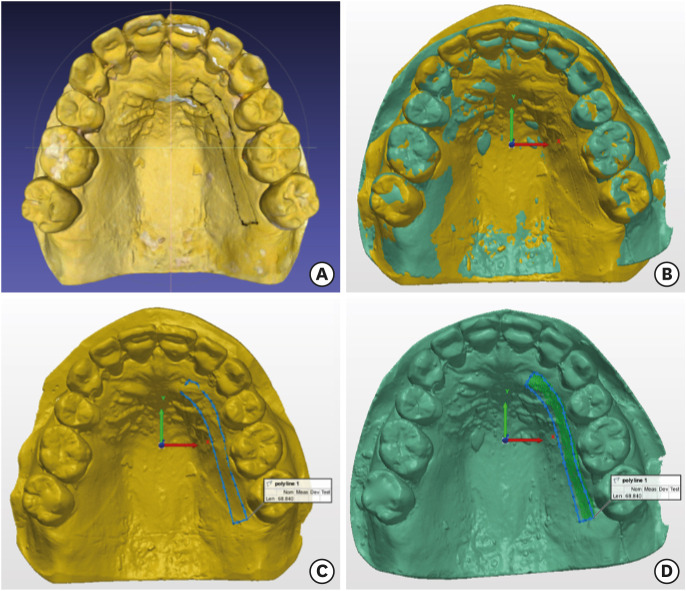
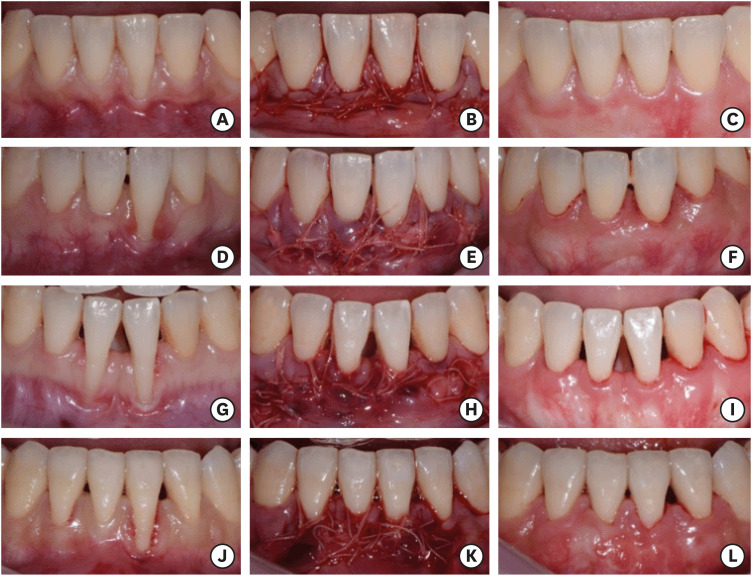
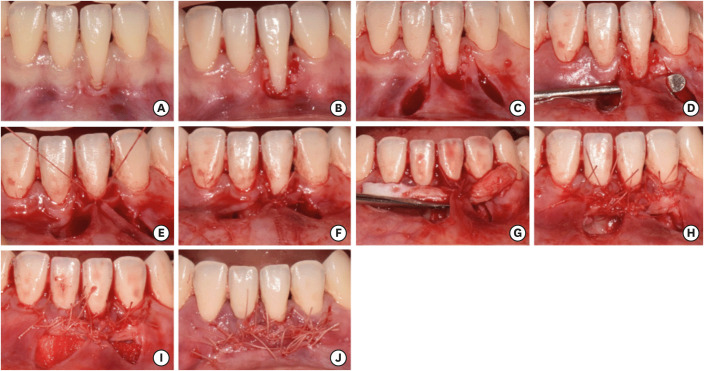
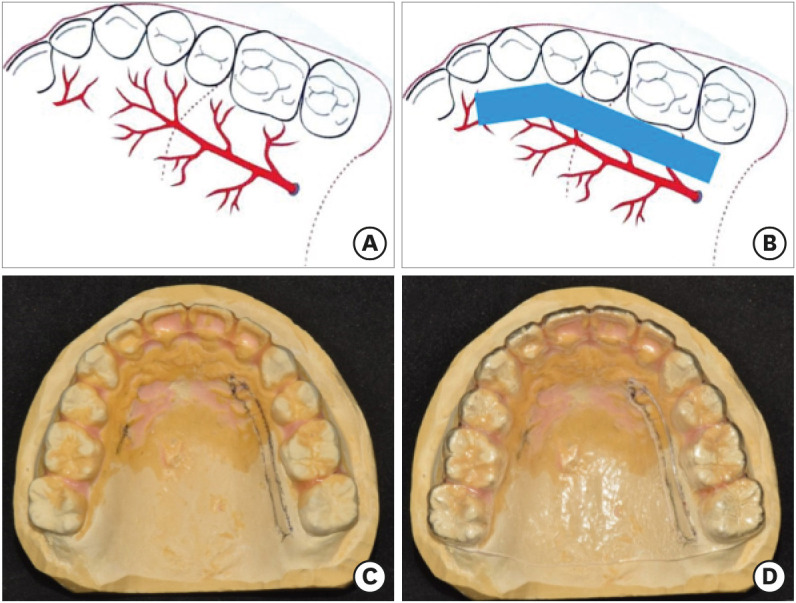
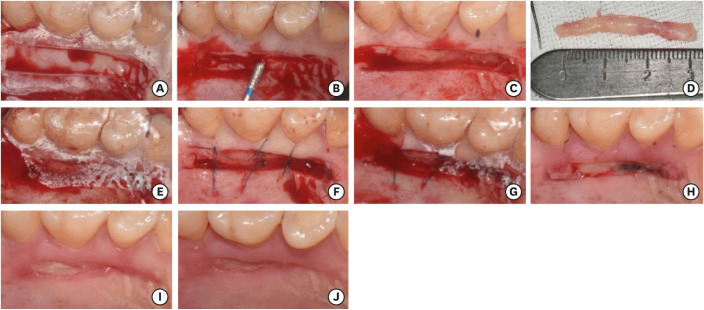
In total, 27 anterior mandibular teeth and palatal donor sites in 17 patients with ≥1 mm of gingival recession (GR) were analyzed before and after root coverage. For the recipient sites, vertical vestibular incisions were made in the interdental area and a subperiosteal tunnel was created with an elevator. After both sides of the marginal gingiva were tied to one another, a prepared connective tissue graft and volume-stable collagen matrix were inserted through the vestibular vertical incision and were fixed with resorbable suture material. The root coverage results of the recipient site were measured at baseline (T), 3 weeks (T), 12 weeks (T), and the latest visit (T). For palatal donor sites, a free gingival graft from a pre-decided area avoiding the main trunk of the greater palatine artery was harvested using a prefabricated surgical template at a depth of 2 mm after de-epithelization using a rotating bur. In each patient, the clinical and volumetric changes at the donor sites between T and T were measured.
During an average follow-up of 14.5 months, teeth with denuded root lengths of 1-3 mm (n=12), 3-6 mm (n=11), and >6 mm (n=2) achieved root coverage of 97.01%±7.65%, 86.70%±5.66%, and 82.53%±1.39%, respectively. Miller classification I (n=12), II (n=10), and III (n=3) teeth showed mean coverage rates of 97.01%±7.65%, 86.91%±5.90%, and 83.19%±1.62%, respectively. At the donor sites, an average defect depth of 1.41 mm (70.5%) recovered in 3 weeks, and the wounds were epithelized completely in all cases.
The modified tunneling technique in this study is a promising treatment modality for overcoming GR in the anterior mandible.
在本研究中,我们旨在评估使用最小限度软组织采集和体积稳定的胶原基质的改良隧道技术在前下颌骨的临床有效性。
对17例牙龈退缩(GR)≥1mm患者的27颗下颌前牙和腭部供区在牙根覆盖前后进行分析。对于受区,在牙间区域做垂直前庭切口,并用剥离子创建骨膜下隧道。将边缘牙龈两侧相互结扎后,通过前庭垂直切口插入制备好的结缔组织移植物和体积稳定的胶原基质,并用可吸收缝合材料固定。在基线(T0)、3周(T1)、12周(T2)和最后一次随访(T3)时测量受区的牙根覆盖结果。对于腭部供区,使用预制手术模板在深度为2mm处,用旋转牙钻去除上皮后,从预先确定的区域采集游离牙龈移植物,避开腭大动脉主干。在每位患者中,测量T0和T3之间供区的临床和体积变化。
在平均14.5个月的随访期间,牙根暴露长度为1 - 3mm(n = 12)、3 - 6mm(n = 11)和>6mm(n = 2)的牙齿的牙根覆盖率分别为97.01%±7.65%、86.70%±5.66%和82.53%±1.39%。米勒分类I类(n = 12)、II类(n = 10)和III类(n = 3)牙齿的平均覆盖率分别为97.01%±7.65%、86.91%±5.90%和83.19%±1.62%。在供区,平均1.41mm(70.5%)的缺损深度在3周内恢复,所有病例伤口均完全上皮化。
本研究中的改良隧道技术是克服前下颌骨GR的一种有前景的治疗方式。