Centre for Safe Medication Practice and Research, Department of Pharmacology and Pharmacy, Li Ka Shing Faculty of Medicine, The University of Hong Kong, Pok Fu Lam, Hong Kong.
Laboratory of Data Discovery for Health (D24H), Hong Kong Science Park, Pak Shek Kok, Hong Kong.
Palliat Med. 2022 Jan;36(1):30-43. doi: 10.1177/02692163211049309. Epub 2021 Dec 29.
Assessing pain in infants, children and young people with life-limiting conditions remains a challenge due to diverse patient conditions, types of pain and often a reduced ability or inability of patients to communicate verbally.
To systematically identify pain assessment tools that are currently used in paediatric palliative care and examine their psychometric properties and feasibility and make recommendations for clinical practice.
A systematic literature review and evaluation of psychometric properties of pain assessment tools of original peer-reviewed research published from inception of data sources to April 2021.
PsycINFO via ProQuest, Web of Science Core, Medline via Ovid, EMBASE, BIOSIS and CINAHL were searched from inception to April 2021. Hand searches of reference lists of included studies and relevant reviews were performed.
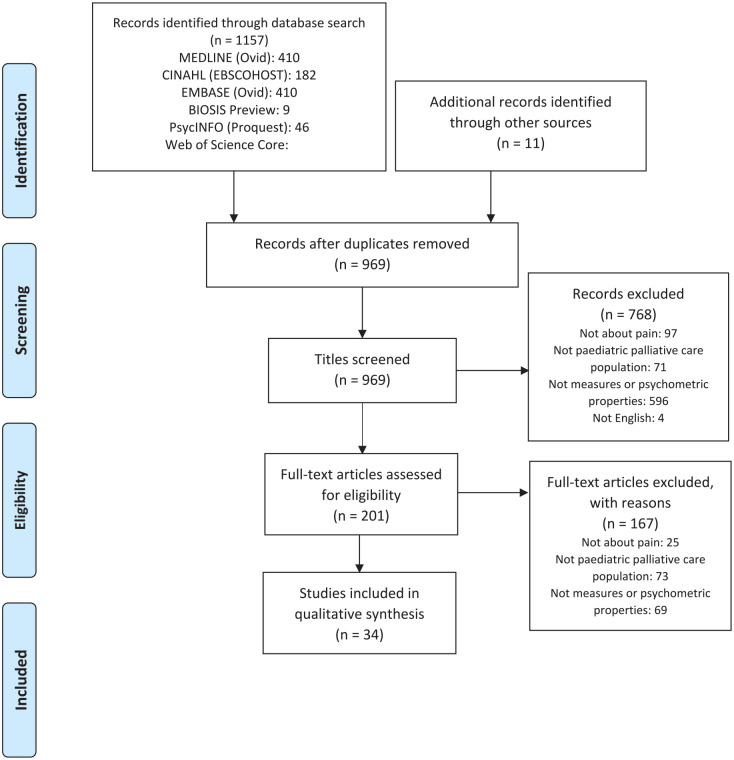
From 1168 articles identified, 201 papers were selected for full-text assessment. Thirty-four articles met the eligibility criteria and we examined the psychometric properties of 22 pain assessment tools. Overall, the Faces Pain Scale-Revised (FPS-R) had high cross-cultural validity, construct validity (hypothesis testing) and responsiveness; while the Faces, Legs, Activity, Cry and Consolability (FLACC) scale and Paediatric Pain Profile (PPP) had high internal consistency, criterion validity, reliability and responsiveness. The number of studies per psychometric property of each pain assessment tool was limited and the methodological quality of included studies was low.
Balancing aspects of feasibility and psychometric properties, the FPS-R is recommended for self-assessment, and the FLACC scale/FLACC Revised and PPP are the recommended observational tools in their respective age groups.
由于患者病情多样、疼痛类型多样,且患者通常表达能力下降或丧失,因此评估患有生命终末期疾病的婴儿、儿童和青少年的疼痛仍然具有挑战性。
系统识别目前在儿科姑息治疗中使用的疼痛评估工具,并评估其心理测量学特性和可行性,并为临床实践提出建议。
对原始同行评审研究中疼痛评估工具的系统文献综述和心理测量学特性评估,这些研究发表于数据来源开始至 2021 年 4 月。
从数据来源开始至 2021 年 4 月,通过 ProQuest 的 PsycINFO、Web of Science Core、Ovid 中的 Medline、EMBASE、BIOSIS 和 CINAHL 搜索 PsycINFO、Web of Science Core、Medline、EMBASE、BIOSIS 和 CINAHL。对纳入研究和相关综述的参考文献进行了手工检索。
从 1168 篇文章中确定了 201 篇文章进行全文评估。34 篇文章符合纳入标准,我们检查了 22 种疼痛评估工具的心理测量学特性。总体而言,修订后的面部表情疼痛量表(FPS-R)具有较高的跨文化有效性、结构有效性(假设检验)和反应性;而面部、腿部、活动、哭泣和安慰性(FLACC)量表和儿科疼痛概况(PPP)具有较高的内部一致性、标准效度、可靠性和反应性。每个疼痛评估工具的心理测量特性的研究数量有限,纳入研究的方法学质量较低。
平衡可行性和心理测量学特性,FPS-R 推荐用于自我评估,而 FLACC 量表/FLACC 修订版和 PPP 是各自年龄段推荐的观察工具。