Prieto-Merino David, Mulick Amy, Armstrong Craig, Hoult Helen, Fawcett Scott, Eliasson Lina, Clifford Sarah
Sprout Health Solutions Ltd, London, UK.
London School of Hygiene and Tropical Medicine, London, UK.
J Pharm Policy Pract. 2021 Dec 29;14(1):113. doi: 10.1186/s40545-021-00385-w.
The proportion of days covered (PDC) is used to estimate medication adherence by looking at the proportion of days in which a person has access to the medication, over a given period of interest. This study aimed to adapt the PDC algorithm to allow for plausible assumptions about prescription refill behaviour when applied to data from online pharmacy suppliers.
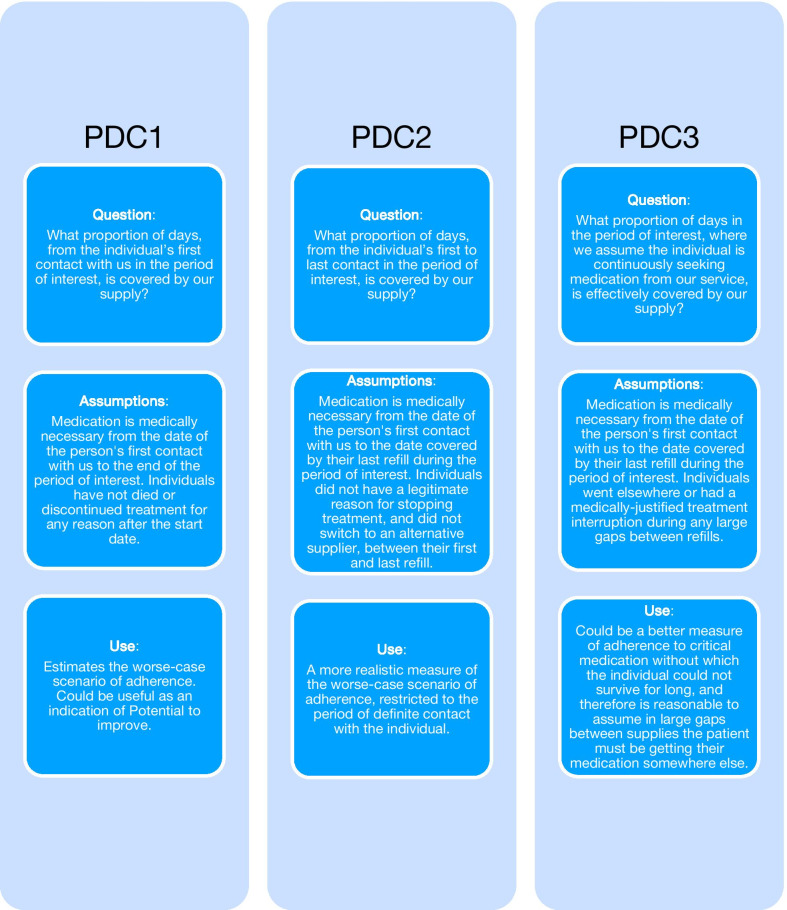
Three PDC algorithms, the conventional approach (PDC1) and two alternative approaches (PDC2 and PDC3), were used to estimate adherence in a real-world dataset from an online pharmacy. Each algorithm has different denominators and increasing levels of complexity. PDC1, the conventional approach, is the total number of days between first dispensation and a defined end date. PDC2 counts the days until the end of supply date. PDC3 removes from the denominator specifically defined large gaps between refills, which could indicate legitimate reasons for treatment discontinuation. The distribution of the three PDCs across four different follow-up lengths was compared.
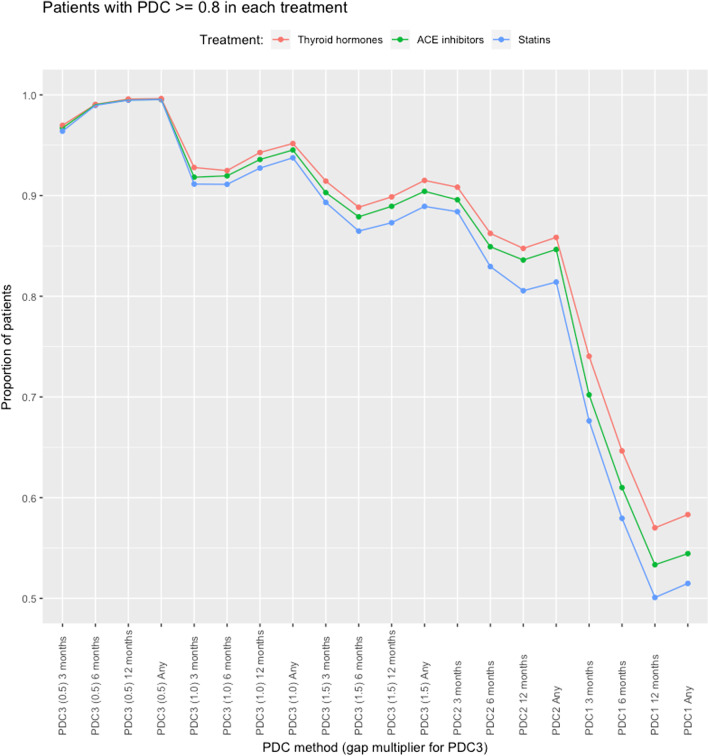
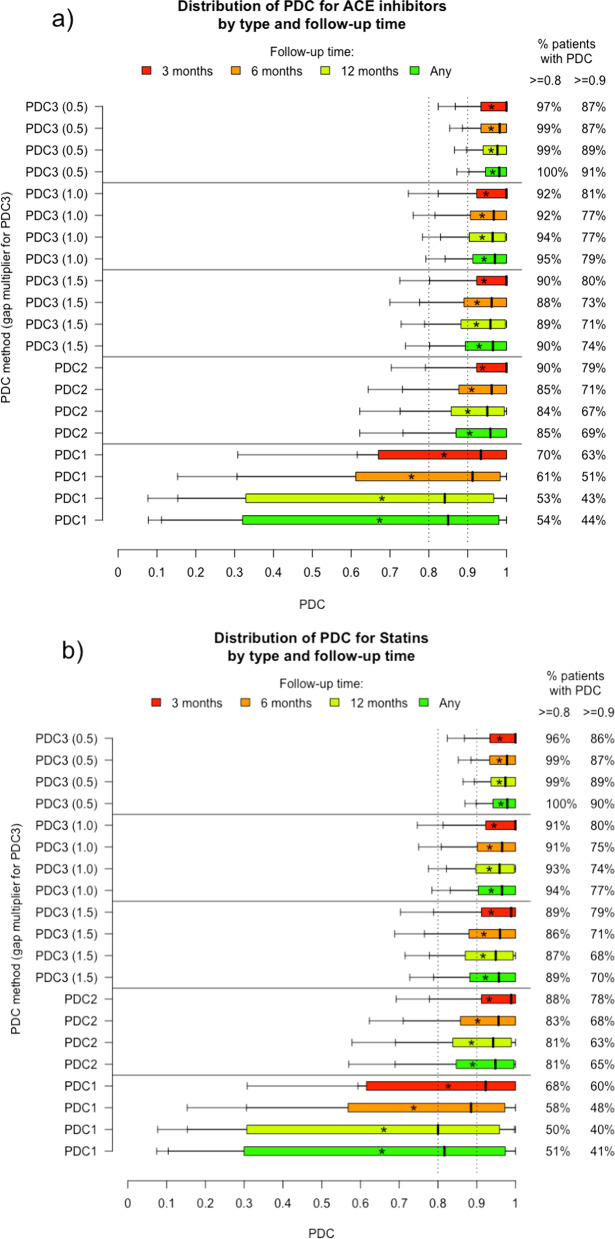
The dataset included people taking ACE inhibitors (n = 65,905), statins (n = 100,362), and/or thyroid hormones (n = 30,637). The proportion of people taking ACE inhibitors with PDC ≥ 0.8 was 50-74% for PDC1, 81-91% for PDC2, and 86-100% for PDC3 with values depending on drug and length of follow-up. Similar ranges were identified in people taking statins and thyroid hormones.
These algorithms enable researchers and healthcare providers to assess pharmacy services and individual levels of adherence in real-world databases, particularly in settings where people may switch between different suppliers of medicines, meaning an individual supplier's data may show temporary but legitimate gaps in access to medication. Accurately identifying problems with adherence provides the foundation for opportunities to improve experience, adherence and outcomes and to reduce medicines wastage. Research with people taking medications and prescribers is required to validate the algorithms' assumptions.
覆盖天数比例(PDC)用于通过查看在给定的感兴趣时间段内一个人能够获取药物的天数比例来估计药物依从性。本研究旨在调整PDC算法,以便在应用于来自在线药房供应商的数据时,能够对处方再填充行为做出合理假设。
使用三种PDC算法,即传统方法(PDC1)和两种替代方法(PDC2和PDC3),来估计来自一家在线药房的真实世界数据集中的依从性。每种算法有不同的分母且复杂度不断增加。PDC1,即传统方法,是首次配药与定义的结束日期之间的总天数。PDC2计算直到供应结束日期的天数。PDC3从分母中去除特定定义的再填充之间的大间隔,这可能表明治疗中断的合理原因。比较了三种PDC在四种不同随访时长中的分布情况。
该数据集包括服用血管紧张素转换酶抑制剂(n = 65,905)、他汀类药物(n = 100,362)和/或甲状腺激素(n = 30,637)的人群。服用血管紧张素转换酶抑制剂且PDC≥0.8的人群比例,PDC1为50 - 74%,PDC2为81 - 91%,PDC3为86 - 100%,具体数值取决于药物和随访时长。服用他汀类药物和甲状腺激素的人群中也发现了类似范围。
这些算法使研究人员和医疗保健提供者能够在真实世界数据库中评估药房服务和个体依从性水平,特别是在人们可能在不同药品供应商之间切换的情况下,这意味着单个供应商的数据可能显示获取药物方面暂时但合理的间隔。准确识别依从性问题为改善体验、依从性和治疗结果以及减少药物浪费提供了机会基础。需要对服药人群和开处方者进行研究以验证算法的假设。