Faculty of Public Health, Mahidol University, Bangkok, Thailand.
Center of Excellence on Environmental Health and Toxicology, Bangkok, Thailand.
Asian Pac J Cancer Prev. 2021 Dec 1;22(12):3789-3801. doi: 10.31557/APJCP.2021.22.12.3789.
Tobacco companies and their associated businesses know that placement - where one can see and purchase their products - is critical to their success. Placement is one of the four fundamental Ps of marketing along with product, price and promotion. Placement includes identifying retail locations in important places such as in shopping districts, within neighborhoods, near schools, at beaches, and in parks. In Southeast Asia, counteracting tobacco company placement strategies that result in market penetration is essential to advancing the endgame, namely ending tobacco use. However, in Southeast Asia research on the placement of tobacco products has been limited.
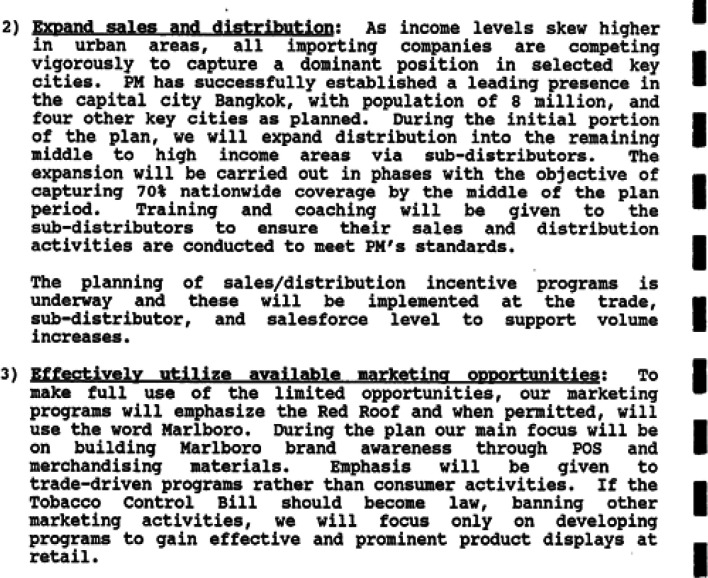
We undertook to analyze how Philip Morris International (PMI) through its subsidiary Philip Morris Asia Inc. (PMAI), from the time the company entered Thailand's market once it was forced open in 1990, developed its successful product placement strategies and tactics.
We examined over 4,000 PMI and PMAI internal documents using an historical, iterative and thematic approach. We analyzed the most relevant and illuminating documents, particularly those in which PMAI discussed retailer supply, retailer acceptance and retailer cooperation.
Even before foreign tobacco brands were legally allowed to be sold in Thailand, PMAI was already doing customer research in Thailand. In 1989, PMAI conducted a study of potential Thai customers in which 24% of respondents' lack of availability (i.e., product placement) was one of the main reasons for not smoking PMI's products. Based on these findings, PMAI engaged in intensive internal efforts to address the placement barrier to gain share. PMAI placed considerable emphasis on "stimulating retail trade acceptance" by making payments to retailers who met agreed upon and contracted product sales targets. PMAI's initial successes incentivizing Thai retailers by essentially buying prime retail space for placement of their brands, to crowd out local and other foreign brands, became the foundation of what evolved into a sophisticated program to make placement highly lucrative for retailers.
PMAI viewed aggressive product placement as essential to success as a new entrant in Thailand, and their product placement strategies contributed substantially to capturing a large share of the market. Therefore, endgame strategies must focus on restricting product placement through surveillance of tobacco industry legal, investment and retailer actions and through stricter tobacco retailer licensing requirements and penalties.
烟草公司及其关联企业知道,产品的展示位置——人们能够看到和购买其产品的位置——对其成功至关重要。展示位置是营销的四个基本要素之一,其他三个要素是产品、价格和促销。展示位置包括在购物区、社区内、学校附近、海滩和公园等重要地点确定零售地点。在东南亚,抵制烟草公司的展示位置策略,防止其渗透市场,对于推进最终目标——即结束烟草使用——至关重要。然而,在东南亚,对烟草产品展示位置的研究一直很有限。
我们分析了菲利普莫里斯国际公司(PMI)通过其子公司菲利普莫里斯亚洲公司(PMAI),自该公司于 1990 年被迫进入泰国市场以来,如何制定成功的产品展示位置策略和战术。
我们使用历史、迭代和主题方法,审查了超过 4000 份 PMI 和 PMAI 的内部文件。我们分析了最相关和最有启发性的文件,特别是那些 PMAI 讨论零售商供应、零售商接受和零售商合作的文件。
甚至在外国烟草品牌在泰国被合法允许销售之前,PMAI 已经在泰国进行客户研究。1989 年,PMAI 对潜在的泰国客户进行了一项研究,其中 24%的受访者表示,缺乏供应(即产品展示位置)是他们不吸烟 PMI 产品的主要原因之一。基于这些发现,PMAI 内部进行了密集的努力,以解决产品展示位置的障碍,以增加市场份额。PMAI 非常重视“刺激零售贸易接受度”,向达到商定的和合同规定的产品销售目标的零售商支付款项。PMAI 的初步成功激励了泰国零售商,他们基本上通过购买主要的零售空间来展示他们的品牌,以排挤当地和其他外国品牌,这成为后来演变成一个为零售商提供丰厚利润的复杂计划的基础。
PMAI 认为,作为泰国的新进入者,积极的产品展示位置对于成功至关重要,他们的产品展示位置策略为其在市场上占据大量份额做出了重大贡献。因此,最终目标战略必须通过监测烟草行业的法律、投资和零售商的行动,以及通过更严格的烟草零售商许可要求和处罚,来关注限制产品展示位置。