Institute for Endocrinology and Experimental Oncology "G. Salvatore," National Research Council, 80131 Naples, Italy;
Institute of Biochemistry and Cell Biology, National Research Council, 80131 Naples, Italy.
Proc Natl Acad Sci U S A. 2022 Jan 4;119(1). doi: 10.1073/pnas.2026494119.
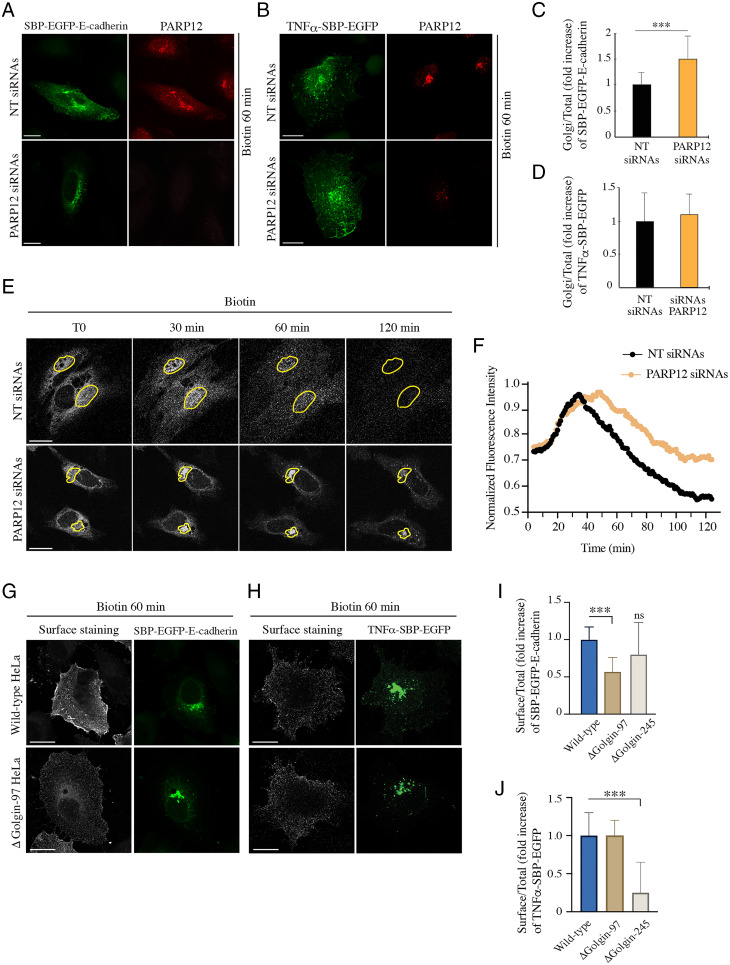
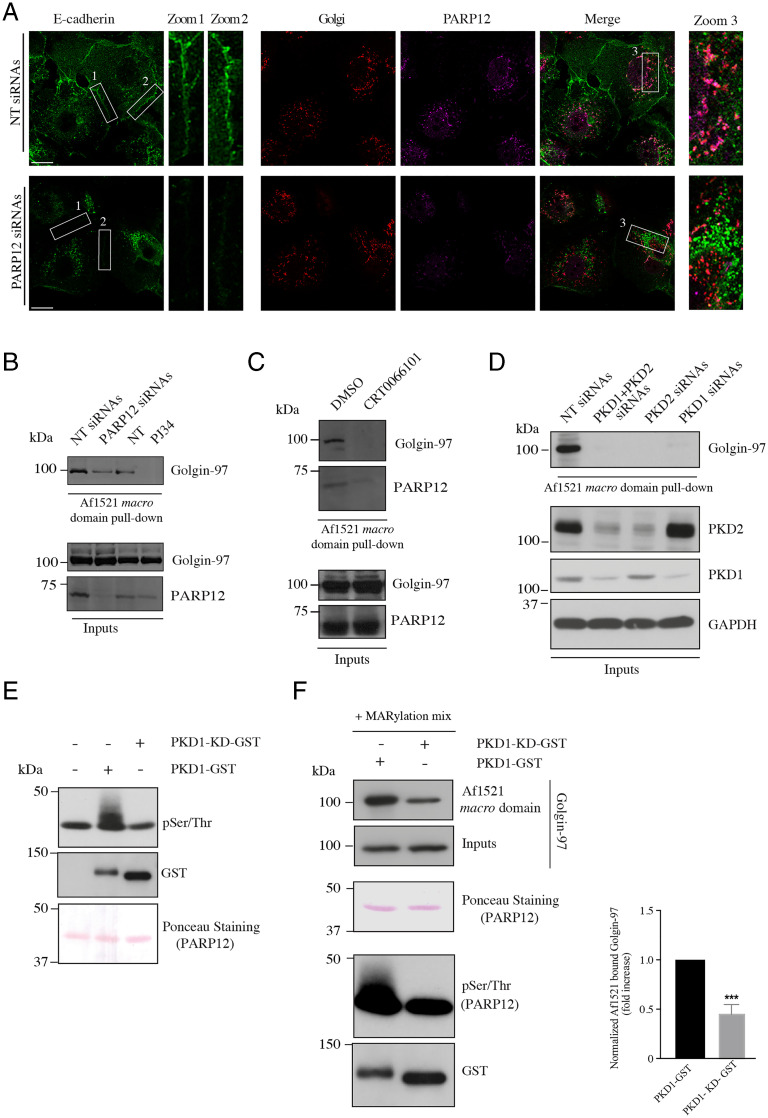
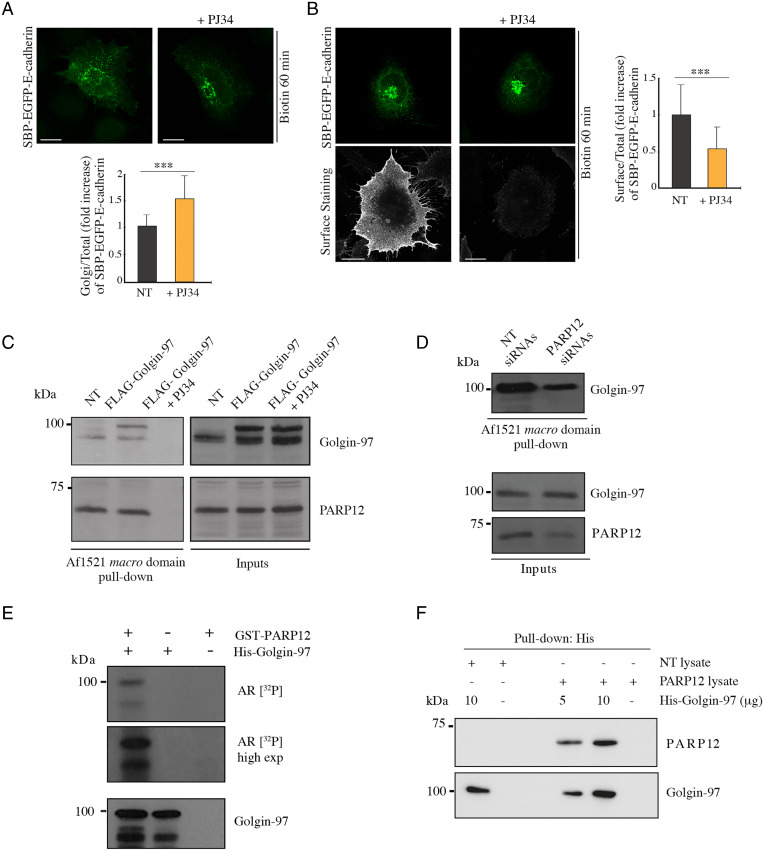
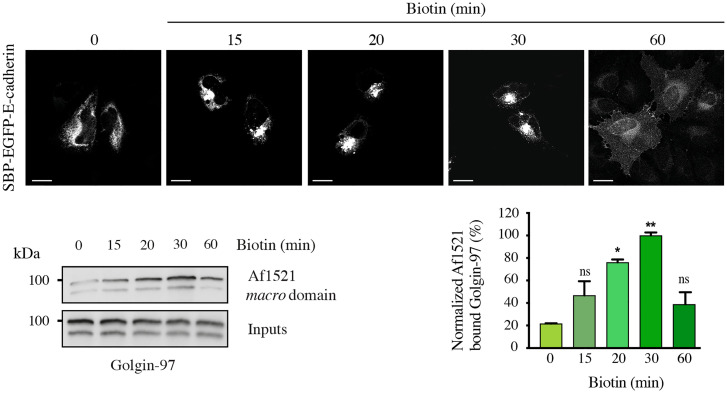
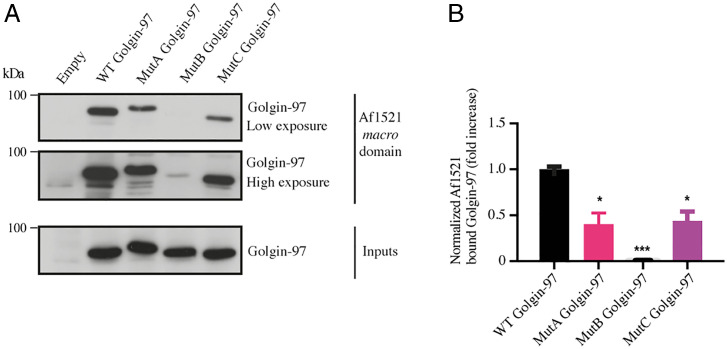
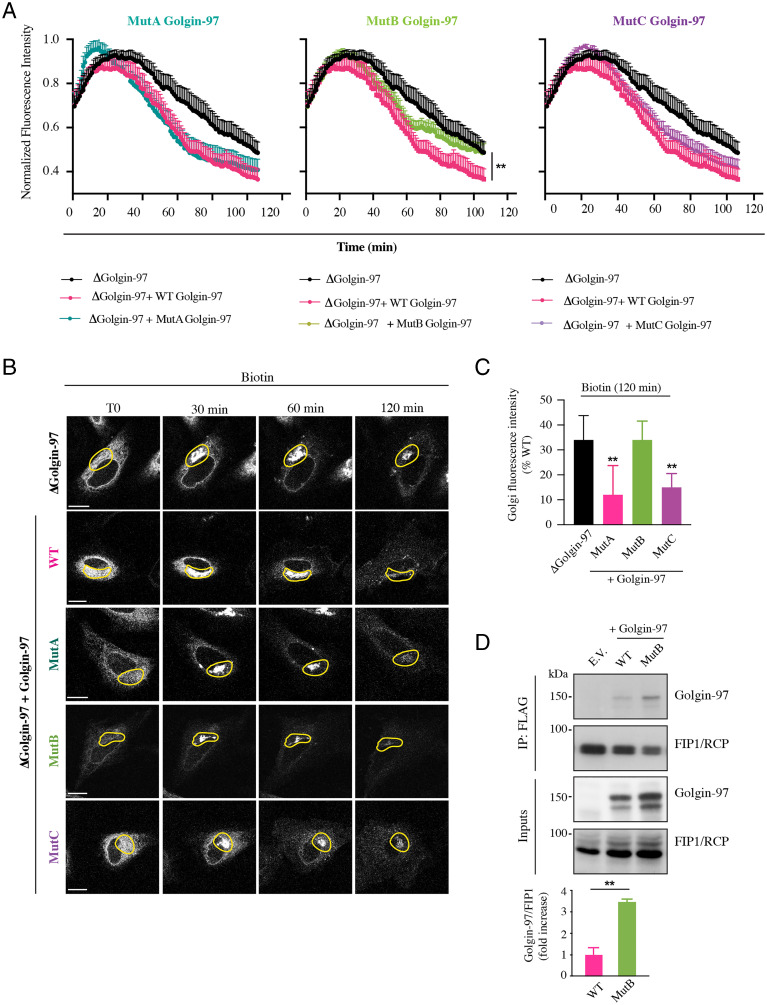
Adenosine diphosphate (ADP)-ribosylation is a posttranslational modification involved in key regulatory events catalyzed by ADP-ribosyltransferases (ARTs). Substrate identification and localization of the mono-ADP-ribosyltransferase PARP12 at the -Golgi network (TGN) hinted at the involvement of ARTs in intracellular traffic. We find that Golgin-97, a TGN protein required for the formation and transport of a specific class of basolateral cargoes (e.g., E-cadherin and vesicular stomatitis virus G protein [VSVG]), is a PARP12 substrate. PARP12 targets an acidic cluster in the Golgin-97 coiled-coil domain essential for function. Its mutation or PARP12 depletion, delays E-cadherin and VSVG export and leads to a defect in carrier fission, hence in transport, with consequent accumulation of cargoes in a -Golgi/Rab11-positive intermediate compartment. In contrast, PARP12 does not control the Golgin-245-dependent traffic of cargoes such as tumor necrosis factor alpha (TNFα). Thus, the transport of different basolateral proteins to the plasma membrane is differentially regulated by Golgin-97 mono-ADP-ribosylation by PARP12. This identifies a selective regulatory mechanism acting on the transport of Golgin-97- vs. Golgin-245-dependent cargoes. Of note, PARP12 enzymatic activity, and consequently Golgin-97 mono-ADP-ribosylation, depends on the activation of protein kinase D (PKD) at the TGN during traffic. PARP12 is directly phosphorylated by PKD, and this is essential to stimulate PARP12 catalytic activity. PARP12 is therefore a component of the PKD-driven regulatory cascade that selectively controls a major branch of the basolateral transport pathway. We propose that through this mechanism, PARP12 contributes to the maintenance of E-cadherin-mediated cell polarity and cell-cell junctions.
二磷酸腺苷(ADP)-核糖基化是一种翻译后修饰,参与 ADP-核糖基转移酶(ARTs)催化的关键调节事件。单ADP-核糖基转移酶 PARP12 的底物鉴定和在 -高尔基网络(TGN)的定位提示 ART 参与细胞内运输。我们发现,高尔基糖蛋白 97(Golgin-97)是一种 TGN 蛋白,对于特定类别的基底外侧货物(例如 E-钙粘蛋白和水疱性口炎病毒 G 蛋白[VSVG])的形成和运输是必需的,是 PARP12 的底物。PARP12 靶向高尔基体 97 卷曲螺旋结构域中的酸性簇,该簇对于功能至关重要。其突变或 PARP12 耗竭会延迟 E-钙粘蛋白和 VSVG 的输出,并导致载体裂变缺陷,从而导致运输中断,随后货物在 -高尔基/ Rab11 阳性中间隔室中积累。相比之下,PARP12 并不控制高尔基体 245 依赖性货物(如肿瘤坏死因子 alpha(TNFα))的运输。因此,不同基底外侧蛋白向质膜的运输受到 PARP12 对 Golgin-97 的单 ADP-核糖基化的差异调节。这确定了一种选择性调节机制,作用于 Golgin-97-与 Golgin-245 依赖性货物的运输。值得注意的是,PARP12 的酶活性,以及随之而来的 Golgin-97 单 ADP-核糖基化,取决于运输过程中 TGN 上蛋白激酶 D(PKD)的激活。PKD 直接磷酸化 PARP12,这对于刺激 PARP12 的催化活性是必需的。PARP12 因此是 PKD 驱动的调节级联的一个组成部分,该级联选择性地控制基底外侧运输途径的主要分支。我们提出,通过这种机制,PARP12 有助于维持 E-钙粘蛋白介导的细胞极性和细胞-细胞连接。