Wu Su-Ying, Wang Wei-Tsong, Hsiao Ming-Hsuan
Institute of Information Management, National Cheng Kung University, Tainan City, Taiwan.
Kaohsiung Medical University Hospital, Kaohsiung Medical University, Kaohsiung, Taiwan.
Front Psychol. 2021 Dec 14;12:736277. doi: 10.3389/fpsyg.2021.736277. eCollection 2021.
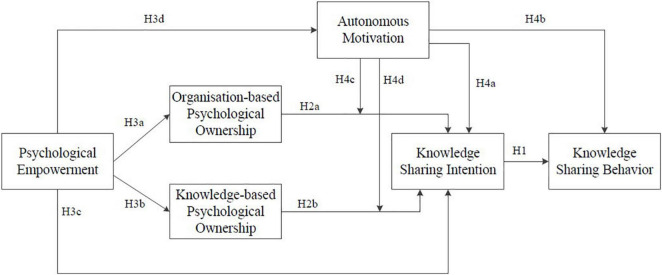
There exists a lack of an understanding of how to facilitate knowledge sharing (KS) behaviors in healthcare organizations. This study is among the first to specifically address this issue through synthesizing psychological ownership (PO), self-determination theory, and psychological empowerment (PE) theory. This study developed a research model that described the impact of the psychological and motivational facilitating factors, including autonomous motivation, user PE, and PO on knowledge sharing intention (KSI) and knowledge sharing behavior (KSB). Data collected from 343 healthcare professionals were analyzed using the technique of partial least squares (PLS) to validate the research model. The results indicated that user PE, organization-based PO, and autonomous motivation all had significant direct/indirect positive effects on KSI and KSB as we hypothesized. Surprisingly, knowledge-based PO had a significant positive effect on KSI, which contradicted our original hypothesis. The implications for theory and for practice, limitations, and future research directions are discussed accordingly.
目前对于如何促进医疗保健组织中的知识共享(KS)行为缺乏理解。本研究是首批通过综合心理所有权(PO)、自我决定理论和心理授权(PE)理论来专门解决这一问题的研究之一。本研究构建了一个研究模型,该模型描述了包括自主动机、用户心理授权和心理所有权在内的心理和动机促进因素对知识共享意愿(KSI)和知识共享行为(KSB)的影响。使用偏最小二乘法(PLS)技术对从343名医疗保健专业人员收集的数据进行分析,以验证该研究模型。结果表明,正如我们所假设的,用户心理授权、基于组织的心理所有权和自主动机对知识共享意愿和知识共享行为均具有显著的直接/间接正向影响。令人惊讶的是,基于知识的心理所有权对知识共享意愿具有显著的正向影响,这与我们最初的假设相矛盾。据此讨论了本研究对理论和实践的启示、局限性以及未来的研究方向。