Obrenovic Bojan, Jianguo Du, Tsoy Diana, Obrenovic Slobodan, Khan Muhammad Aamir Shafique, Anwar Farooq
School of Management, Jiangsu University, Zhenjiang, China.
School of Media and Communication, Shanghai Jiao Tong University, Shanghai, China.
Front Psychol. 2020 Jul 16;11:1496. doi: 10.3389/fpsyg.2020.01496. eCollection 2020.
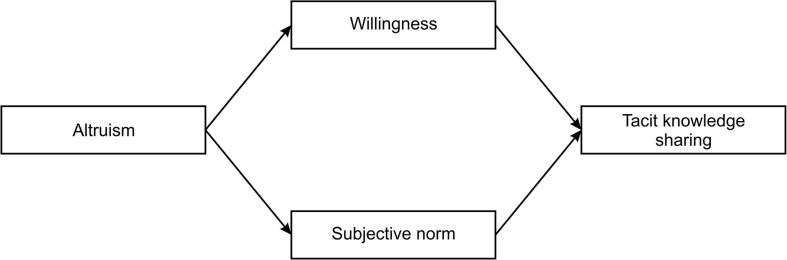
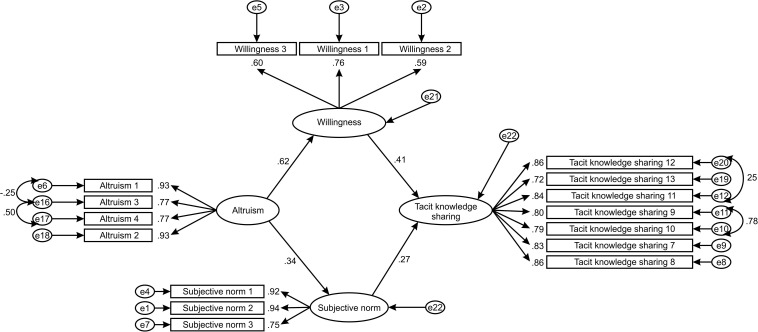
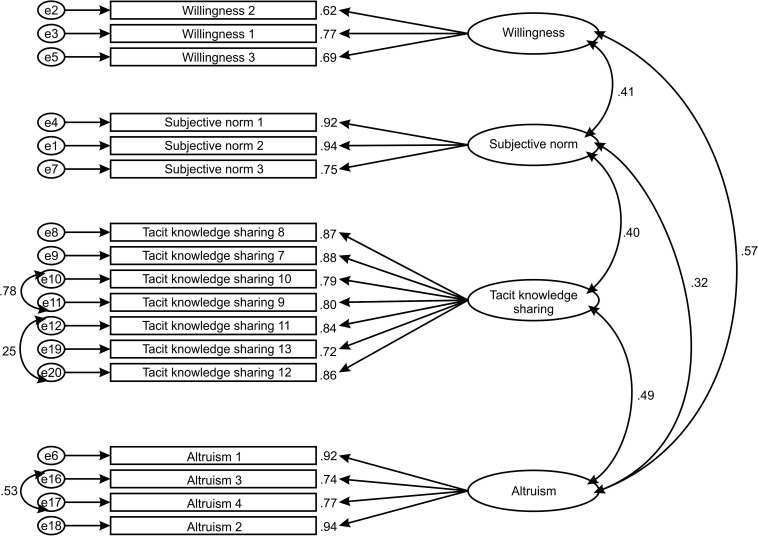
Knowledge sharing between individuals is a key process for knowledge-intensive organizations to create value and gain a competitive edge. An individual is in the center of a complex set of factors, which are conducive to the knowledge-sharing process. The purpose of this empirical study is to explain the interaction mechanisms between personality and knowledge-sharing behavior and to examine the mediating effects of willingness to share knowledge and subjective norm. The theory of planned behavior, the social exchange theory, and the big five personality traits theory are combined to explain tacit knowledge-sharing behavior. A survey strategy and purposive sampling was applied, and the analysis was conducted on a sample of 288 employees from Croatia working on knowledge-intensive tasks for which high levels of tacit knowledge sharing are characteristic. A standard online questionnaire consisted of items evaluated on a 7-point Likert-scale, ranging from strongly agree (7) to strongly disagree (1). In the structural model, relationships between altruism, willingness, subjective norm, and tacit knowledge sharing were tested. Confirmatory factor analysis with maximum likelihood estimation was performed by using SEM software AMOS version 23. The findings of the study suggest that altruism has a direct impact on tacit knowledge sharing, reaffirming a relationship with knowledge sharing but distinguishing between sharing of different types of knowledge, assessing tacit knowledge sharing as a construct separate from general knowledge sharing. Our findings suggest that willingness to share is a predictive factor of knowledge sharing behavior between employees, having both direct impact on tacit knowledge sharing and being a mediator between the trait of altruism and tacit knowledge sharing. The mediation test also indicates that altruism has an indirect influence on tacit knowledge sharing when subjective norm was a mediator. The findings suggest that personality traits relying on social capital, such as altruism, have more influence on tacit knowledge sharing compared to personality traits that have accentuated intrinsic components. The study contributes to the better understanding of factors stimulating knowledge-sharing behaviors and provides recommendations based on empirical evidence, which may later be applied in the development of knowledge-sharing leadership styles, employee hiring, and auxiliary initiatives.
个体之间的知识共享是知识密集型组织创造价值和获得竞争优势的关键过程。个体处于一系列复杂因素的中心,这些因素有利于知识共享过程。本实证研究的目的是解释个性与知识共享行为之间的相互作用机制,并检验知识共享意愿和主观规范的中介作用。将计划行为理论、社会交换理论和大五人格特质理论结合起来解释隐性知识共享行为。采用了调查策略和目的抽样法,对来自克罗地亚的288名从事知识密集型任务的员工样本进行了分析,这些任务具有高水平隐性知识共享的特点。一份标准的在线问卷由在7点李克特量表上评估的项目组成,从强烈同意(7)到强烈不同意(1)。在结构模型中,测试了利他主义、意愿、主观规范和隐性知识共享之间的关系。使用SEM软件AMOS 23版本进行了最大似然估计的验证性因素分析。研究结果表明,利他主义对隐性知识共享有直接影响,重申了与知识共享的关系,但区分了不同类型知识的共享,将隐性知识共享评估为与一般知识共享不同的结构。我们的研究结果表明,共享意愿是员工之间知识共享行为的一个预测因素,对隐性知识共享既有直接影响,又是利他主义特质与隐性知识共享之间的中介。中介测试还表明,当主观规范作为中介时,利他主义对隐性知识共享有间接影响。研究结果表明,与强调内在成分的人格特质相比,依赖社会资本的人格特质,如利他主义,对隐性知识共享的影响更大。该研究有助于更好地理解刺激知识共享行为的因素,并根据实证证据提供建议,这些建议随后可能应用于知识共享领导风格的发展、员工招聘和辅助举措。