Department of Radiology, The Second Affiliated Hospital, Zhejiang University School of Medicine, Hangzhou, China.
Department of Neurology, The Second Affiliated Hospital, Zhejiang University School of Medicine, Hangzhou, China.
Hum Brain Mapp. 2022 Apr 15;43(6):1984-1996. doi: 10.1002/hbm.25768. Epub 2021 Dec 31.
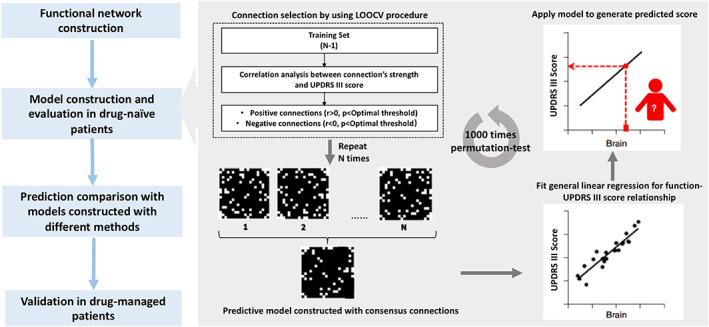
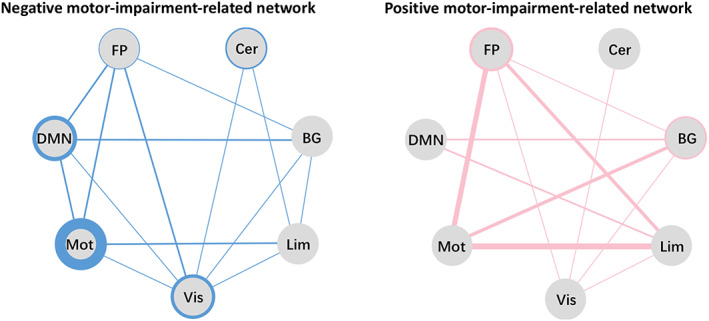
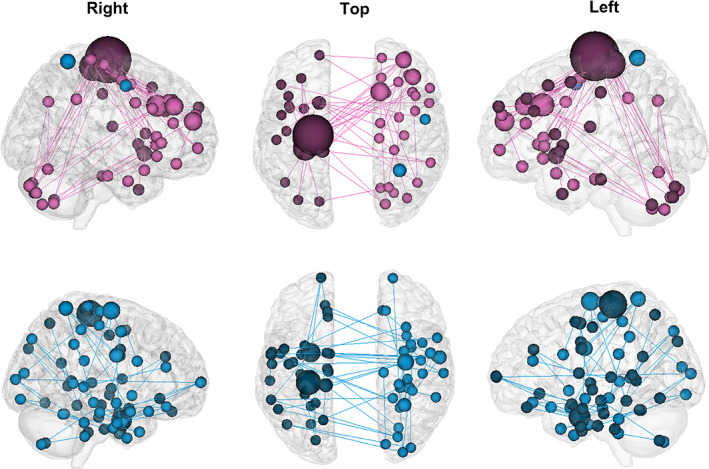
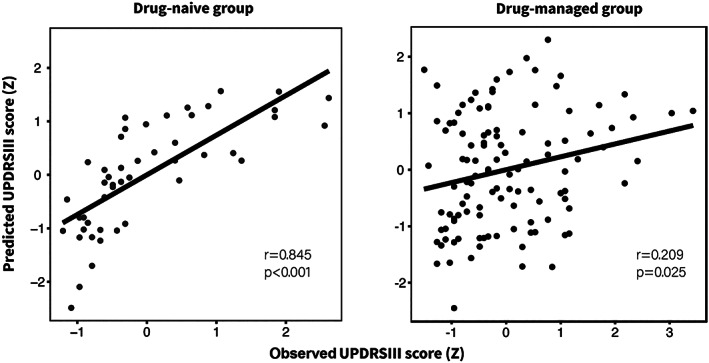
Identifying a whole-brain connectome-based predictive model in drug-naïve patients with Parkinson's disease and verifying its predictions on drug-managed patients would be useful in determining the intrinsic functional underpinnings of motor impairment and establishing general brain-behavior associations. In this study, we constructed a predictive model from the resting-state functional data of 47 drug-naïve patients by using a connectome-based approach. This model was subsequently validated in 115 drug-managed patients. The severity of motor impairment was assessed by calculating Unified Parkinson's Disease Rating Scale Part III scores. The predictive performance of model was evaluated using the correlation coefficient (r ) between predicted and observed scores. As a result, a connectome-based model for predicting individual motor impairment in drug-naïve patients was identified with significant performance (r = .845, p < .001, p = .002). Two patterns of connection were identified according to correlations between connection strength and the severity of motor impairment. The negative motor-impairment-related network contained more within-network connections in the motor, visual-related, and default mode networks, whereas the positive motor-impairment-related network was constructed mostly with between-network connections coupling the motor-visual, motor-limbic, and motor-basal ganglia networks. Finally, this predictive model constructed around drug-naïve patients was confirmed with significant predictive efficacy on drug-managed patients (r = .209, p = .025), suggesting a generalizability in Parkinson's disease patients under long-term drug influence. In conclusion, this study identified a whole-brain connectome-based model that could predict the severity of motor impairment in Parkinson's patients and furthers our understanding of the functional underpinnings of the disease.
识别基于全脑连接组的预测模型在未经药物治疗的帕金森病患者中,并验证其对药物管理患者的预测,这对于确定运动障碍的内在功能基础和建立一般的大脑-行为关联将非常有用。在这项研究中,我们使用基于连接组的方法从 47 名未经药物治疗的患者的静息态功能数据中构建了一个预测模型。该模型随后在 115 名接受药物治疗的患者中进行了验证。通过计算统一帕金森病评定量表第三部分的分数来评估运动障碍的严重程度。使用预测分数和观察分数之间的相关系数(r)来评估模型的预测性能。结果,确定了一种基于连接组的模型,可预测未经药物治疗的患者个体运动障碍,其性能具有显著意义(r=0.845,p<0.001,p=0.002)。根据连接强度与运动障碍严重程度之间的相关性,确定了两种连接模式。负的运动障碍相关网络在运动、视觉相关和默认模式网络中包含更多的内联网连接,而正的运动障碍相关网络主要由连接运动-视觉、运动-边缘和运动-基底节网络的网间连接构成。最后,这个在未经药物治疗的患者周围构建的预测模型在药物管理的患者中被证实具有显著的预测效力(r=0.209,p=0.025),这表明该模型在长期药物影响下的帕金森病患者中具有普遍性。总之,这项研究确定了一种基于全脑连接组的模型,可以预测帕金森病患者运动障碍的严重程度,并进一步加深了我们对该疾病功能基础的理解。