Department of Ophthalmology, Kobe City Eye Hospital, Kobe, Japan.
Department of Ophthalmology, Kobe City Medical Center General Hospital, Kobe, Japan.
Eye (Lond). 2023 Jan;37(1):42-47. doi: 10.1038/s41433-021-01878-3. Epub 2022 Jan 1.
To predict the visual prognosis of cataract surgery in patients with retinitis pigmentosa by measuring ellipsoid zone (EZ) width using spectral-domain optical coherence tomography.
This retrospective study included patients with retinitis pigmentosa who underwent uncomplicated cataract surgery between December 2017 and June 2020. Preoperative best-corrected visual acuity (BCVA) and the best postoperative BCVA during follow-up were collected. EZ width was measured on preoperative cross-sectional optical coherence tomography images along the horizontal/vertical meridian through the fovea.
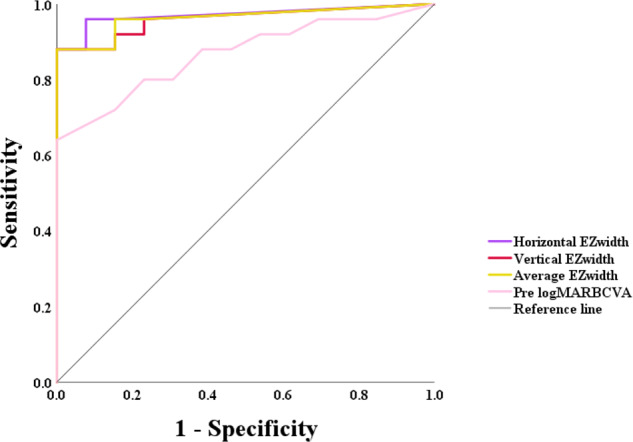
Thirty-eight eyes of 38 patients (22 female; mean [±standard deviation] age, 62.1 ± 11.8 years) were included. The median preoperative logarithm of the minimum angle of resolution BCVA of 0.52 (range, 0.00-3.00) significantly improved to 0.07 (range, -0.18-3.00) after surgery (P < 0.001). On preoperative spectral-domain optical coherence tomography images, the median horizontal, vertical, and average EZ widths were 783 (range, 0-9837), 761 (range, 0-10 250), and 769 (range, 0-10 043) μm, respectively. Postoperative BCVA significantly correlated with the horizontal (r = -0.784, P < 0.001), vertical (r = -0.777, P < 0.001), and average EZ widths (r = -0.777, P < 0.001). The area under the receiver operating characteristic curve for the ability of the horizontal, vertical, and average EZ widths to discriminate eyes with and without postoperative BCVA ≤ 0.3 was 0.971, 0.960, and 0.963, respectively, with best cut-off values of 513, 608, and 515 μm, respectively.
EZ width measurement can help predict the visual prognosis of cataract surgery in patients with retinitis pigmentosa. A preferable visual acuity prognosis can be expected in patients with an EZ width of approximately 600 μm.
通过测量频域光相干断层扫描的椭圆体带(EZ)宽度,预测色素性视网膜炎患者白内障手术的视力预后。
本回顾性研究纳入了 2017 年 12 月至 2020 年 6 月间接受单纯白内障手术的色素性视网膜炎患者。收集术前最佳矫正视力(BCVA)和随访期间最佳术后 BCVA。在术前的横断面光相干断层扫描图像上,通过黄斑的水平/垂直子午线测量 EZ 宽度。
共纳入 38 只眼(22 只眼为女性;平均[±标准差]年龄为 62.1±11.8 岁)。术前最小分辨角对数视力的中位数为 0.52(范围,0.00-3.00),术后显著改善至 0.07(范围,-0.18-3.00)(P<0.001)。在术前的频域光相干断层扫描图像上,水平、垂直和平均 EZ 宽度的中位数分别为 783(范围,0-9837)、761(范围,0-10250)和 769(范围,0-10043)μm。术后 BCVA 与水平(r=-0.784,P<0.001)、垂直(r=-0.777,P<0.001)和平均 EZ 宽度(r=-0.777,P<0.001)显著相关。水平、垂直和平均 EZ 宽度预测术后 BCVA≤0.3 的能力的受试者工作特征曲线下面积分别为 0.971、0.960 和 0.963,最佳截断值分别为 513、608 和 515μm。
EZ 宽度测量有助于预测色素性视网膜炎患者白内障手术的视力预后。预计 EZ 宽度约为 600μm 的患者视力预后较好。