Aguglia Andrea, Fusar-Poli Laura, Amerio Andrea, Placenti Valeria, Concerto Carmen, Martinotti Giovanni, Carrà Giuseppe, Bartoli Francesco, D'Agostino Armando, Serafini Gianluca, Amore Mario, Aguglia Eugenio, Ostuzzi Giovanni, Barbui Corrado
Department of Neuroscience, Rehabilitation, Ophthalmology, Genetics, Maternal and Child Health, Section of Psychiatry, Istituto di Ricovero e Cura a Carattere Scientifico (IRCCS) Ospedale Policlinico San Martino, University of Genoa, Genoa, Italy.
Istituto di Ricovero e Cura a Carattere Scientifico (IRCCS) Ospedale Policlinico San Martino, Genoa, Italy.
Front Psychiatry. 2021 Dec 16;12:784366. doi: 10.3389/fpsyt.2021.784366. eCollection 2021.
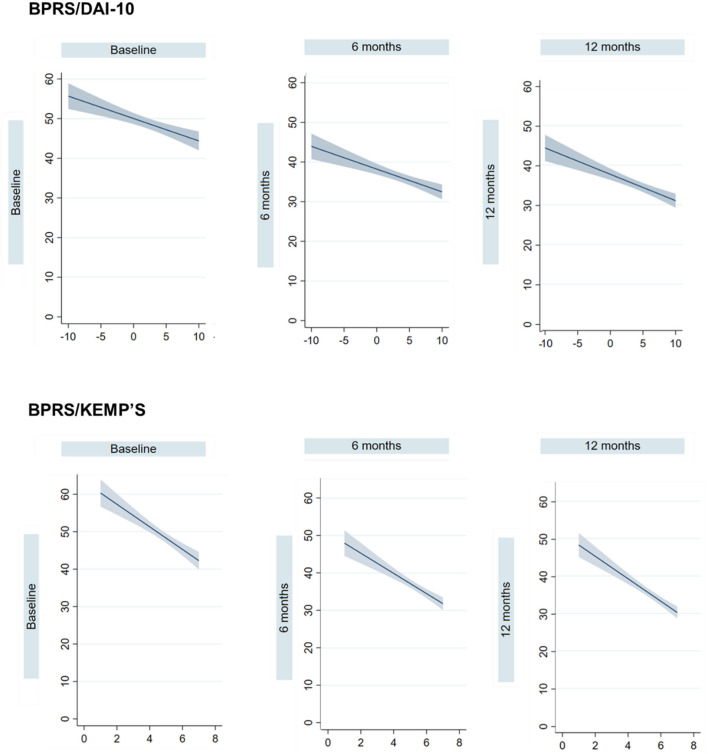
Long-acting injectable (LAI) antipsychotics are efficacious in managing psychotic symptoms in people affected by severe mental disorders, such as schizophrenia and bipolar disorder. The present study aimed to investigate whether attitude toward treatment and treatment adherence represent predictors of symptoms changes over time. The STAR Network "Depot Study" was a naturalistic, multicenter, observational, prospective study that enrolled people initiating a LAI without restrictions on diagnosis, clinical severity or setting. Participants from 32 Italian centers were assessed at three time points: baseline, 6-month, and 12-month follow-up. Psychopathological symptoms, attitude toward medication and treatment adherence were measured using the Brief Psychiatric Rating Scale (BPRS), the Drug Attitude Inventory (DAI-10) and the Kemp's 7-point scale, respectively. Linear mixed-effects models were used to evaluate whether attitude toward medication and treatment adherence independently predicted symptoms changes over time. Analyses were conducted on the overall sample and then stratified according to the baseline severity (BPRS < 41 or BPRS ≥ 41). We included 461 participants of which 276 were males. The majority of participants had received a primary diagnosis of a schizophrenia spectrum disorder (71.80%) and initiated a treatment with a second-generation LAI (69.63%). BPRS, DAI-10, and Kemp's scale scores improved over time. Six linear regressions-conducted considering the outcome and predictors at baseline, 6-month, and 12-month follow-up independently-showed that both DAI-10 and Kemp's scale negatively associated with BPRS scores at the three considered time points. Linear mixed-effects models conducted on the overall sample did not show any significant association between attitude toward medication or treatment adherence and changes in psychiatric symptoms over time. However, after stratification according to baseline severity, we found that both DAI-10 and Kemp's scale negatively predicted changes in BPRS scores at 12-month follow-up regardless of baseline severity. The association at 6-month follow-up was confirmed only in the group with moderate or severe symptoms at baseline. Our findings corroborate the importance of improving the quality of relationship between clinicians and patients. Shared decision making and thorough discussions about benefits and side effects may improve the outcome in patients with severe mental disorders.
长效注射用(LAI)抗精神病药物在治疗受严重精神障碍影响的人群(如精神分裂症和双相情感障碍患者)的精神病症状方面疗效显著。本研究旨在调查对治疗的态度和治疗依从性是否可预测症状随时间的变化。STAR网络“长效注射剂研究”是一项自然主义、多中心、观察性前瞻性研究,纳入开始使用长效注射剂的人群,对诊断、临床严重程度或治疗环境没有限制。来自32个意大利中心的参与者在三个时间点接受评估:基线、6个月和12个月随访。分别使用简明精神病评定量表(BPRS)、药物态度量表(DAI - 10)和肯普7分制量表测量精神病理症状、对药物的态度和治疗依从性。使用线性混合效应模型评估对药物的态度和治疗依从性是否能独立预测症状随时间的变化。对总体样本进行分析,然后根据基线严重程度(BPRS < 41或BPRS≥41)进行分层。我们纳入了461名参与者,其中276名是男性。大多数参与者的初步诊断为精神分裂症谱系障碍(71.80%),并开始使用第二代长效注射剂治疗(69.63%)。BPRS、DAI - 10和肯普量表评分随时间改善。分别在基线、6个月和12个月随访时考虑结果和预测因素进行的六项线性回归显示,在三个时间点,DAI - 10和肯普量表均与BPRS评分呈负相关。对总体样本进行的线性混合效应模型未显示对药物的态度或治疗依从性与精神症状随时间的变化之间存在任何显著关联。然而,根据基线严重程度分层后,我们发现无论基线严重程度如何,DAI - 10和肯普量表在12个月随访时均能负向预测BPRS评分的变化。仅在基线时症状为中度或重度的组中证实了6个月随访时的关联。我们的研究结果证实了改善临床医生与患者之间关系质量的重要性。共同决策以及对益处和副作用进行充分讨论可能会改善严重精神障碍患者的治疗结果。