Wang Yunpeng, Mao Jiaoyu, Li Xiaodong, Wang Beibei, Zhou Xiaoguang
Department of Neonatology, Huazhong University of Science and Technology Union Shenzhen Hospital, Shenzhen, Guangdong 518052, P.R. China.
Department of Neonatology, Children's Hospital of Nanjing Medical University, Nanjing, Jiangsu 210008, P.R. China.
Exp Ther Med. 2022 Jan;23(1):99. doi: 10.3892/etm.2021.11022. Epub 2021 Dec 1.
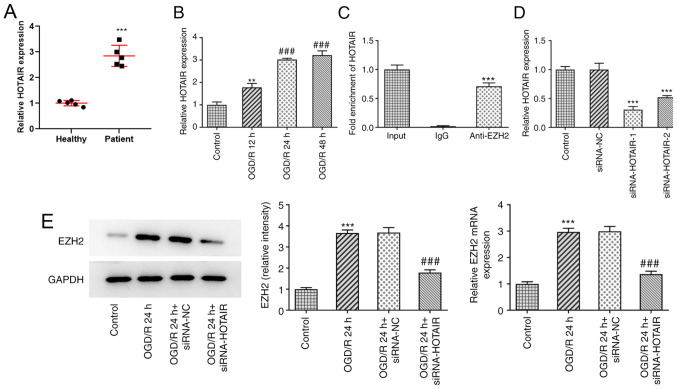
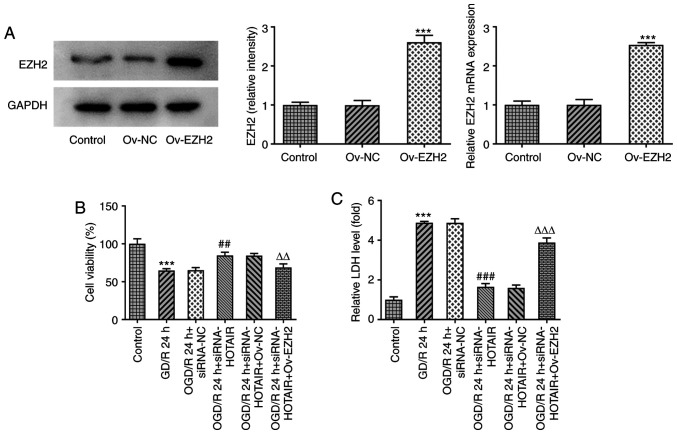
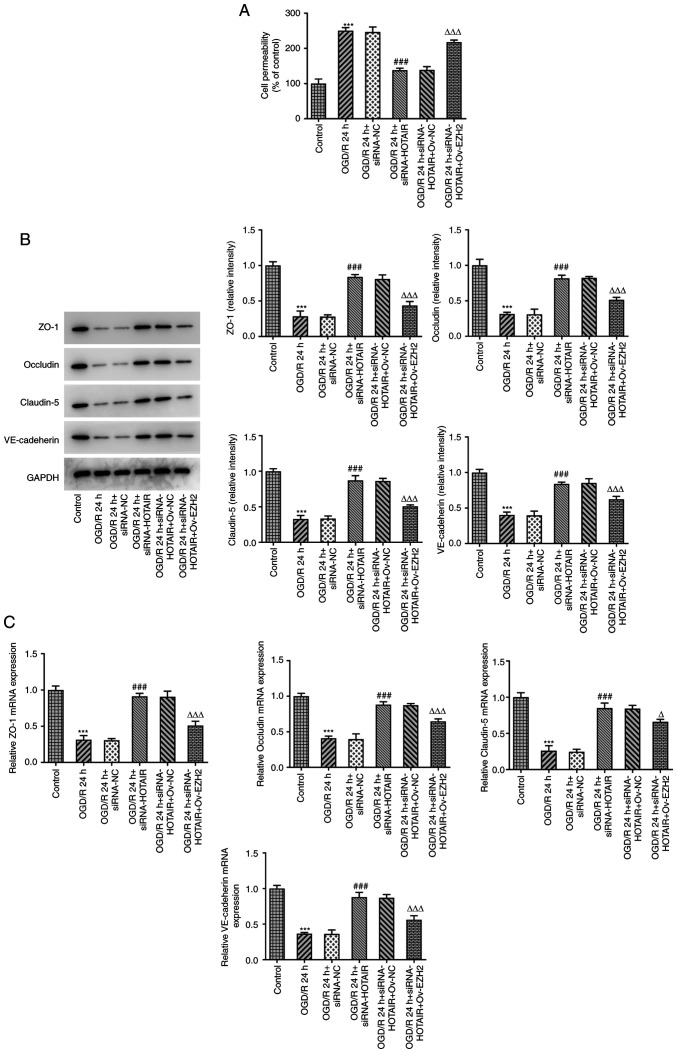
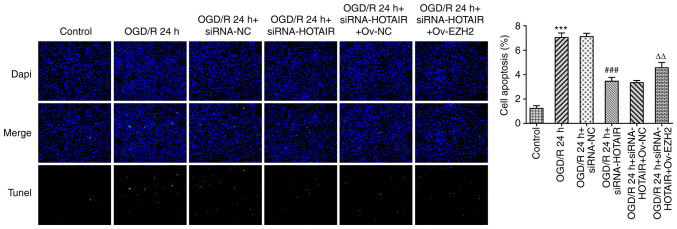
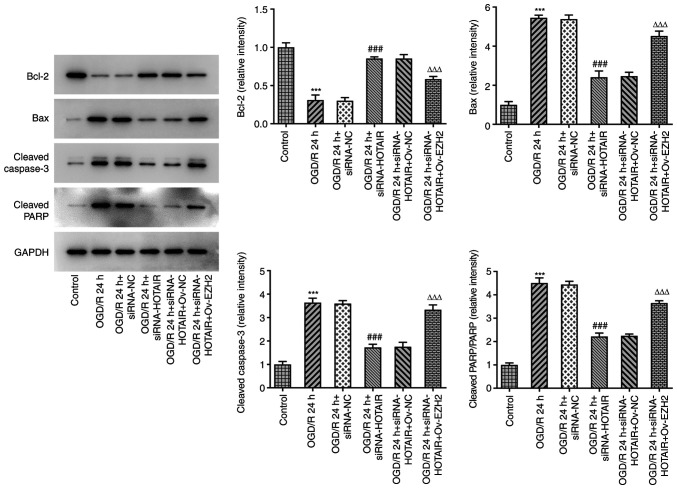
Long non-coding RNAs (lncRNA) serve an important role in neonatal hypoxic-ischemic encephalopathy (HIE) have been reported to regulate the activity of HIE-associated proteins. The present study aimed to elucidate the role of Hox transcript antisense intergenic RNA (HOTAIR) in oxygen-glucose deprivation/reperfusion (OGD/R)-induced injury in human brain microvascular endothelial cells (hBMVECs). The levels of HOTAIR were evaluated in the serum of neonatal patients with HIE, and the effects of HOTAIR were evaluated using assays, such as reverse transcription-quantitative PCR to detect lncRNA and mRNA levels and western blot analysis to determine protein levels. Moreover, RNA immunoprecipitation assays were used to evaluate the association between HOTAIR and enhancer of zeste homolog 2 (EZH2), Cell Counting Kit-8 was used to detect cell viability, an endothelial monolayer cell permeability assay was used to analyze cell viability, TUNEL staining was used to detect the levels of apoptosis, a Transwell assay was used to evaluate cell invasion and a tube formation assay was used to analyze tube formation ability. In addition, the effects of HOTAIR and EZH2 on cell apoptosis and the invasive and tube formation abilities of hBMVECs were investigated using TUNEL, Transwell and tube formation assays, respectively. The results showed that the expression levels of HOTAIR were markedly increased both in neonatal HIE patients and in the OGD/R injury model. HOTAIR knockdown reduced hBMVEC viability, enhanced cell permeability and apoptosis, in addition to decreasing the expression levels of tight junction-related proteins, such as zonula occludens-1, occluden, Claudin5 and vascular endothelial-cadherin. However, EZH2 overexpression reversed the effects of HOTAIR silencing on hBMVECs. Additionally, HOTAIR knockdown enhanced the migratory and tube formation abilities of OGD/R-induced hBMVECs, which were also reversed by EZH2 overexpression. Overall, the present study revealed an association between the HOTAIR/EZH2 axis and brain microvascular endothelial cell injury and angiogenesis, which provides a novel insight into the molecular mechanism underlying stroke or the development of new pharmacotherapies.
据报道,长链非编码RNA(lncRNA)在新生儿缺氧缺血性脑病(HIE)中发挥重要作用,可调节HIE相关蛋白的活性。本研究旨在阐明Hox转录反义基因间RNA(HOTAIR)在氧糖剥夺/复氧(OGD/R)诱导的人脑微血管内皮细胞(hBMVECs)损伤中的作用。评估了新生儿HIE患者血清中HOTAIR的水平,并通过逆转录定量PCR检测lncRNA和mRNA水平、蛋白质免疫印迹分析测定蛋白质水平等实验评估了HOTAIR的作用。此外,采用RNA免疫沉淀实验评估HOTAIR与zeste同源物2增强子(EZH2)之间的关联,使用细胞计数试剂盒-8检测细胞活力,采用内皮单层细胞通透性实验分析细胞活力,用TUNEL染色检测凋亡水平,采用Transwell实验评估细胞侵袭能力,用管腔形成实验分析管腔形成能力。另外,分别使用TUNEL、Transwell和管腔形成实验研究了HOTAIR和EZH2对hBMVECs细胞凋亡以及侵袭和管腔形成能力的影响。结果显示,新生儿HIE患者和OGD/R损伤模型中HOTAIR的表达水平均显著升高。敲低HOTAIR可降低hBMVECs的活力,增强细胞通透性和凋亡,还可降低紧密连接相关蛋白如闭合蛋白-1、咬合蛋白、Claudin5和血管内皮钙黏蛋白的表达水平。然而,EZH2过表达可逆转HOTAIR沉默对hBMVECs的影响。此外,敲低HOTAIR可增强OGD/R诱导的hBMVECs的迁移和管腔形成能力,EZH2过表达也可逆转此作用。总体而言,本研究揭示了HOTAIR/EZH2轴与脑微血管内皮细胞损伤及血管生成之间的关联,为中风的分子机制或新药物治疗的开发提供了新见解。