Fajar Amir, Syarifuddin Erwin, Hendarto Joko, Labeda Ibrahim, Lusikooy Ronald Erasio, Dani Muhammad Iwan, Sampetoding Samuel, Kusuma Muhammad Ihwan, Uwuratuw Julianus Aboyaman, Faruk Muhammad
Division of Digestive, Department of Surgery, Faculty of Medicine, Hasanuddin University, Makassar, Indonesia.
Division of Digestive, Department of Surgery, Dr. Wahidin Sudirohusodo General Hospital, Makassar, Indonesia.
Ann Med Surg (Lond). 2021 Dec 9;73:103166. doi: 10.1016/j.amsu.2021.103166. eCollection 2022 Jan.
An inguinal hernia is a protrusion of abdominal-cavity contents through the inguinal canal. Protection against an inguinal hernia depends on the integrity of fascial tissue, which is maintained by collagen. Collagen is a structural protein consisting of amino acids, the most common of which is glycine. This study aimed to determine the relationship between glycine and the appearance of lateral inguinal hernias. To this end, the researchers examined the profile of collagen and glycine levels in the tissue of the sheath of the rectus femoris in patients with lateral inguinal hernia (indirect inguinal hernia).
The study used a cross-sectional design to determine glycine levels in rectus anterior sheath tissue in patients with indirect inguinal hernia. Examination of collagen glycine levels was conducted using the ELISA (Enzyme-Linked immunosorbent assay) method. Data were analyzed using the Statistical Package for the Social Science (SPSS) program. An ANOVA test, Pearson's correlation test, and Spearman's correlation test were also performed. A p-value <0.05 was said to be significant.
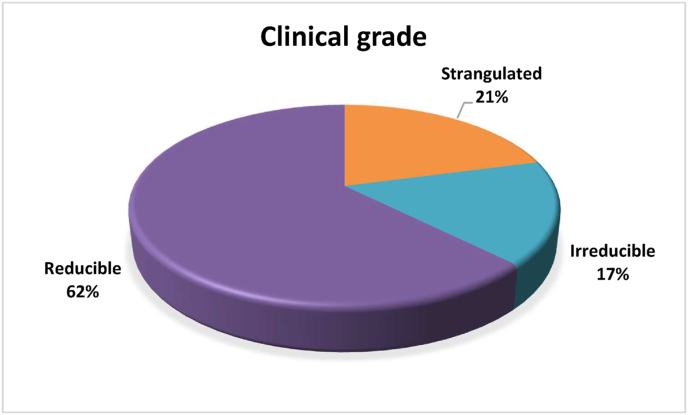
Across 72 samples, the mean body mass index (BMI) was 22.5 kg/m2 and, the mean clinical onset was 28.02 months. Correlation tests showed a correlation between glycine levels and clinical onset (p = 0.026). The ANOVA test showed a difference between glycine levels with age group (p = 0.025) and BMI (p = 0.015). The correlation between glycine levels and clinical-grade (p = 0.416) was not statistically significant.
There is a significant relationship between glycine levels and age, BMI, and clinical onset of indirect inguinal hernia.
腹股沟疝是腹腔内容物通过腹股沟管突出形成的。预防腹股沟疝依赖于筋膜组织的完整性,而筋膜组织由胶原蛋白维持。胶原蛋白是一种由氨基酸组成的结构蛋白,其中最常见的是甘氨酸。本研究旨在确定甘氨酸与外侧腹股沟疝发生之间的关系。为此,研究人员检测了外侧腹股沟疝(间接腹股沟疝)患者股直肌鞘组织中的胶原蛋白和甘氨酸水平。
本研究采用横断面设计来确定间接腹股沟疝患者腹直肌前鞘组织中的甘氨酸水平。使用酶联免疫吸附测定(ELISA)法检测胶原蛋白甘氨酸水平。数据使用社会科学统计软件包(SPSS)程序进行分析。还进行了方差分析、Pearson相关检验和Spearman相关检验。p值<0.05被认为具有统计学意义。
在72个样本中,平均体重指数(BMI)为22.5kg/m²,平均临床发病时间为28.02个月。相关性检验显示甘氨酸水平与临床发病时间之间存在相关性(p = 0.026)。方差分析显示甘氨酸水平在不同年龄组(p = 0.025)和BMI(p = 0.015)之间存在差异。甘氨酸水平与临床分级之间的相关性(p = 0.416)无统计学意义。
甘氨酸水平与间接腹股沟疝的年龄、BMI和临床发病时间之间存在显著关系。