Chihuri Stanford T, Youdan Gregory A, Wong Christopher K
Columbia University, Mailman School of Public Health, 722 West 168 Street, New York, NY 10032, USA.
Teachers College Columbia University, Biobehavioral Sciences, 1152B Thorndike Hall Box 5, New York, NY 10027, USA.
Prev Med Rep. 2021 Nov 2;24:101626. doi: 10.1016/j.pmedr.2021.101626. eCollection 2021 Dec.
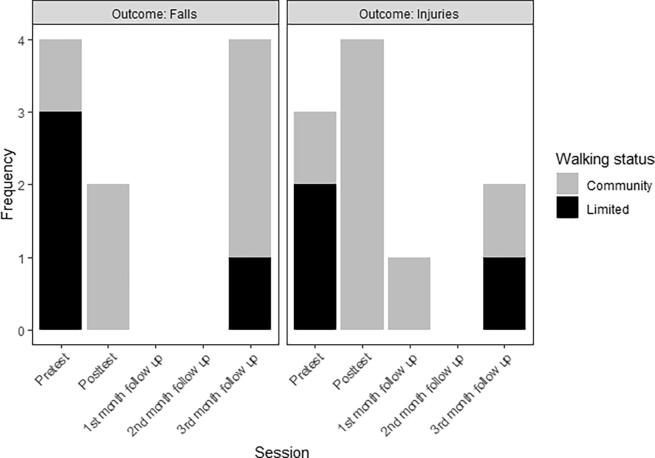
People with lower-limb loss (PLL) have high annual fall and injury rates. People with transtibial amputations have better walking function than those with transfemoral amputations but paradoxically incur more fall-related injuries. Risk exposure, however, has not been previously considered. This study examined whether all-cause fall and injury incidence per person-step exposure over time varied in PLL of different walking abilities. The prospective cohort design, conducted at a major medical center, included five assessments 1-month apart. Walking ability level was categorized by Houghton Scale scores: ≥9 indicating community walking and ≤ 8 indicating limited community-household walking. Accelerometer-measured daily step counts were collected via StepWatch4 monitors. The main outcome measures, self-reported all-cause falls and injuries were assessed using the standard National Health Injury Survey. Generalized estimating equations, using Poisson distributions and log of step count as an offset, determined fall and injury incidence rate ratio [IRR] according to walking ability level. Ten people, aged 33-63 years with amputations of different causes and levels, were assessed monthly over five months. The community walking group (n = 6) had six falls and seven injuries; the limited community walking group (n = 4) had four falls and three injuries. For PLL, limited community walking ability was associated with higher incidence of falls (IRR = 6.10, 95%CI = 1.12-33.33, p = 0.037) and injuries (IRR = 8.56, 95%CI = 1.73-42.40, p = 0.009) when accounting for person-steps. Considering per person-step exposure over time added precision to fall and injury risk assessment that clarified the risks: PLL with limited community walking ability have higher fall and injury risks.
下肢缺失患者(PLL)每年的跌倒和受伤率都很高。经胫骨截肢患者的行走功能比经股骨截肢患者更好,但矛盾的是,前者与跌倒相关的损伤更多。然而,此前尚未考虑风险暴露因素。本研究调查了不同行走能力的PLL患者随着时间推移每人每步暴露的全因跌倒和受伤发生率是否存在差异。在一家大型医疗中心进行的前瞻性队列研究设计包括相隔1个月的5次评估。行走能力水平根据霍顿量表评分进行分类:≥9分表示可在社区行走,≤8分表示社区 - 家庭行走受限。通过StepWatch4监测器收集加速度计测量的每日步数。主要结局指标,即自我报告的全因跌倒和受伤情况,使用标准的国家健康伤害调查进行评估。使用泊松分布并以步数的对数作为偏移量的广义估计方程,根据行走能力水平确定跌倒和受伤发生率比[IRR]。10名年龄在33 - 63岁、因不同原因和水平截肢的患者在5个月内每月接受评估。社区行走组(n = 6)有6次跌倒和7次受伤;社区 - 家庭行走受限组(n = 4)有4次跌倒和3次受伤。对于PLL患者,在考虑每人步数时,社区 - 家庭行走能力受限与更高的跌倒发生率(IRR = 6.10,95%CI = 1.12 - 33.33,p = 0.037)和受伤发生率(IRR = 8.56,95%CI = 1.73 - 42.40,p = 0.009)相关。考虑随着时间推移的每人每步暴露增加了跌倒和受伤风险评估的精确度,明确了风险:社区 - 家庭行走能力受限的PLL患者有更高的跌倒和受伤风险。