Human Physiology and Sports Physiotherapy research group, Vrije Universiteit Brussel, Brussels, Belgium.
BruBotics, Vrije Universiteit Brussel, Brussels, Belgium.
PLoS One. 2024 Mar 21;19(3):e0299869. doi: 10.1371/journal.pone.0299869. eCollection 2024.
Lower limb amputation contributes to structural and functional brain alterations, adversely affecting gait, balance, and overall quality of life. Therefore, selecting an appropriate prosthetic ankle is critical in enhancing the well-being of these individuals. Despite the availability of various prostheses, their impact on brain neuroplasticity remains poorly understood.
The primary objective is to examine differences in the degree of brain neuroplasticity using magnetic resonance imaging (MRI) between individuals wearing a new passive ankle prosthesis with an articulated ankle joint and a standard passive prosthesis, and to examine changes in brain neuroplasticity within these two prosthetic groups. The second objective is to investigate the influence of prosthetic type on walking performance and quality of life. The final objective is to determine whether the type of prosthesis induces differences in the walking movement pattern.
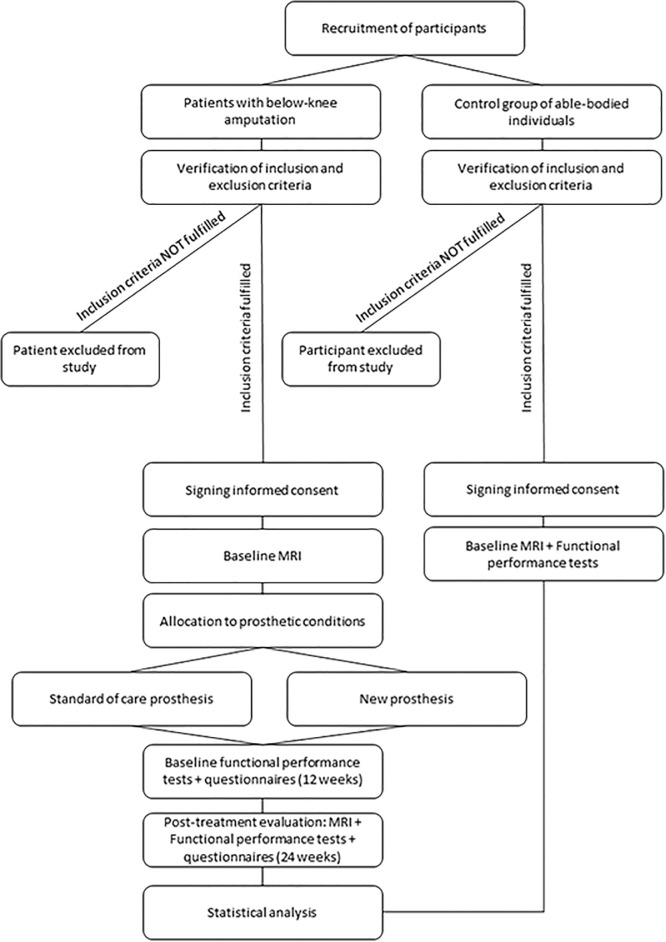
Participants with a unilateral transtibial amputation will follow a 24-week protocol. Prior to rehabilitation, baseline MRI scans will be performed, followed by allocation to the intervention arms and commencement of rehabilitation. After 12 weeks, baseline functional performance tests and a quality of life questionnaire will be administered. At the end of the 24-week period, participants will undergo the same MRI scans, functional performance tests and questionnaire to evaluate any changes. A control group of able-bodied individuals will be included for comparative analysis.
This study aims to unravel the differences in brain neuroplasticity and prosthesis type in patients with a unilateral transtibial amputation and provide insights into the therapeutic benefits of prosthetic devices. The findings could validate the therapeutic benefits of more advanced lower limb prostheses, potentially leading to a societal impact ultimately improving the quality of life for individuals with lower limb amputation.
NCT05818410 (Clinicaltrials.gov).
下肢截肢会导致大脑结构和功能发生改变,从而对步态、平衡和整体生活质量产生不利影响。因此,选择合适的假肢对于提高这些人的幸福感至关重要。尽管有各种假肢可供选择,但它们对大脑神经可塑性的影响仍知之甚少。
本研究旨在使用磁共振成像(MRI)检查穿戴关节式踝部假肢的新型被动踝关节假肢和标准被动假肢的个体之间大脑神经可塑性程度的差异,并研究这两种假肢组内大脑神经可塑性的变化。第二个目的是研究假肢类型对步行性能和生活质量的影响。最后一个目的是确定假肢类型是否会导致步行运动模式的差异。
单侧胫骨截肢患者将遵循 24 周的方案。在康复前进行基线 MRI 扫描,然后分配到干预组并开始康复。12 周后,进行基线功能性能测试和生活质量问卷调查。在 24 周结束时,对参与者进行相同的 MRI 扫描、功能性能测试和问卷调查,以评估任何变化。还将纳入一组健康的对照组进行比较分析。
本研究旨在揭示单侧胫骨截肢患者大脑神经可塑性和假肢类型的差异,并深入了解假肢设备的治疗效果。研究结果可能会验证更先进的下肢假肢的治疗效果,从而可能对社会产生影响,最终提高下肢截肢患者的生活质量。
NCT05818410(Clinicaltrials.gov)。