Hupin David, Sarajlic Philip, Venkateshvaran Ashwin, Fridén Cecilia, Nordgren Birgitta, Opava Christina H, Lundberg Ingrid E, Bäck Magnus
Translational Cardiology, Center for Molecular Medicine, Karolinska Institutet, Stockholm, Sweden.
Department of Medicine Solna, Karolinska Institutet, Stockholm, Sweden.
Front Med (Lausanne). 2021 Dec 15;8:788243. doi: 10.3389/fmed.2021.788243. eCollection 2021.
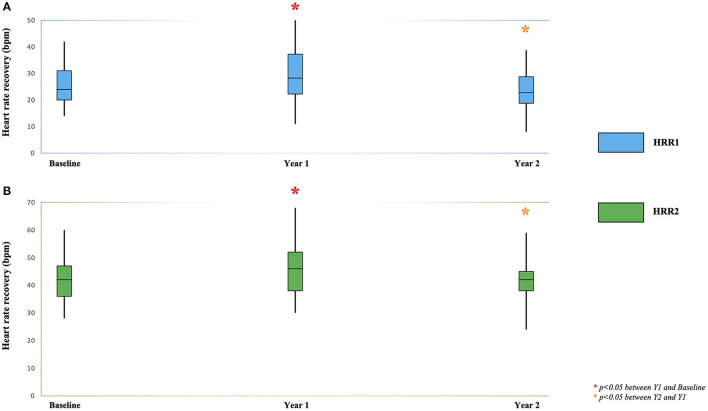
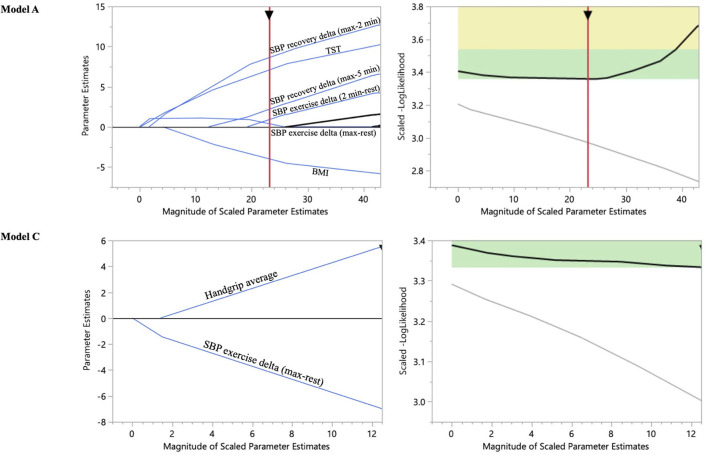
Chronic inflammation leads to autonomic dysfunction, which may contribute to the increased risk of cardiovascular diseases (CVD) in patients with rheumatoid arthritis (RA). Exercise is known to restore autonomic nervous system (ANS) activity and particularly its parasympathetic component. A practical clinical tool to assess autonomic function, and in particular parasympathetic tone, is heart rate recovery (HRR). The aim of this substudy from the prospective PARA 2010 study was to determine changes in HRR post-maximal exercise electrocardiogram (ECG) after a 2-year physical activity program and to determine the main predictive factors associated with effects on HRR in RA. Twenty-five participants performed physiotherapist-guided aerobic and muscle-strengthening exercises for 1 year and were instructed to continue the unsupervised physical activity program autonomously in the next year. All participants were examined at baseline and at years 1 and 2 with a maximal exercise ECG on a cycle ergometer. HRR was measured at 1, 2, 3, 4, and 5 min following peak heart rate during exercise. Machine-learning algorithms with the elastic net linear regression models were performed to predict changes in HRR1 and HRR2 at 1 year and 2 years of the PARA program. Mean age was 60 years, range of 41-73 years (88% women). Both HRR1 and HRR2 increased significantly from baseline to year 1 with guided physical activity and decreased significantly from year 1 to year 2 with unsupervised physical activity. Blood pressure response to exercise, low BMI, and muscular strength were the best predictors of HRR1/HRR2 increase during the first year and HRR1/HRR2 decrease during the second year of the PARA program. ANS activity in RA assessed by HRR was improved by guided physical activity, and machine learning allowed to identify predictors of the HRR response at the different time points. HRR could be a relevant marker of the effectiveness of physical activity recommended in patients with RA at high risk of CVD. Very inactive and/or high CVD risk RA patients may get substantial benefits from a physical activity program.
慢性炎症会导致自主神经功能障碍,这可能会增加类风湿关节炎(RA)患者患心血管疾病(CVD)的风险。众所周知,运动可恢复自主神经系统(ANS)的活动,尤其是其副交感神经成分。心率恢复(HRR)是评估自主神经功能,特别是副交感神经张力的一种实用临床工具。这项来自前瞻性PARA 2010研究的子研究旨在确定在进行为期2年的体育活动计划后,最大运动心电图(ECG)后HRR的变化,并确定与RA中HRR变化相关的主要预测因素。25名参与者在物理治疗师的指导下进行了1年的有氧运动和肌肉强化运动,并被要求在次年自主继续无监督的体育活动计划。所有参与者在基线时以及第1年和第2年使用自行车测力计进行最大运动心电图检查。在运动中心率峰值后的1、2、3、4和5分钟测量HRR。使用弹性网线性回归模型的机器学习算法来预测PARA计划第1年和第2年的HRR1和HRR2变化。平均年龄为60岁,范围为41 - 73岁(88%为女性)。在有指导的体育活动下,HRR1和HRR2从基线到第1年均显著增加,而在无监督的体育活动下,从第1年到第2年显著下降。运动时的血压反应、低体重指数和肌肉力量是PARA计划第1年HRR1/HRR2增加和第2年HRR1/HRR2下降的最佳预测因素。通过有指导的体育活动,HRR评估的RA中的ANS活动得到改善,并且机器学习能够识别不同时间点HRR反应的预测因素。HRR可能是推荐给有高CVD风险的RA患者的体育活动有效性的一个相关标志物。非常不活跃和/或高CVD风险的RA患者可能会从体育活动计划中获得实质性益处。