Lorenz-Fonfria Victor A, Yagi Kiyoshi, Ito Shota, Kandori Hideki
Institute of Molecular Science, Universitat de València, Paterna, Spain.
Theoretical Molecular Science Laboratory, RIKEN Cluster for Pioneering Research, Saitama, Japan.
Front Mol Biosci. 2021 Dec 17;8:749261. doi: 10.3389/fmolb.2021.749261. eCollection 2021.
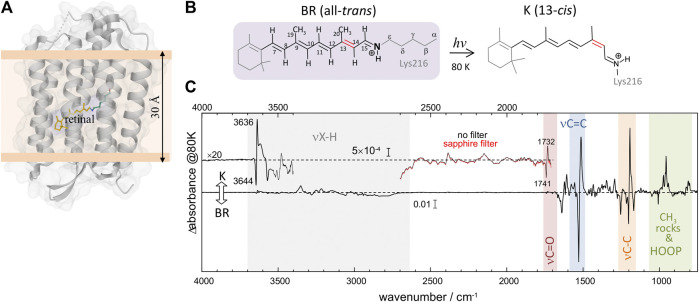
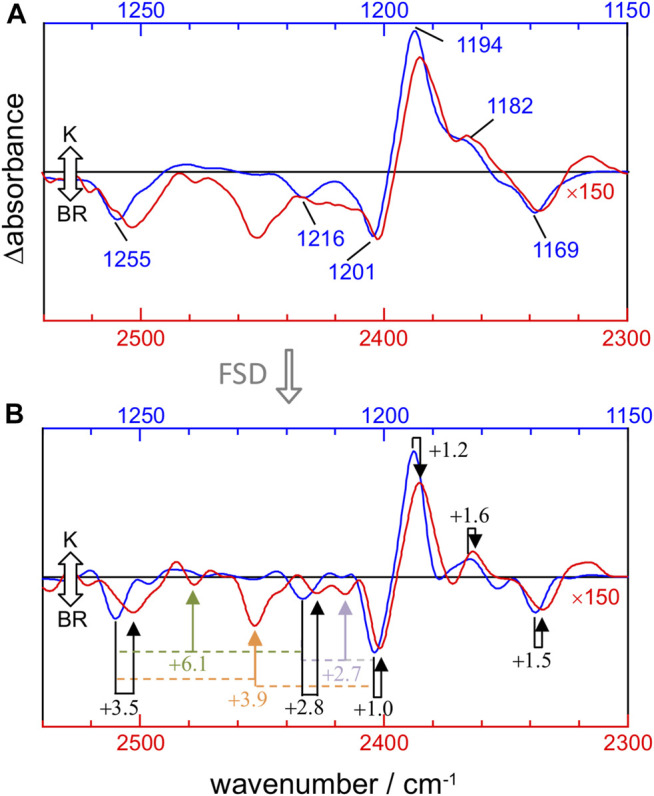
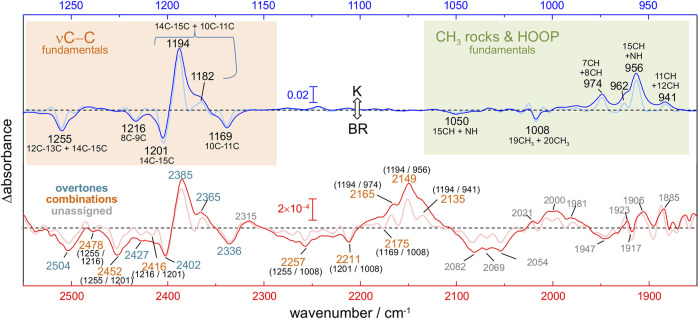
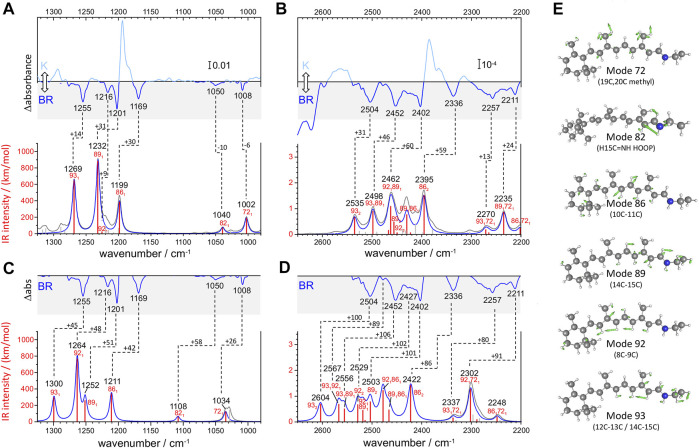
Fundamental vibrations of the chromophore in the membrane protein bacteriorhodopsin (BR), a protonated Schiff base retinal, have been studied for decades, both by resonance Raman and by infrared (IR) difference spectroscopy. Such studies started comparing vibrational changes between the initial BR state (all- retinal) and the K intermediate (13- retinal), being later extended to the rest of intermediates. They contributed to our understanding of the proton-pumping mechanism of BR by exploiting the sensitivity of fundamental vibrational transitions of the retinal to its conformation. Here, we report on new bands in the 2,500 to 1,800 cm region of the K-BR difference FT-IR spectrum. We show that the bands between 2,500 and 2,300 cm originate from overtone and combination transitions from C-C stretches of the retinal. We assigned bands below 2,300 cm to the combination of retinal C-C stretches with methyl rocks and with hydrogen-out-of-plane vibrations. Remarkably, experimental C-C overtone bands appeared at roughly twice the wavenumber of their fundamentals, with anharmonic mechanical constants ≤3.5 cm, and in some cases of ∼1 cm. Comparison of combination and fundamental bands indicates that most of the mechanical coupling constants are also very small. Despite the mechanical quasi-harmonicity of the C-C stretches, the area of their overtone bands was only ∼50 to ∼100 times smaller than of their fundamental bands. We concluded that electrical anharmonicity, the second mechanism giving intensity to overtone bands, must be particularly high for the retinal C-C stretches. We corroborated the assignments of negative bands in the K-BR difference FT-IR spectrum by ab initio anharmonic vibrational calculations of all-trans retinal in BR using a quantum-mechanics/molecular mechanics approach, reproducing reasonably well the small experimental anharmonic and coupling mechanical constants. Yet, and in spite accounting for both mechanical and electrical anharmonicities, the intensity of overtone C-C transitions was underestimated by a factor of 4-20, indicating room for improvement in state-of-the-art anharmonic vibrational calculations. The relatively intense overtone and combination bands of the retinal might open the possibility to detect retinal conformational changes too subtle to significantly affect fundamental transitions but leaving a footprint in overtone and combination transitions.
膜蛋白细菌视紫红质(BR)中的发色团(一种质子化席夫碱视黄醛)的基本振动,通过共振拉曼光谱和红外(IR)差示光谱已经研究了数十年。此类研究一开始比较的是BR初始状态(全反式视黄醛)和K中间体(13 - 顺式视黄醛)之间的振动变化,后来扩展到了其余中间体。这些研究通过利用视黄醛基本振动跃迁对其构象的敏感性,帮助我们理解了BR的质子泵浦机制。在此,我们报道了K - BR差示傅里叶变换红外光谱在2500至1800 cm区域出现的新谱带。我们表明,2500至2300 cm之间的谱带源自视黄醛C - C伸缩振动的泛音和组合跃迁。我们将2300 cm以下的谱带归属于视黄醛C - C伸缩振动与甲基摇摆以及氢面外振动的组合。值得注意的是,实验测得的C - C泛音谱带出现在其基频波数的大约两倍处,非谐力学常数≤3.5 cm,在某些情况下约为1 cm。组合谱带与基频谱带的比较表明,大多数力学耦合常数也非常小。尽管C - C伸缩振动具有力学准谐性,但其泛音谱带的面积仅比其基频谱带小约50至约100倍。我们得出结论,对于视黄醛C - C伸缩振动而言,赋予泛音谱带强度的第二种机制——电非谐性必定特别高。我们通过使用量子力学/分子力学方法对BR中的全反式视黄醛进行从头算非谐振动计算,证实了K - BR差示傅里叶变换红外光谱中负谱带的归属,相当好地再现了实验测得的小非谐和耦合力学常数。然而,尽管同时考虑了力学和电非谐性,C - C跃迁泛音的强度仍被低估了4至20倍,这表明最先进的非谐振动计算仍有改进空间。视黄醛相对较强的泛音和组合谱带可能为检测视黄醛构象变化开辟了可能性,这些构象变化过于细微,无法显著影响基本跃迁,但却在泛音和组合跃迁中留下了痕迹。