Mizurini Daniella M, Hottz Eugenio D, Bozza Patrícia T, Monteiro Robson Q
Institute of Medical Biochemistry Leopoldo de Meis, Federal University of Rio de Janeiro (UFRJ), Rio de Janeiro, Brazil.
Oswaldo Cruz Foundation, Laboratory of Immunopharmacology, Oswaldo Cruz Institute, Rio de Janeiro, Brazil.
Front Cardiovasc Med. 2021 Dec 17;8:785738. doi: 10.3389/fcvm.2021.785738. eCollection 2021.
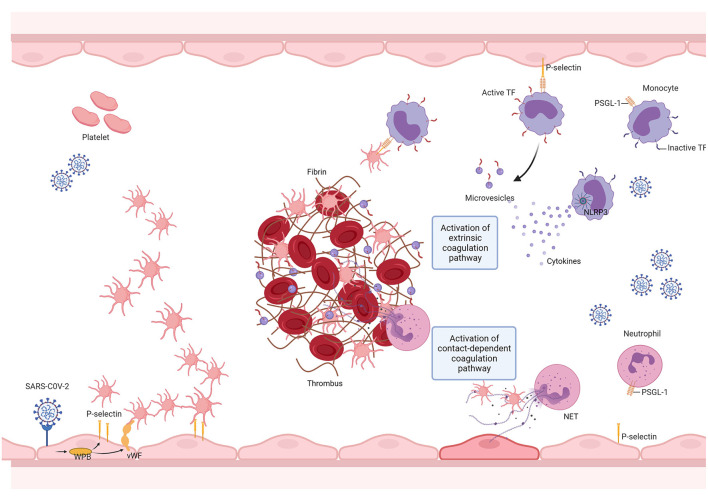
The novel coronavirus disease (COVID-19) is associated with a high incidence of coagulopathy and venous thromboembolism that may contribute to the worsening of the clinical outcome in affected patients. Marked increased D-dimer levels are the most common laboratory finding and have been repeatedly reported in critically ill COVID-19 patients. The infection caused by Severe Acute Respiratory Syndrome Coronavirus-2 (SARS-CoV-2) is followed by a massive release of pro-inflammatory cytokines, which mediate the activation of endothelial cells, platelets, monocytes, and neutrophils in the vasculature. In this context, COVID-19-associated thrombosis is a complex process that seems to engage vascular cells along with soluble plasma factors, including the coagulation cascade, and complement system that contribute to the establishment of the prothrombotic state. In this review, we summarize the main findings concerning the cellular mechanisms proposed for the establishment of COVID-19-associated thrombosis.
新型冠状病毒病(COVID-19)与凝血病和静脉血栓栓塞的高发病率相关,这可能导致受影响患者的临床结局恶化。D-二聚体水平显著升高是最常见的实验室检查结果,并且在重症COVID-19患者中已被反复报道。严重急性呼吸综合征冠状病毒2(SARS-CoV-2)引起的感染之后会大量释放促炎细胞因子,这些细胞因子介导血管系统中内皮细胞、血小板、单核细胞和中性粒细胞的活化。在这种情况下,COVID-19相关的血栓形成是一个复杂的过程,似乎涉及血管细胞以及可溶性血浆因子,包括凝血级联反应和补体系统,这些都有助于形成血栓前状态。在这篇综述中,我们总结了关于COVID-19相关血栓形成所提出的细胞机制的主要研究结果。