Cardiology Unit, IRCCS Policlinico San Donato, Milan, Italy; Università degli studi di Milano, Milan, Italy.
Division of Cardiology, Cardiovascular and Emergency Department, Guglielmo da Saliceto Hospital, Piacenza, Italy.
Int J Cardiol. 2021 Dec 1;344:240-245. doi: 10.1016/j.ijcard.2021.09.058. Epub 2021 Oct 4.
Patients with coronavirus disease 2019 (COVID-19) exhibit high thrombotic risk. The evidence on a potential independent prognostic role of antiplatelet treatment in those patients is limited. The aim of the study was to evaluate the prognostic impact of pre-admission low-dose acetylsalicylic acid (ASA) in a wide series of hospitalized patients with COVID-19.
This cohort study included 984 COVID-19 patients stratified according to ASA intake before hospitalization: ASA (n = 253) and ASA (n = 731). Patients were included in ASA group if they received it daily in the 7 days before admission. 213 (83%) were on ASA 100 mg daily. Primary endpoint was a composite of in-hospital death and/or need for respiratory support upgrade, secondary endpoints were in-hospital death and need for respiratory support upgrade.
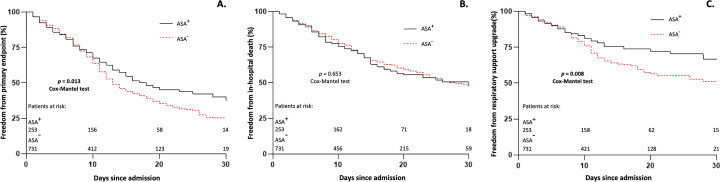
Mean age was 72 [62; 81] with 69% of male patients. ASA patients were significantly older, with higher prevalence of comorbidities. No significant differences regarding the degree of respiratory dysfunction were observed. At 30-day Kaplan-Meier analysis, ASA patients had higher survival free from the primary endpoint and need for respiratory support upgrade, conversely in-hospital death did not significantly differ between groups. At multivariate analysis ASA intake was independently associated with a lower probability of reaching primary endpoint (HR 0.697, 95% C.I. 0.525-0.924; p = 0.012).
In COVID-19 patients undergoing hospitalization, pre-admission treatment with ASA is associated with better in-hospital outcome, mainly driven by less respiratory support upgrade.
患有 2019 年冠状病毒病(COVID-19)的患者存在较高的血栓形成风险。关于抗血小板治疗对这些患者的潜在独立预后作用的证据有限。本研究旨在评估广泛住院 COVID-19 患者入院前低剂量乙酰水杨酸(ASA)的预后影响。
这项队列研究根据入院前 ASA 摄入情况对 984 名 COVID-19 患者进行分层:ASA(n=253)和 ASA(n=731)。如果患者在入院前 7 天内每天接受 ASA 治疗,则将其纳入 ASA 组。213(83%)例患者服用 100mg ASA。主要终点是住院期间死亡和/或需要升级呼吸支持的复合终点,次要终点是住院期间死亡和需要升级呼吸支持。
平均年龄为 72 [62;81],其中 69%为男性。ASA 患者年龄明显较大,合并症患病率较高。观察到呼吸功能障碍的严重程度无明显差异。在 30 天的 Kaplan-Meier 分析中,ASA 患者的主要终点和需要升级呼吸支持的生存率更高,而两组之间的住院死亡率无显著差异。多变量分析表明,ASA 摄入与降低主要终点的可能性独立相关(HR 0.697,95%CI 0.525-0.924;p=0.012)。
在接受住院治疗的 COVID-19 患者中,入院前使用 ASA 治疗与更好的住院结局相关,主要是因为升级呼吸支持的情况减少。