Okpara Enyioma C, Ogunjinmi Oluwasayo E, Oyewo Opeyemi A, Fayemi Omolola E, Onwudiwe Damian C
Material Science Innovation and Modelling (MaSIM) Research Focus Area, Faculty of Natural and Agricultural Sciences, North-West University (Mafikeng Campus), Private Bag X2046, Mmabatho, South Africa.
Department of Chemistry, School of Physical and Chemical Sciences, Faculty of Natural and Agricultural Science, North-West University (Mafikeng Campus), Private Bag X2046, Mmabatho, South Africa.
Heliyon. 2021 Dec 8;7(12):e08571. doi: 10.1016/j.heliyon.2021.e08571. eCollection 2021 Dec.
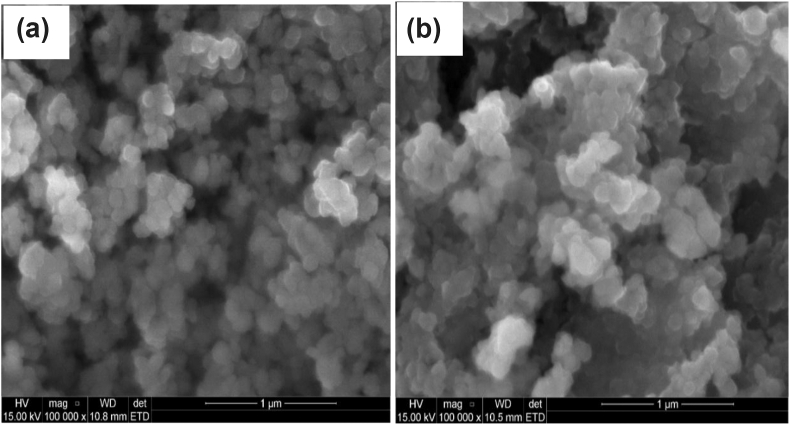
In this work, CuO nanoparticles (NPs) were prepared from the aqueous extracts of fruit by using the conventional heating (CuO(h) NPs) and microwave irradiation (CuO(m) NPs) methods. The synthesized nanoparticles were characterized using scanning electron microscopy (SEM), transmission electron microscopy (TEM), and X-ray diffraction (XRD). The SEM analysis revealed that the CuO NPs from both routes contained essentially smooth surfaces, and displayed some degree of agglomeration. The TEM analysis confirmed some spherical morphology with mean particle sizes of 35.60 ± 6.24 nm and 47.14 ± 6.18 nm for the CuO(h) and CuO(m) NPs respectively. While the CuO(m) NPs possessed a single-phase consistent with the face cantered cubic structure of copper oxide, the CuO(h) NPs showed some extra peaks attributed to CuO NPs as secondary phase. Electrochemical studies were conducted in order to evaluate the electrochemical properties of the NPs. The responses of a gold screen-printed electrode surface treated with both NPs showed that their redox behaviours on (Fe(CN)) probe and KCl electrolytes vary significantly. In (Fe(CN)) probe, the SPAuE/CuO(h) showed enhanced electrochemical response relative to the bare, while the SPAuE/CuO(m) showed a lower current response than the bare. However, in the KCl electrolye, the SPAuE/CuO(h) and SPAuE/CuO(m) were highly electroactive and demonstrated peak current magnitude that was about 26.5 and 83.38 times higher than that of the bare. In this KCl medium, the magnitude of the oxidation peak current of Cu for SPAuE/CuO(m) was about 3 times higher than that of SPAuE/CuO(h). The percentage contraction in redox coordinates between the 1 and 10 scans in both electrodes were 3.88 and 19.28% for SPAuE/CuO(h) and SPAuE/CuO(m) respectively. Thus, the choice of green synthesis route could be exploited in different fields where green NPs is desired.
在本研究中,采用传统加热法(CuO(h) NPs)和微波辐照法(CuO(m) NPs)从水果水提取物中制备了氧化铜纳米颗粒(NPs)。使用扫描电子显微镜(SEM)、透射电子显微镜(TEM)和X射线衍射(XRD)对合成的纳米颗粒进行了表征。SEM分析表明,两种方法制备的CuO NPs表面基本光滑,但都有一定程度的团聚。TEM分析证实,CuO(h) NPs和CuO(m) NPs均呈球形,平均粒径分别为35.60±6.24 nm和47.14±6.18 nm。CuO(m) NPs具有与氧化铜面心立方结构一致的单相,而CuO(h) NPs显示出一些归属于CuO NPs的额外峰作为第二相。为了评估NPs的电化学性质,进行了电化学研究。用两种NPs处理的金丝网印刷电极表面的响应表明,它们在(Fe(CN))探针和KCl电解质上的氧化还原行为有显著差异。在(Fe(CN))探针中,SPAuE/CuO(h)相对于裸电极显示出增强的电化学响应,而SPAuE/CuO(m)显示出比裸电极更低的电流响应。然而,在KCl电解质中,SPAuE/CuO(h)和SPAuE/CuO(m)具有高电活性,其峰值电流幅度分别比裸电极高约26.5倍和83.38倍。在这种KCl介质中,SPAuE/CuO(m)的Cu氧化峰电流幅度约为SPAuE/CuO(h)的3倍。两个电极在第1次和第10次扫描之间的氧化还原坐标收缩百分比,SPAuE/CuO(h)为3.88%,SPAuE/CuO(m)为19.28%。因此,在需要绿色纳米颗粒的不同领域,可以利用绿色合成路线的选择。