
皮划艇水球投掷过程中的三维上身运动学和关节间运动序列
Three-Dimensional Upper Body Kinematics and Inter-articular Kinematic Sequence During a Canoe Polo Throw.
作者信息
Assila Najoua, Delavallade Cyril, Blache Yoann, Berger-Vachon Christian, Collotte Philippe, Duprey Sonia
机构信息
Univ Lyon, Université Claude Bernard Lyon 1, Univ Gustave Eiffel, LBMC UMR_T9406, Lyon, France.
Laboratoire de Simulation et de Modélisation du Mouvement, École de Kinésiologie et des Sciences de l'Activité Physique, Faculté de Médecine, Université de Montréal, Montreal, QC, Canada.
出版信息
Front Sports Act Living. 2021 Dec 15;3:777410. doi: 10.3389/fspor.2021.777410. eCollection 2021.
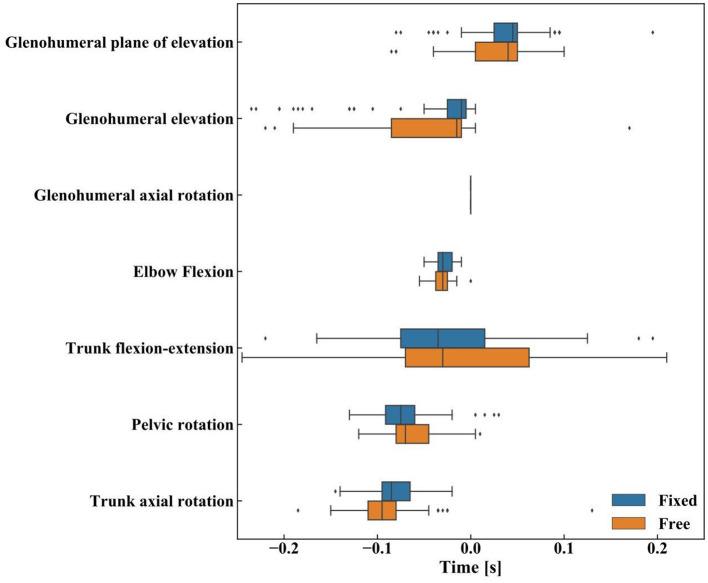
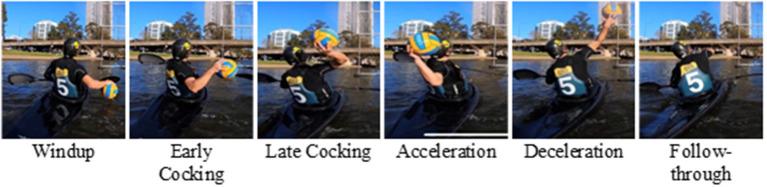
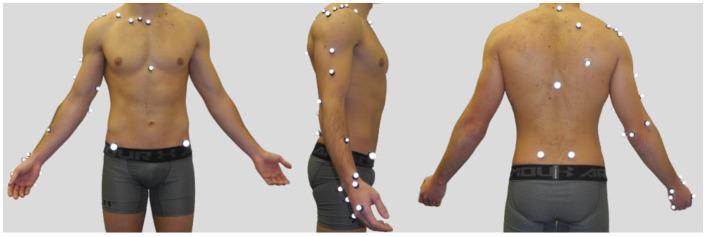
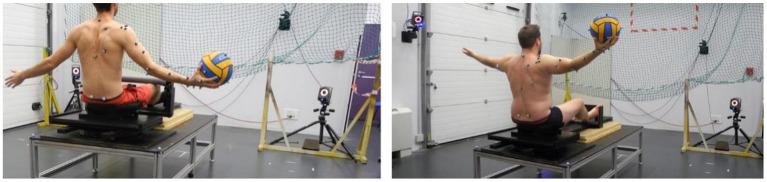
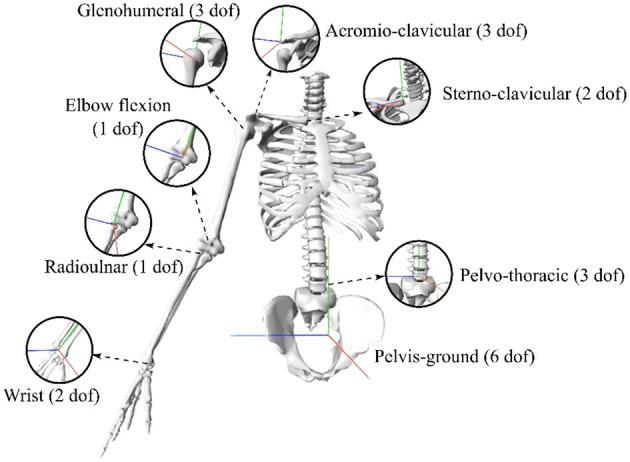
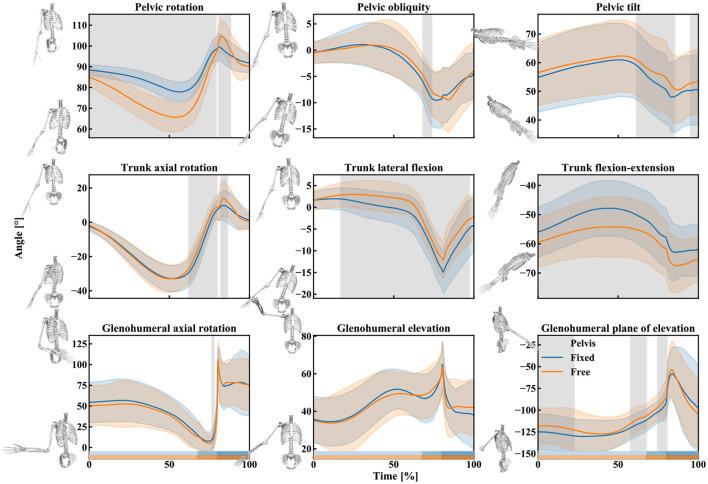
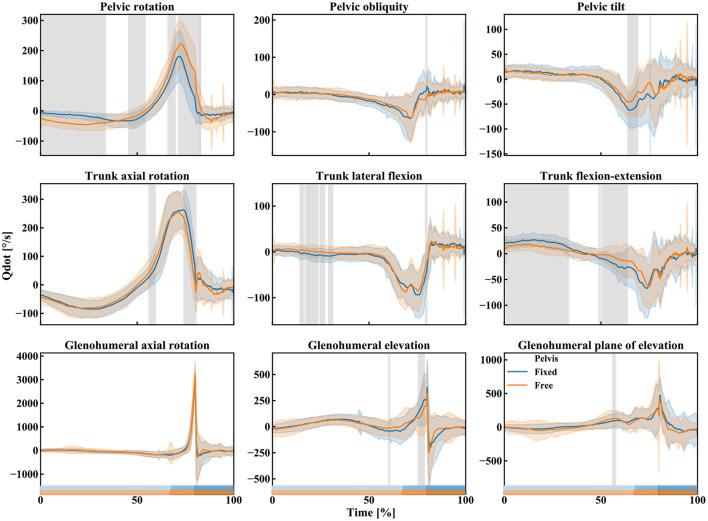
Canoe polo is an increasingly popular discipline requiring both kayaking and ball-handling skills. While the kinematics of the upper body during throw has been investigated for several overhead sports, the canoe polo throw has still to be studied. Therefore, the aim of this study is to analyze the canoe polo throw kinematics in terms of angles and inter-articular sequencing to understand its specificity. A secondary aim was to investigate whether adding pelvis mobility has an impact. Nineteen male players of canoe polo were equipped with reflective body markers for the throw analysis. They performed 5 throws with the pelvis fixed and 5 throws with additional pelvic mobility in rotation around a vertical axis. Inverse kinematics was performed with OpenSim providing pelvis, trunk, and glenohumeral rotations. Angular velocities were calculated to build the inter-articular sequences relative to these throws. Statistical parametric mapping was used to assess the effect of pelvis mobility on the throwing kinematics. Similar kinematics patterns as in other overhead sports were observed, however, a different inter-articular sequence was found for the canoe polo throw with a maximal angular velocity occurring sooner for the thorax in axial rotation than for the pelvis in rotation. While the limitation of rotation of the pelvis around a vertical axis has an influence on the pelvis and trunk kinematics, it did not modify the kinematic sequence.
独木舟水球是一项越来越受欢迎的运动项目,需要具备皮划艇技能和控球技巧。虽然已经对几种上肢过顶运动中投掷时上半身的运动学进行了研究,但独木舟水球投掷仍有待研究。因此,本研究的目的是从角度和关节间顺序方面分析独木舟水球投掷的运动学,以了解其特殊性。第二个目的是研究增加骨盆活动度是否有影响。19名男性独木舟水球运动员配备了反光身体标记物用于投掷分析。他们进行了5次骨盆固定的投掷和5次额外增加骨盆绕垂直轴旋转活动度的投掷。使用OpenSim进行逆运动学分析,得出骨盆、躯干和盂肱关节的旋转情况。计算角速度以建立相对于这些投掷的关节间顺序。使用统计参数映射来评估骨盆活动度对投掷运动学的影响。观察到与其他上肢过顶运动相似的运动学模式,然而,发现独木舟水球投掷的关节间顺序不同,胸部轴向旋转的最大角速度出现得比骨盆旋转时更早。虽然骨盆绕垂直轴旋转的限制对骨盆和躯干的运动学有影响,但它并没有改变运动学顺序。
 Zotero 插件