Parisien Robert L, Trofa David P, Cronin Patrick K, Dashe Jesse, Curry Emily J, Eichinger Josef K, Levine William N, Tornetta Paul, Li Xinning
Boston University Medical Center, Boston, Massachusetts.
Columbia University Medical Center, New York, New York.
Arthrosc Sports Med Rehabil. 2021 Oct 12;3(6):e1899-e1904. doi: 10.1016/j.asmr.2021.08.017. eCollection 2021 Dec.
Evidenced-based decision-making is rooted in comparative clinical studies; however, a small number of outcome event reversals have the potential to change study significance. The purpose of this study was to determine the utility of applying fragility analysis to comparative studies in the published orthopaedic shoulder literature.
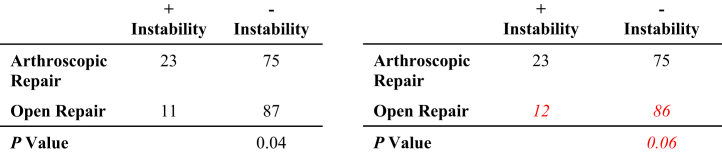
Comparative clinical shoulder research studies reporting 1:1 dichotomous categorical data were analyzed in 6 leading orthopaedic journals between 2006 and 2016. Statistical significance was defined as a value of less than .05. The fragility index (FI) for each study outcome was determined by the number of event reversals required to change the value to either greater or less than 0.05, thus changing the study conclusions. The associated fragility quotient (FQ) was determined by dividing the FI by the total population comprising a particular outcome.
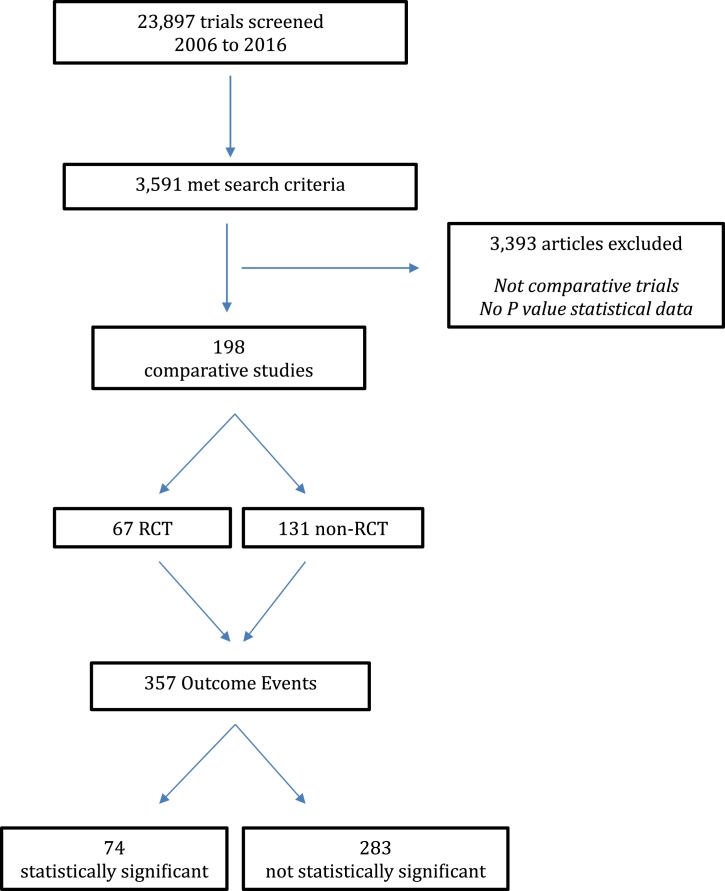
Of the 23,897 studies screened, 3,591 met search criteria, with 198 comparative studies ultimately included for analysis, 67 of which were randomized controlled trials. There were 357 total outcome events with 74 reported as significant and 283 as not significant. The FI was 4 (IQR 2-6) with an associated FQ of 0.066 (interquartile range [IQR] 0.038-0.102). There was no difference in statistical fragility between randomized and nonrandomized trials with both revealing a FI of 4 and FQ of 0.068 (IQR 0.044-0.107) and 0.065 (IQR 0.031-0.101), respectively.
This current analysis reveals that comparative shoulder studies published in six leading orthopaedic journals are at risk of statistical fragility. As such, contemporary clinical shoulder literature may not be as robust as traditionally perceived with the reversal of only a few outcome events required to change study significance. Therefore, we advocate the reporting of both FI and FQ in addition to the value as statistical complements to all comparative investigations to provide a more comprehensive understanding of trial stability and significance in the published shoulder literature.
Comparative study designs are commonly employed in shoulder research. Several studies in both the general medical and orthopaedic literature have identified a lack of statistical robustness through comprehensive fragility analysis. Our findings demonstrate the value may be an inadequate independent statistical metric requiring the complement of a FI and FQ to aid in the interpretation and understanding of study significance for clinical decision-making.
循证决策基于比较性临床研究;然而,少量结局事件的逆转有可能改变研究的意义。本研究的目的是确定在已发表的骨科肩部文献中,将脆弱性分析应用于比较性研究的效用。
对2006年至2016年期间6种主要骨科期刊上报告1:1二分分类数据的比较性临床肩部研究进行分析。统计学显著性定义为P值小于0.05。每项研究结局的脆弱性指数(FI)通过将P值改变为大于或小于0.05从而改变研究结论所需的事件逆转数量来确定。相关的脆弱性商数(FQ)通过将FI除以包含特定结局的总人群来确定。
在筛选的23,897项研究中,3,591项符合检索标准,最终纳入198项比较性研究进行分析,其中67项为随机对照试验。共有357个总结局事件,74项报告为显著,283项为不显著。FI为4(四分位间距[IQR]2 - 6),相关FQ为0.066(四分位间距[IQR]0.038 - 0.102)。随机试验和非随机试验在统计脆弱性方面没有差异,两者的FI分别为4,FQ分别为0.068(IQR 0.044 - 0.107)和0.065(IQR 0.031 - 0.101)。
当前分析表明,在六种主要骨科期刊上发表的比较性肩部研究存在统计脆弱性风险。因此,当代临床肩部文献可能不像传统认为的那样稳健,只需少量结局事件逆转就能改变研究意义。因此,我们主张除P值外,还应报告FI和FQ,作为所有比较性研究的统计补充,以便更全面地理解已发表肩部文献中试验的稳定性和意义。
比较性研究设计在肩部研究中常用。普通医学和骨科文献中的多项研究通过全面的脆弱性分析发现缺乏统计稳健性。我们的研究结果表明,P值可能是一个不充分的独立统计指标,需要FI和FQ作为补充,以帮助解释和理解研究意义,用于临床决策。