Taghavi Bahreghani Morteza, Geraily G Hazale, Alizadeh S Haban, Najafi Masoud, Shirazi Alireza
Department of Medical Physics and Biomedical Engineering, Tehran University of Medical Sciences, Tehran, Iran.
Department of Medical Physics and Biomedical Engineering, Tehran University of Medical Sciences, Tehran, Iran. Email:
Cell J. 2021 Dec;23(7):730-735. doi: 10.22074/cellj.2021.7610. Epub 2021 Dec 29.
Whereas prostate cancer (PrCa) may be unresponsive or moderately responsive to radiation therapy (RT)- most common modality for treatment of PrCa- patients must receive a high dose of RT In order to achieve appropriate tumour control. However, this increase in radiation dose may lead to severe adverse effects in normal tissues. Sensitization of PrCa to radiation provides an alternate approach to improve the therapeutic efficacy of RT. This study aims to assess the radiosensitisation effect of apigenin (Api) on a prostate cancer cell line (LNCaP).
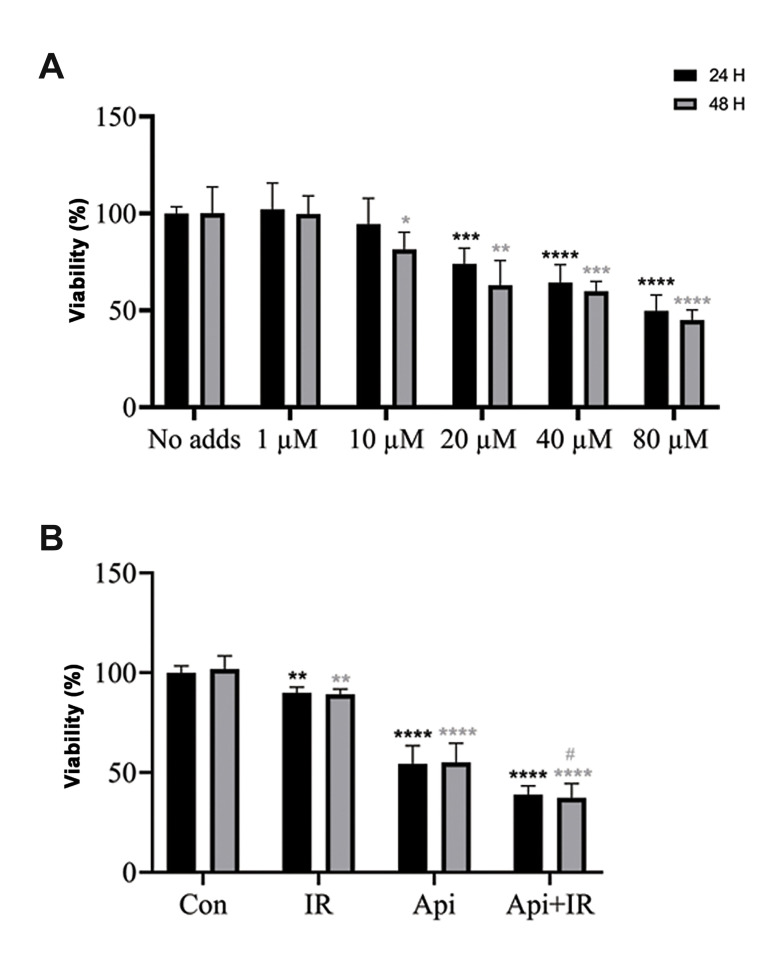
In this experimental study, LNCaP cells were treated with 0-80 μM Api to investigate its effect on LNCaP cell viability and determine its half-maximal inhibitory concentration (IC). Next, the cells were divided into four groups: i. Control, ii. Cells treated with the IC concentration of Api, iii. Cells treated with 2 Gy ionizing radiation (IR), and cells co-treated with Api and IR. The 3-(4,5-dimethylthiazol-2-yl)-2,5-diphenyltetrazolium bromide (MTT) assay, real-time polymerase chain reaction (PCR), and an Annexin V-FITC/PI assay were performed to assess cell survival, and expressions, and presence of apoptosis and necrosis.
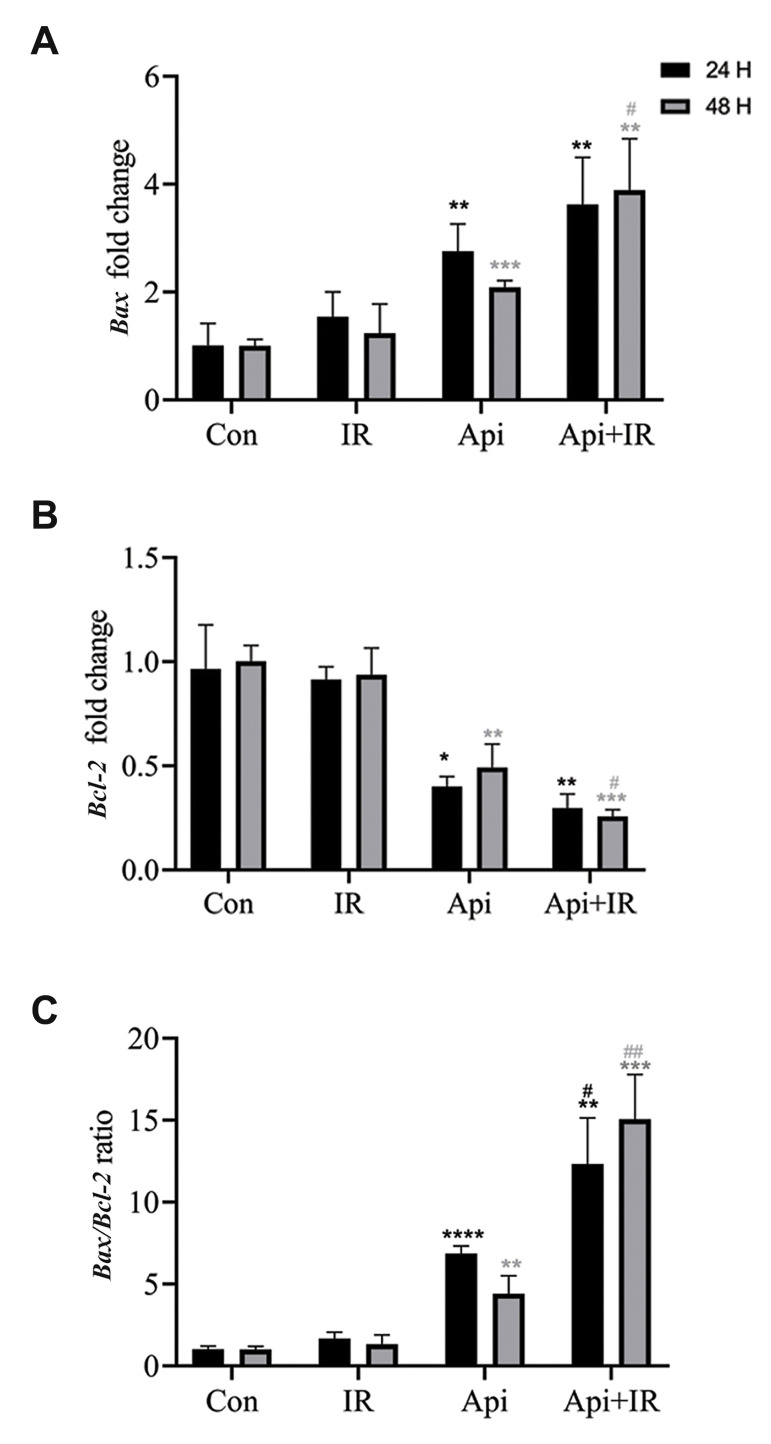
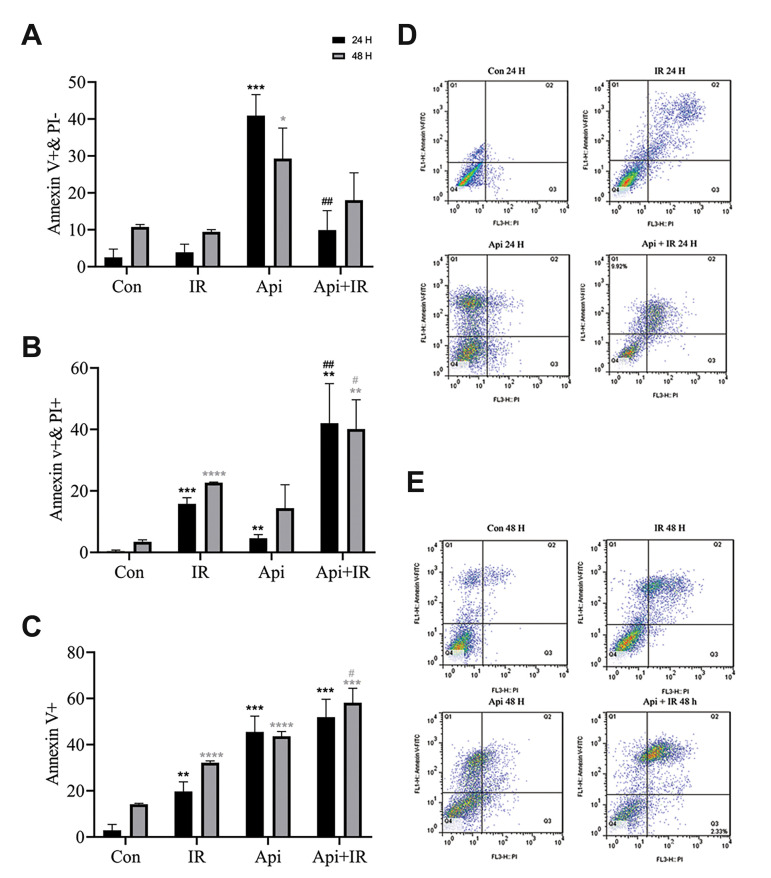
Api inhibited cell survival in a dose-dependent, but not time-dependent manner. Cells treated with Api had increased amounts of early apoptosis, late apoptosis, and secondary necrosis compared to the control group. This group also had decreased gene expression and up-regulated Bax gene expression. Co-treatment with Api and IR significantly inhibited cell survival, and increased early apoptosis, late apoptosis and secondary necrosis compared to the other groups. There was a significant decrease in gene expression along with up-regulation of Bax gene expression, and ratio changes that favoured apoptosis.
Api inhibited PrCa cell survival and induced apoptosis as a single agent. In addition, Api significantly sensitized the LNCaP cells to IR and enhanced radiation-induced apoptosis.
鉴于前列腺癌(PrCa)对放射治疗(RT)可能无反应或反应中等——RT是治疗PrCa最常用的方式——患者必须接受高剂量的RT才能实现适当的肿瘤控制。然而,这种辐射剂量的增加可能会对正常组织产生严重的不良反应。使PrCa对辐射敏感为提高RT的治疗效果提供了另一种方法。本研究旨在评估芹菜素(Api)对前列腺癌细胞系(LNCaP)的放射增敏作用。
在本实验研究中,用0 - 80 μM的Api处理LNCaP细胞,以研究其对LNCaP细胞活力的影响并确定其半数最大抑制浓度(IC)。接下来,将细胞分为四组:i. 对照组,ii. 用IC浓度的Api处理的细胞,iii. 用2 Gy电离辐射(IR)处理的细胞,以及用Api和IR共同处理的细胞。进行3 -(4,5 - 二甲基噻唑 - 2 - 基)- 2,5 - 二苯基四氮唑溴盐(MTT)测定、实时聚合酶链反应(PCR)和膜联蛋白V - FITC/PI测定,以评估细胞存活、基因表达以及凋亡和坏死的情况。
Api以剂量依赖性而非时间依赖性方式抑制细胞存活。与对照组相比,用Api处理的细胞早期凋亡、晚期凋亡和继发性坏死的数量增加。该组还出现基因表达降低和Bax基因表达上调。与其他组相比,Api和IR共同处理显著抑制细胞存活,并增加早期凋亡、晚期凋亡和继发性坏死。基因表达显著降低,同时Bax基因表达上调,且比率变化有利于凋亡。
Api作为单一药物可抑制PrCa细胞存活并诱导凋亡。此外,Api使LNCaP细胞对IR显著敏感,并增强辐射诱导的凋亡。