Department of Radiology, The Third Hospital of Hebei Medical University, Hebei Province Biomechanical Key Laboratory of Orthopedics, Shijiazhuang, Hebei, China.
MR Collaboration, Siemens Healthineers Ltd., Shanghai, China.
BMC Musculoskelet Disord. 2022 Jan 3;23(1):19. doi: 10.1186/s12891-021-04973-4.
The cartilage segmentation algorithms make it possible to accurately evaluate the morphology and degeneration of cartilage. There are some factors (location of cartilage subregions, hydrarthrosis and cartilage degeneration) that may influence the accuracy of segmentation. It is valuable to evaluate and compare the accuracy and clinical value of volume and mean T2* values generated directly from automatic knee cartilage segmentation with those from manually corrected results using prototype software.
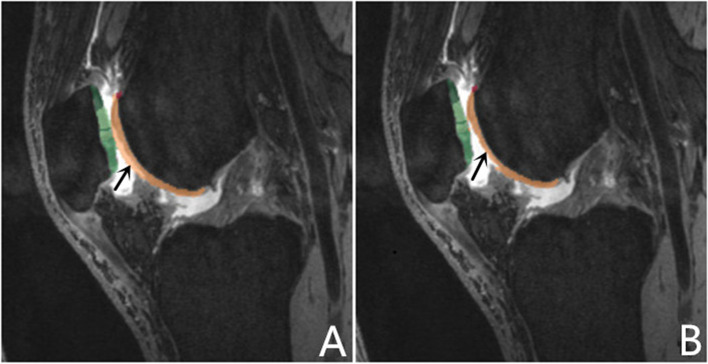
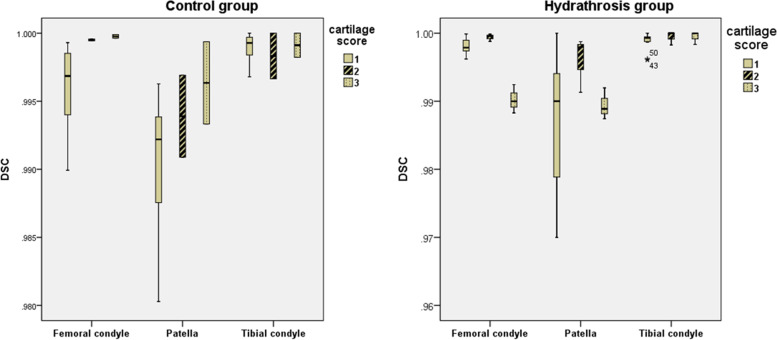
Thirty-two volunteers were recruited, all of whom underwent right knee magnetic resonance imaging examinations. Morphological images were obtained using a three-dimensional (3D) high-resolution Double-Echo in Steady-State (DESS) sequence, and biochemical images were obtained using a two-dimensional T2* mapping sequence. Cartilage score criteria ranged from 0 to 2 and were obtained using the Whole-Organ Magnetic Resonance Imaging Score (WORMS). The femoral, patellar, and tibial cartilages were automatically segmented and divided into subregions using the post-processing prototype software. Afterwards, all the subregions were carefully checked and manual corrections were done where needed. The dice coefficient correlations for each subregion by the automatic segmentation were calculated.
Cartilage volume after applying the manual correction was significantly lower than automatic segmentation (P < 0.05). The percentages of the cartilage volume change for each subregion after manual correction were all smaller than 5%. In all the subregions, the mean T2* relaxation time within manual corrected subregions was significantly lower than in regions after automatic segmentation (P < 0.05). The average time for the automatic segmentation of the whole knee was around 6 min, while the average time for manual correction of the whole knee was around 27 min.
Automatic segmentation of cartilage volume has a high dice coefficient correlation and it can provide accurate quantitative information about cartilage efficiently without individual bias. Advances in knowledge: Magnetic resonance imaging is the most promising method to detect structural changes in cartilage tissue. Unfortunately, due to the structure and morphology of the cartilages obtaining accurate segmentations can be problematic. There are some factors (location of cartilage subregions, hydrarthrosis and cartilage degeneration) that may influence segmentation accuracy. We therefore assessed the factors that influence segmentations error.
软骨分割算法可实现对软骨形态和退变的精确评估。有一些因素(软骨亚区的位置、滑液和软骨退变)可能会影响分割的准确性。评估和比较直接从自动膝关节软骨分割生成的容积和平均 T2* 值与使用原型软件进行手动校正后的结果的准确性和临床价值是很有价值的。
招募了 32 名志愿者,所有志愿者均接受右膝关节磁共振成像检查。形态学图像采用三维(3D)高分辨率双稳态稳态(DESS)序列获得,生化图像采用二维 T2*映射序列获得。软骨评分标准范围为 0 至 2 分,采用全器官磁共振成像评分(WORMS)获得。使用后处理原型软件对股骨、髌骨和胫骨软骨进行自动分割并划分为亚区。然后仔细检查所有亚区,并在需要时进行手动校正。通过自动分割计算每个亚区的骰子系数相关性。
应用手动校正后软骨体积明显低于自动分割(P<0.05)。手动校正后各亚区软骨体积变化率均小于 5%。在所有亚区中,手动校正后的亚区平均 T2*弛豫时间均明显低于自动分割后的亚区(P<0.05)。整个膝关节的自动分割平均时间约为 6 分钟,而整个膝关节的手动校正平均时间约为 27 分钟。
软骨体积的自动分割具有较高的骰子系数相关性,可在没有个体偏差的情况下高效提供软骨的准确定量信息。知识的进步:磁共振成像是检测软骨组织结构变化最有前途的方法。不幸的是,由于软骨的结构和形态,获得准确的分割可能会有问题。有一些因素(软骨亚区的位置、滑液和软骨退变)可能会影响分割的准确性。因此,我们评估了影响分割误差的因素。