Department of Reproductive Medicine and Gynaecological Endocrinology, University Medical Centre Maribor, 2000, Maribor, Slovenia.
Department of Animal Science, Biotechnical Faculty, University of Ljubljana, 1230, Domžale, Slovenia.
Reprod Biol Endocrinol. 2022 Jan 3;20(1):2. doi: 10.1186/s12958-021-00871-5.
Women with uterine adenomyosis seeking assisted reproduction have been associated with compromised endometrial receptivity to embryo implantation. To understand the mechanisms involved in this process, we aimed to compare endometrial transcriptome profiles during the window of implantation (WOI) between women with and without adenomyosis.
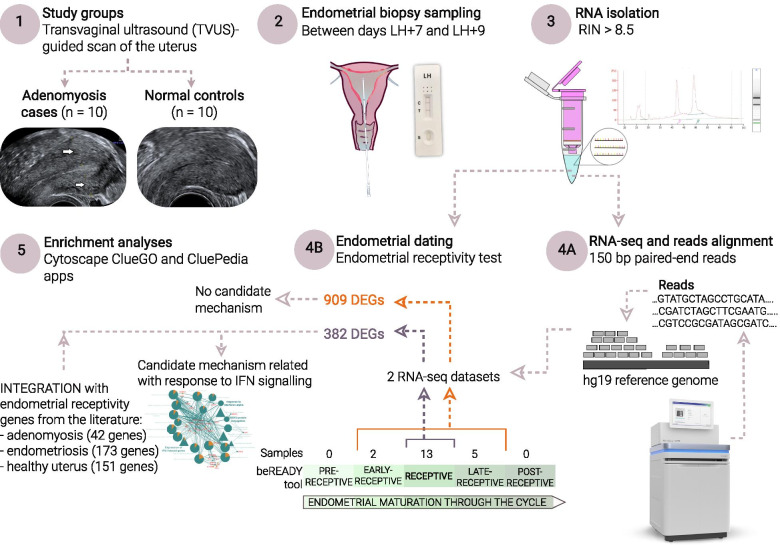
We obtained endometrial biopsies LH-timed to the WOI from women with sonographic features of adenomyosis (n=10) and controls (n=10). Isolated RNA samples were subjected to RNA sequencing (RNA-seq) by the Illumina NovaSeq 6000 platform and endometrial receptivity classification with a molecular tool for menstrual cycle phase dating (beREADY®, CCHT). The program language R and Bioconductor packages were applied to analyse RNA-seq data in the setting of the result of accurate endometrial dating. To suggest robust candidate pathways, the identified differentially expressed genes (DEGs) associated with the adenomyosis group in the receptive phase were further integrated with 151, 173 and 42 extracted genes from published studies that were related to endometrial receptivity in healthy uterus, endometriosis and adenomyosis, respectively. Enrichment analyses were performed using Cytoscape ClueGO and CluePedia apps.
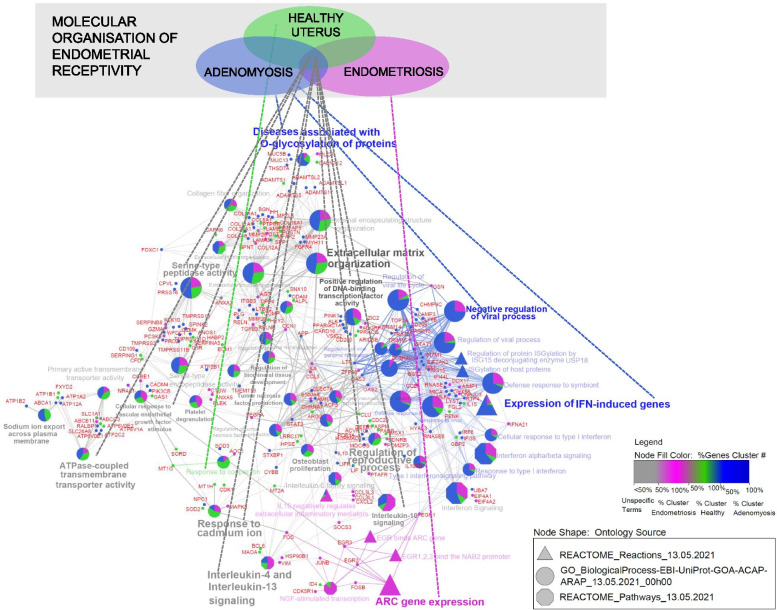
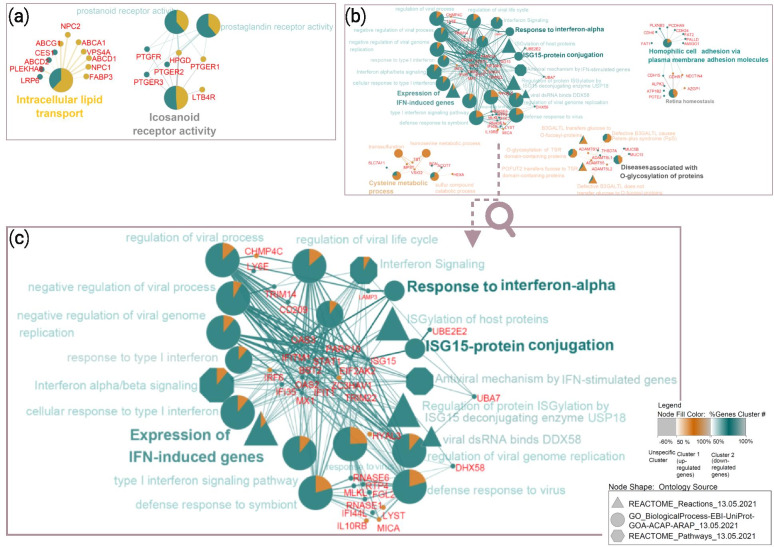
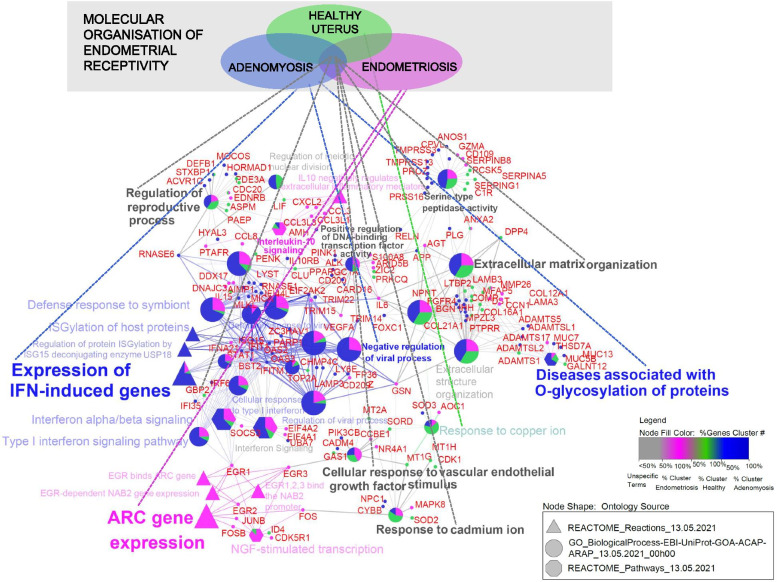
Out of 20 endometrial samples, 2 were dated to the early receptive phase, 13 to the receptive phase and 5 to the late receptive phase. Comparison of the transcriptomics data from all 20 samples provided 909 DEGs (p<0.05; nonsignificant after adjusted p value) in the adenomyosis group but only 4 enriched pathways (Bonferroni p value < 0.05). The analysis of 13 samples only dated to the receptive phase provided suggestive 382 DEGs (p<0.05; nonsignificant after adjusted p value) in the adenomyosis group, leading to 33 enriched pathways (Bonferroni p value < 0.05). These included pathways were already associated with endometrial biology, such as "Expression of interferon (IFN)-induced genes" and "Response to IFN-alpha". Data integration revealed pathways indicating a unique effect of adenomyosis on endometrial molecular organization (e.g., "Expression of IFN-induced genes") and its interference with endometrial receptivity establishment (e.g., "Extracellular matrix organization" and "Tumour necrosis factor production").
Accurate endometrial dating and RNA-seq analysis resulted in the identification of altered response to IFN signalling as the most promising candidate of impaired uterine receptivity in adenomyosis.
患有子宫腺肌病的寻求辅助生殖的女性,其子宫内膜对胚胎着床的接受能力受损。为了了解这一过程中涉及的机制,我们旨在比较患有和不患有腺肌病的女性在着床窗口期(WOI)的子宫内膜转录组谱。
我们从具有超声特征的腺肌病患者(n=10)和对照组(n=10)中获得 LH 定时的 WOI 子宫内膜活检。将分离的 RNA 样本用 Illumina NovaSeq 6000 平台进行 RNA 测序(RNA-seq),并使用月经周期相位约会的分子工具(beREADY®,CCHT)进行子宫内膜接受能力分类。应用 R 程序语言和 Bioconductor 包来分析准确子宫内膜日期结果设置下的 RNA-seq 数据。为了提出稳健的候选途径,我们进一步整合了与腺肌病组在接受期相关的 151、173 和 42 个从已发表的研究中提取的与健康子宫、子宫内膜异位症和腺肌病的子宫内膜接受性相关的差异表达基因(DEGs)。使用 Cytoscape ClueGO 和 CluePedia 应用程序进行富集分析。
在 20 个子宫内膜样本中,2 个样本被标记为早期接受期,13 个样本被标记为接受期,5 个样本被标记为晚期接受期。比较 20 个样本的转录组学数据,在腺肌病组中发现了 909 个差异表达基因(p<0.05;调整后 p 值无统计学意义),但仅发现了 4 个富集途径(Bonferroni p 值<0.05)。仅对 13 个标记为接受期的样本进行分析,在腺肌病组中发现了 382 个有意义的差异表达基因(p<0.05;调整后 p 值无统计学意义),导致 33 个富集途径(Bonferroni p 值<0.05)。这些途径包括已经与子宫内膜生物学相关的途径,如“干扰素(IFN)诱导基因的表达”和“对 IFN-α的反应”。数据整合显示了腺肌病对子宫内膜分子组织的独特影响的途径(例如,“干扰素诱导基因的表达”)及其对子宫内膜接受能力建立的干扰(例如,“细胞外基质组织”和“肿瘤坏死因子的产生”)。
准确的子宫内膜日期和 RNA-seq 分析确定了 IFN 信号反应的改变作为腺肌病中子宫内膜接受能力受损的最有前途的候选者。