Department of Obstetrics and Gynecology, Peking Union Medical College Hospital, Beijing, 100730, China.
Department of Pathology, Peking Union Medical College Hospital, Beijing, 100730, China.
Sci Rep. 2020 Apr 6;10(1):5984. doi: 10.1038/s41598-020-63065-w.
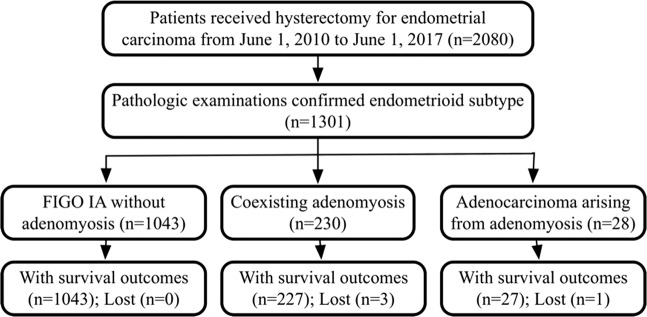
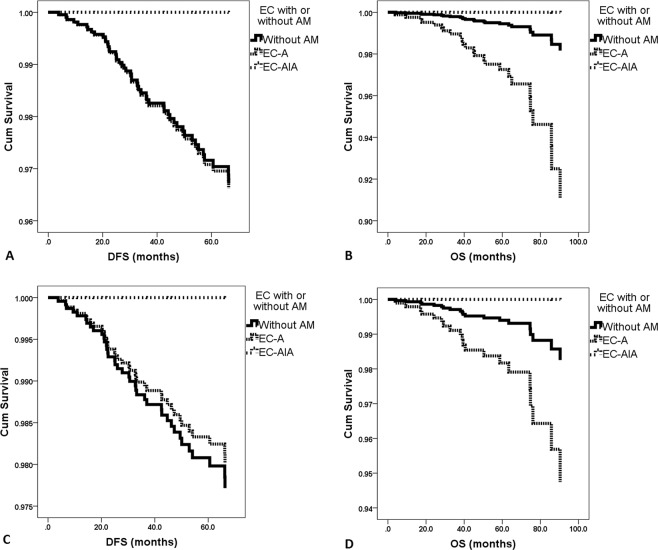
Little is known about the epidemiological and clinicopathological characteristics of endometrial endometrioid carcinoma (EEC) coexisting with or arising in adenomyosis (EEC-A or EEC-AIA) due to their rarity. This study compared EEC-A and EEC-AIA with endometrial carcinoma without adenomyosis. Cases of endometrial cancer treated at the study center from June 1, 2010, to June 1, 2017, were reviewed. The epidemiological, clinicopathological characteristics and survival outcomes were compared among three groups of endometrioid subtypes: group A, stage IA endometrial carcinoma patients without coexisting adenomyosis; group B, patients with EEC-A; and group C, patients with EEC-AIA. Among the 2080 patients reviewed, groups A, B, and C included 1043, 230 and 28 patients, respectively. Patients in group A and group B had similar clinicopathological and survival outcomes. Patients in group C were significantly younger and had less gravidity and parity than patients in groups A and B. More tumors from group C were grade 1, and they had a smaller maximum diameter and less mismatch repair deficiency than those from groups A and B. After a median follow-up of 57.0 months, the 5-year disease-free survival (DFS) rates of groups A, B and C were 96%, 91% and 100% (p = 0.045), respectively; the 5-year overall survival (OS) rates were 98%, 93% and 100%, respectively (p = 0.001), in the Kaplan-Meier analysis. However, these difference disappeared in a subgroup of stage IA patients in univariate and multivariate analysis. Cox regression analysis in stage IA patients also revealed no significant differences in survival outcome across the three groups. In conclusion, EEC-AIA exhibited specific clinicopathological characteristics that were probably associated with favorable survival outcomes. The characteristics and survival outcomes of EEC-A were similar to those of EEC without adenomyosis in stage IA patients.
由于其罕见性,人们对合并或源自子宫腺肌病的子宫内膜内膜样癌(EEC-A 或 EEC-AIA)的流行病学和临床病理特征知之甚少。本研究比较了 EEC-A 和 EEC-AIA 与无腺肌病的子宫内膜癌。回顾了 2010 年 6 月 1 日至 2017 年 6 月 1 日在研究中心治疗的子宫内膜癌病例。比较了三组子宫内膜样亚型的流行病学、临床病理特征和生存结果:A 组,IA 期无合并腺肌病的子宫内膜癌患者;B 组,EEC-A 患者;C 组,EEC-AIA 患者。在回顾的 2080 例患者中,A、B 和 C 组分别包括 1043、230 和 28 例患者。A 组和 B 组患者的临床病理和生存结果相似。C 组患者明显比 A 组和 B 组患者年轻,生育力和产次较少。C 组的肿瘤更多为 1 级,最大直径较小,且与 A 组和 B 组相比,错配修复缺陷较少。在中位随访 57.0 个月后,A、B 和 C 组的 5 年无病生存率(DFS)分别为 96%、91%和 100%(p=0.045);5 年总生存率(OS)分别为 98%、93%和 100%,分别为(p=0.001),在 Kaplan-Meier 分析中。然而,在单变量和多变量分析的 IA 期患者亚组中,这些差异消失了。IA 期患者的 Cox 回归分析也表明三组之间的生存结果无显著差异。总之,EEC-AIA 表现出特定的临床病理特征,这可能与良好的生存结果相关。在 IA 期患者中,EEC-A 的特征和生存结果与无腺肌病的 EEC 相似。