Division of Maternal and Fetal Medicine, Department of Obstetrics and Gynecology, Duke University School of Medicine, Durham, North Carolina.
Duke University School of Medicine, Durham, North Carolina.
JAMA Netw Open. 2022 Jan 4;5(1):e2142343. doi: 10.1001/jamanetworkopen.2021.42343.
Low-dose aspirin (LDA) is one of the few evidence-based interventions for preventing preeclampsia, which is a leading cause of maternal or fetal morbidity and mortality. Current guidelines recommend LDA based on the presence of risk factors for preeclampsia, but the population-based prevalence of these factors is unknown.
To estimate population-level prevalence of preeclampsia risk factors used in prophylactic LDA guidelines for pregnant patients and the association of these risk factors with reported rates of pregnancy-related hypertension.
DESIGN, SETTING, AND PARTICIPANTS: A retrospective cohort study was conducted using National Center for Health Statistics birth certificate data to describe the frequency of pregnant individuals with moderate to high-risk factors for preeclampsia and pregnancy-related hypertension rates. The study used all birth records in the United States for the 2019 calendar year.
Documentation of preeclampsia risk factors: multifetal gestation, pregestational diabetes, chronic hypertension (high-risk factors) and nulliparity, a body mass index greater than 30, African American race, a maternal age 35 years or older, an interval of more than 10-years since last birth, and having low socioeconomic status (moderate risk factors).
Prevalence of each risk factor alone and in combinations leading to a recommendation for LDA; incidence of pregnancy-related hypertension by risk factor and combinations of risk factors.
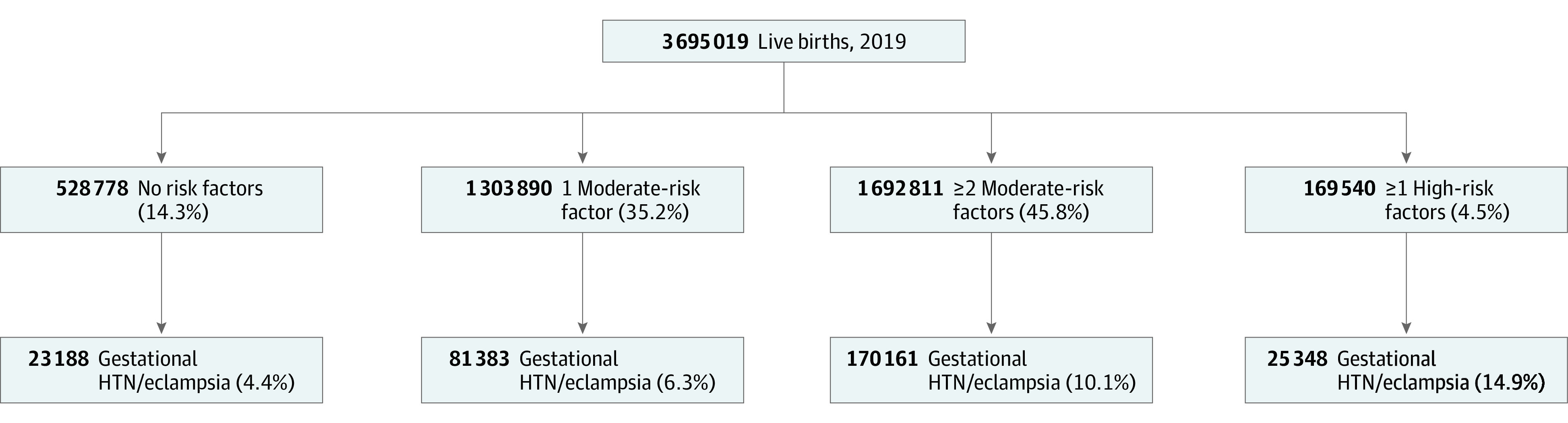
There were 3 695 019 pregnancies in 2019, including 528 778 with no risk factors, 169 540 with 1 or more high-risk factors, and 2 996 701 with 1 or more moderate-risk factors. The mean (SD) of the cohort was 29.1 (5.8) years. Multifetal gestation was the most common high-risk factor and found in 123 995 pregnancies (3.4%), and low socioeconomic status was the most common moderate-risk factor and present in 1 732 729 pregnancies (46.9%). Based on 2021 criteria (a single high- or moderate-risk factors for preeclampsia), 3 166 241 pregnant patients (85.7%) were eligible for LDA. The incidence of pregnancy-related hypertension increased with the number of moderate-risk factors. The 2021 guidelines suggest considering or recommend LDA in 92.3% of pregnancies diagnosed with pregnancy-related hypertension.
These data support the recently published guidelines and suggest further simplified guidelines recommending LDA to patients with any single moderate-risk factors.
小剂量阿司匹林(LDA)是预防子痫前期的少数循证干预措施之一,子痫前期是孕产妇或胎儿发病率和死亡率的主要原因。目前的指南建议根据子痫前期的风险因素使用 LDA,但这些因素的人群患病率尚不清楚。
估计用于孕妇预防性 LDA 指南的子痫前期风险因素的人群水平患病率,以及这些风险因素与报告的妊娠相关高血压发生率之间的关联。
设计、设置和参与者:使用国家卫生统计中心出生证明数据进行回顾性队列研究,以描述具有中高度子痫前期风险因素的孕妇的频率和妊娠相关高血压的发生率。该研究使用了 2019 年全年美国所有的出生记录。
子痫前期风险因素的记录:多胎妊娠、孕前糖尿病、慢性高血压(高风险因素)和不孕、身体质量指数大于 30、非裔美国人种族、母亲年龄 35 岁或以上、上次分娩后间隔超过 10 年以及社会经济地位较低(中风险因素)。
单独和联合使用 LDA 建议的每个风险因素的患病率;根据风险因素和风险因素组合发生妊娠相关高血压的发生率。
2019 年有 3695019 例妊娠,其中 528778 例无风险因素,169540 例有 1 个或多个高风险因素,2996701 例有 1 个或多个中风险因素。队列的平均(SD)年龄为 29.1(5.8)岁。多胎妊娠是最常见的高风险因素,见于 123995 例妊娠(3.4%),社会经济地位较低是最常见的中风险因素,见于 1732729 例妊娠(46.9%)。根据 2021 年标准(子痫前期单一高或中风险因素),有 3166241 例孕妇(85.7%)适合使用 LDA。妊娠相关高血压的发生率随中等风险因素数量的增加而增加。2021 年的指南建议,在诊断为妊娠相关高血压的 92.3%的妊娠中,考虑或建议使用 LDA。
这些数据支持最近发布的指南,并表明进一步简化的指南建议对任何单一中度风险因素的患者使用 LDA。