Key Laboratory of Carcinogenesis and Translational Research (Ministry of Education/Beijing), Department of Gastrointestinal Oncology, Peking University Cancer Hospital & Institute, No. 52, Fucheng Road, Haidian District, Beijing, 100142, China.
Department of Medical Oncology, Fudan University Shanghai Cancer Center, Shanghai, China.
Cancer Immunol Immunother. 2022 Aug;71(8):1897-1908. doi: 10.1007/s00262-021-03102-3. Epub 2022 Jan 5.
This first-in-human phase 1 trial is to evaluate the safety, pharmacokinetics, preliminary efficacy, and biomarkers of sugemalimab, a full-length, fully human anti-PD-L1 monoclonal antibody, in Chinese patients with advanced malignancies.
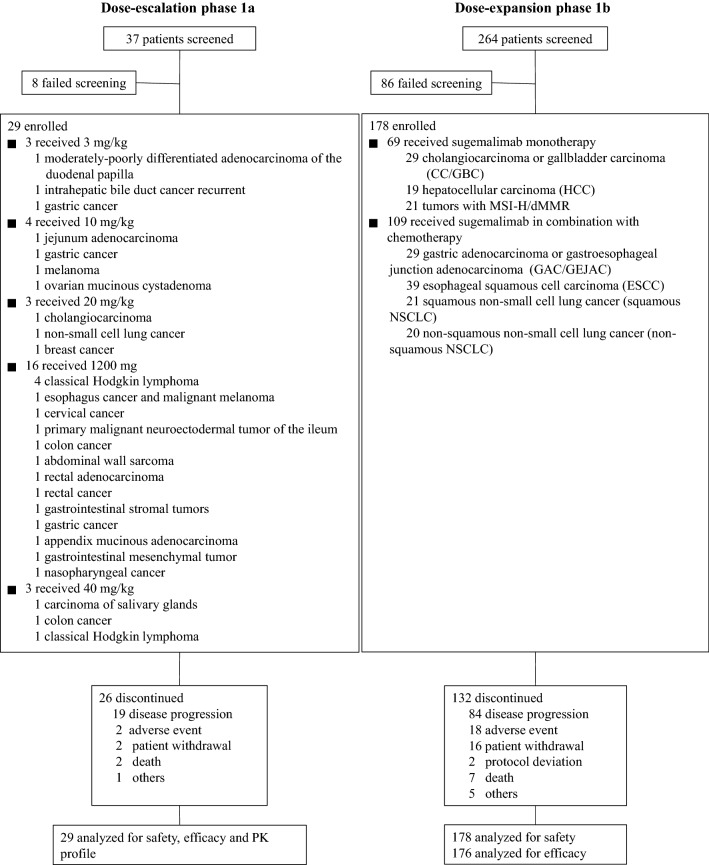
Eligible patients with unresectable advanced or metastatic solid tumors or lymphomas were enrolled in phase 1a to receive sugemalimab following a modified 3 + 3 design. The primary endpoints included safety, tolerability, and the recommended Phase 2 dose (RP2D). In phase 1b, patients with 7 selected types of tumor received sugemalimab at the RP2D alone (monotherapy cohorts) or in combination with standard-of-care (SOC) chemotherapy (combination cohorts). The primary endpoint of phase 1b was investigator-assessed objective response rate (ORR).
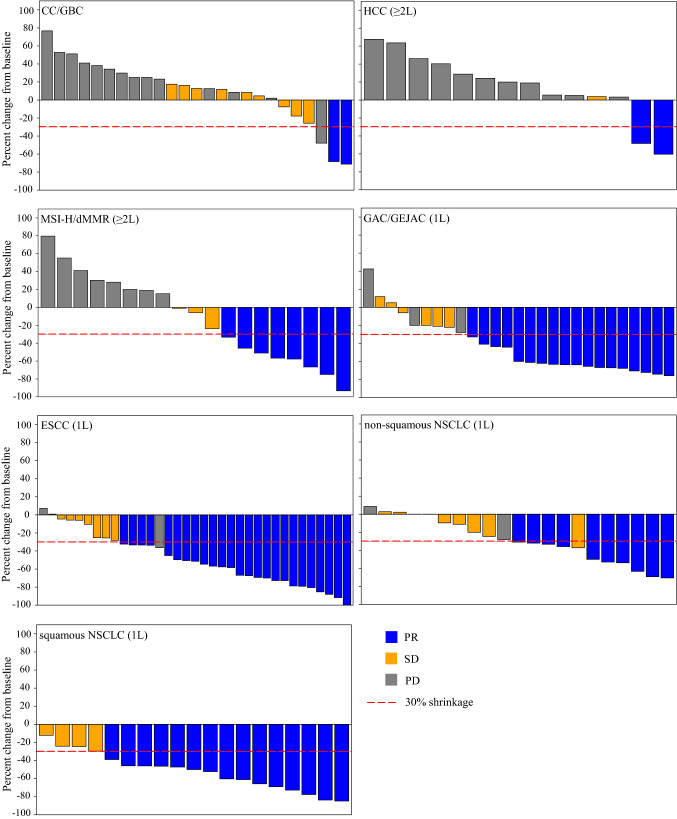
As of 19 February 2020, 29 and 178 patients were treated in phase 1a and 1b, respectively. No dose-limiting toxicities were observed in phase 1a, and the RP2D of sugemalimab was determined as 1200 mg fixed dose once every 3 weeks. Sugemalimab-related adverse events (AEs) were mostly (75.9%) grade 1-2 in phase 1a. Antitumor activity was observed across dose levels with an ORR of 24.1%. In phase 1b, 15.9% and 40.4% of patients in the monotherapy and combination cohorts, respectively, reported grade 3-5 sugemalimab-related AEs. Promising efficacy was observed in all combination cohorts, with ORRs ranging from 47.6 to 75.0%. Exploratory biomarker analysis did not indicate significant differences in responses at different PD-L1 expression/tumor mutation burden levels.
Sugemalimab was well-tolerated and showed promising antitumor activity as monotherapy or in combination with SOC chemotherapy in advanced malignancies. This trial was registered with ClinicalTrials.gov on Oct 18, 2017, number NCT03312842.
这是一项首次人体的 1 期临床试验,旨在评估 sugemalimab(一种全长、全人源抗 PD-L1 单克隆抗体)在中国晚期恶性肿瘤患者中的安全性、药代动力学、初步疗效和生物标志物。
纳入不可切除的晚期或转移性实体瘤或淋巴瘤患者,按照改良的 3+3 设计在 1a 期接受 sugemalimab 治疗。主要终点包括安全性、耐受性和推荐的 2 期剂量(RP2D)。在 1b 期,7 种特定类型肿瘤的患者单独接受 sugemalimab(单药队列)或联合标准治疗(SOC)化疗(联合队列)的 RP2D。1b 期的主要终点是研究者评估的客观缓解率(ORR)。
截至 2020 年 2 月 19 日,分别有 29 例和 178 例患者在 1a 期和 1b 期接受了治疗。在 1a 期未观察到剂量限制毒性,sugemalimab 的 RP2D 确定为 1200mg 固定剂量,每 3 周一次。在 1a 期,sugemalimab 相关不良事件(AE)主要为 1-2 级(75.9%)。在不同剂量水平均观察到抗肿瘤活性,客观缓解率为 24.1%。在 1b 期,单药和联合队列中分别有 15.9%和 40.4%的患者报告有 3-5 级的 sugemalimab 相关 AE。所有联合队列均观察到有前景的疗效,客观缓解率范围为 47.6%至 75.0%。探索性生物标志物分析表明,在不同 PD-L1 表达/肿瘤突变负荷水平的患者中,反应无显著差异。
sugemalimab 耐受性良好,作为单药治疗或联合 SOC 化疗在晚期恶性肿瘤中具有良好的抗肿瘤活性。该试验于 2017 年 10 月 18 日在 ClinicalTrials.gov 上注册,编号为 NCT03312842。