Department of Medicine, The University of North Carolina at Chapel Chapel Hill, Chapel Hill, NC, USA.
Department of Biochemistry, McGill University, Montreal, QC, Canada.
BMC Cancer. 2022 Jan 5;22(1):38. doi: 10.1186/s12885-021-08908-z.
Melanoma-intrinsic activated β-catenin pathway, the product of the catenin beta 1 (CTNNB1) gene, has been associated with low/absent tumor-infiltrating lymphocytes, accelerated tumor growth, metastases development, and resistance to anti-PD-L1/anti-CTLA-4 agents in mouse melanoma models. Little is known about the association between the adenomatous polyposis coli (APC) and CTNNB1 gene mutations in stage IV melanoma with immunotherapy response and overall survival (OS).
We examined the prognostic significance of somatic APC/CTNNB1 mutations in the Cancer Genome Atlas Project for Skin Cutaneous Melanoma (TCGA-SKCM) database. We assessed APC/CTNNB1 mutations as predictors of response to immunotherapies in a clinicopathologically annotated metastatic patient cohort from three US melanoma centers.
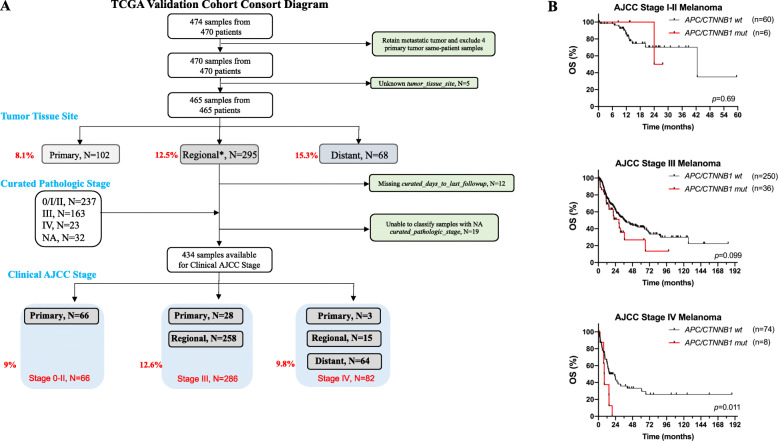
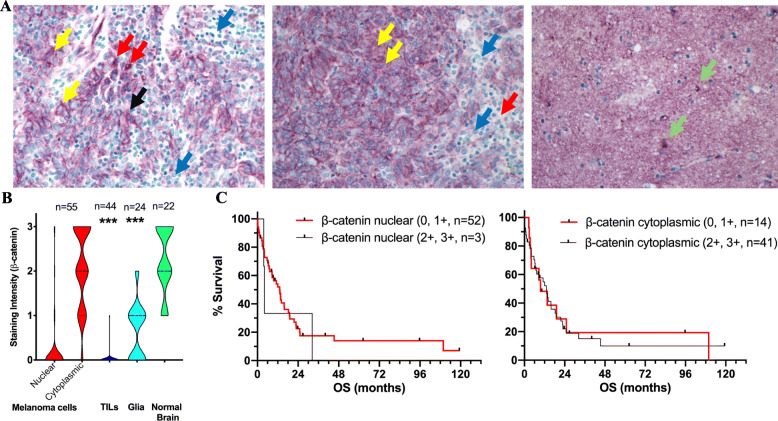
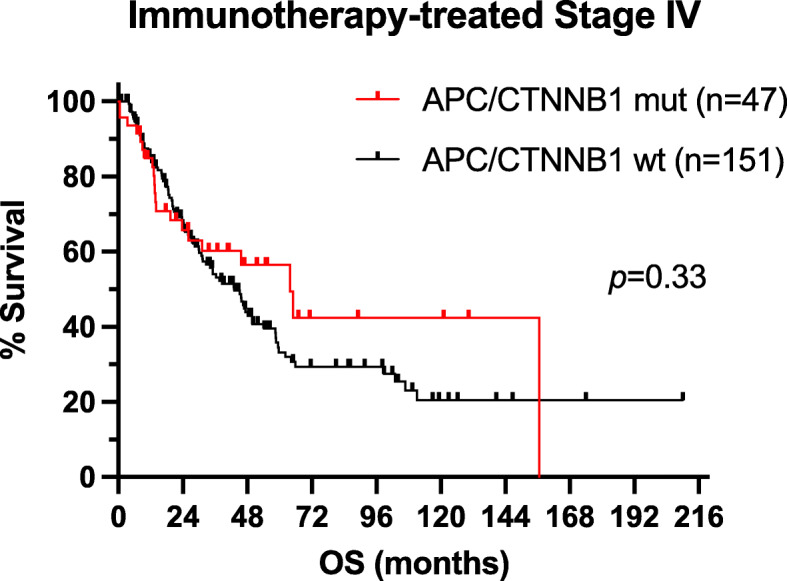
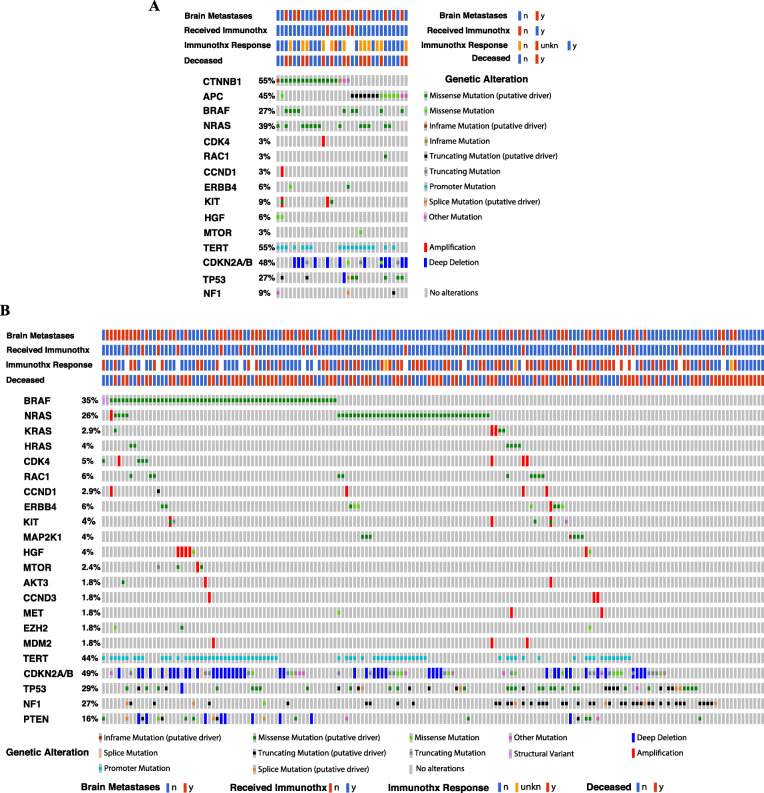
In the TCGA-SKCM patient cohort (n = 434) presence of a somatic APC/CTNNB1 mutation was associated with a worse outcome only in stage IV melanoma (n = 82, median OS of APC/CTNNB1 mutants vs. wild-type was 8.15 vs. 22.8 months; log-rank hazard ratio 4.20, p = 0.011). APC/CTNNB1 mutation did not significantly affect lymphocyte distribution and density. In the 3-melanoma institution cohort, tumor tissues underwent targeted panel sequencing using two standards of care assays. We identified 55 patients with stage IV melanoma and APC/CTNNB1 genetic aberrations (mut) and 169 patients without (wt). At a median follow-up of more than 25 months for both groups, mut compared with wt patients had slightly more frequent (44% vs. 39%) and earlier (66% vs. 45% within six months from original diagnosis of stage IV melanoma) development of brain metastases. Nevertheless, time-to-development of brain metastases was not significantly different between the two groups. Fortunately, mut patients had similar clinical benefits from PD-1 inhibitor-based treatments compared to wt patients (median OS 26.1 months vs. 29.9 months, respectively, log-rank p = 0.23). Less frequent mutations in the NF1, RAC1, and PTEN genes were seen in the mut compared with wt patients from the 3-melanoma institution cohort. Analysis of brain melanoma tumor tissues from a separate craniotomy patient cohort (n = 55) showed that melanoma-specific, activated β-catenin (i.e., nuclear localization) was infrequent (n = 3, 6%) and not prognostic in established brain metastases.
APC/CTNNB1 mutations are associated with a worse outcome in stage IV melanoma and early brain metastases independent of tumor-infiltrating lymphocyte density. However, PD1 inhibitor-based treatments provide comparable benefits to both mut and wt patients with stage IV melanoma.
黑色素瘤内在激活的β-连环蛋白通路是连环蛋白β 1(CTNNB1)基因的产物,与肿瘤浸润淋巴细胞减少/缺失、肿瘤生长加速、转移发展以及对小鼠黑色素瘤模型中的抗 PD-L1/抗 CTLA-4 药物的耐药性有关。关于 IV 期黑色素瘤中腺瘤性结肠息肉病(APC)和 CTNNB1 基因突变与免疫治疗反应和总生存期(OS)之间的关联知之甚少。
我们在癌症基因组图谱计划皮肤黑色素瘤(TCGA-SKCM)数据库中检查了体细胞 APC/CTNNB1 突变的预后意义。我们评估了 APC/CTNNB1 突变作为三个美国黑色素瘤中心的临床病理注释转移性患者队列中对免疫治疗反应的预测因子。
在 TCGA-SKCM 患者队列(n=434)中,只有在 IV 期黑色素瘤(n=82)中存在体细胞 APC/CTNNB1 突变与较差的预后相关,APC/CTNNB1 突变体与野生型相比中位 OS 分别为 8.15 和 22.8 个月(对数秩风险比 4.20,p=0.011)。APC/CTNNB1 突变并未显著影响淋巴细胞分布和密度。在 3 个黑色素瘤机构队列中,肿瘤组织使用两种标准护理检测进行了靶向面板测序。我们确定了 55 名患有 IV 期黑色素瘤和 APC/CTNNB1 遗传异常(mut)的患者和 169 名没有 APC/CTNNB1 遗传异常(wt)的患者。在两组均超过 25 个月的中位随访中,与 wt 患者相比,mut 患者的脑转移发展更频繁(44% vs. 39%)且更早(66% vs. 45%在 IV 期黑色素瘤确诊后六个月内)。然而,两组之间脑转移的发展时间没有显著差异。幸运的是,与 wt 患者相比,mut 患者从 PD-1 抑制剂治疗中获得了相似的临床获益(中位 OS 分别为 26.1 个月和 29.9 个月,对数秩 p=0.23)。与 wt 患者相比,mut 患者来自 3 个黑色素瘤机构队列的 NF1、RAC1 和 PTEN 基因突变较少。对来自单独开颅手术患者队列(n=55)的脑黑色素瘤肿瘤组织的分析表明,黑色素瘤特异性、激活的β-连环蛋白(即核定位)很少见(n=3,6%),并且在已建立的脑转移中没有预后意义。
APC/CTNNB1 突变与 IV 期黑色素瘤和独立于肿瘤浸润淋巴细胞密度的早期脑转移的不良预后相关。然而,基于 PD1 抑制剂的治疗为 IV 期黑色素瘤的 mut 和 wt 患者提供了相当的获益。